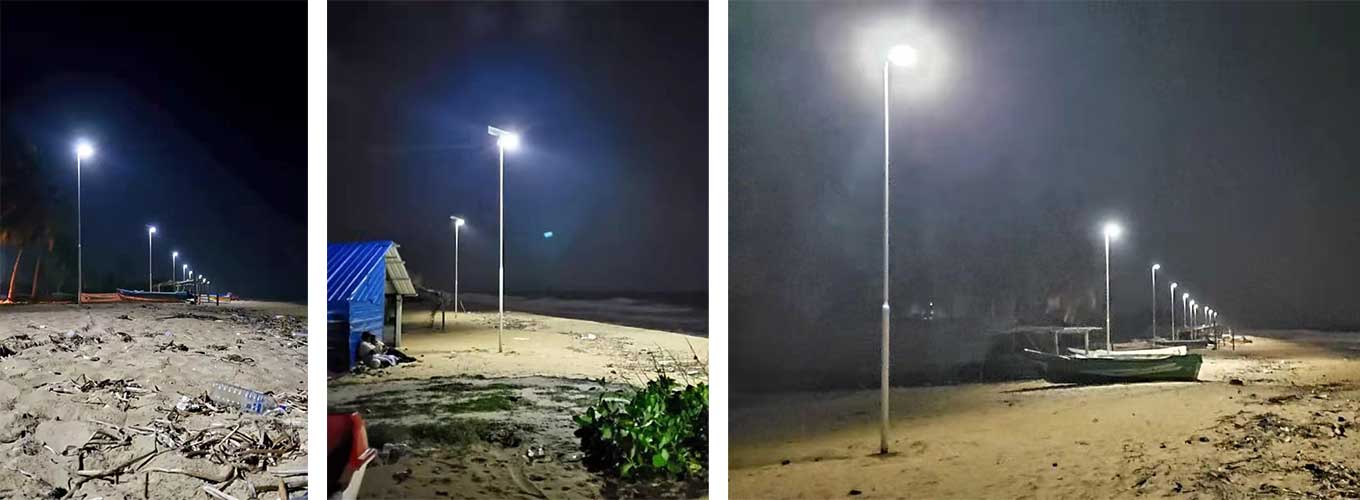
Coastal Highway Lighting in Sri Lanka: RS-SL120P Deployment

Technical Specifications
| Parameter | Specification Details |
|---|---|
| Product Model | Solar Sailing Light II - RS-SL120P (All-in-Two) |
| Luminous Flux | 7,200 LM (High Brightness LED) |
| Solar Panel | 80W / 18V Monocrystalline PV |
| Battery Capacity | 320WH Premium LiFePO4 Battery |
| Installation Height | 7 Meters Heavy-Duty Pole |
| Application Scenario | Beachfront Highway, Sri Lanka |
Severe Coastal Environmental Challenges
Ensuring that solar street lights can operate stably and reliably on the tropical beach required overcoming several critical environmental pain points:
- High Corrosive Salt Spray: Standard metal fixtures degrade rapidly under constant marine air exposure, leading to housing rust and mechanical failure.
- Tropical Wind Loads & Monsoon Force: Open beachfront highways experience severe wind shear, demanding outstanding aerodynamic stability from the bracket and light structure.
- Temperature Swings & Humidity: Harsh coastal temperatures and intense morning-to-night humidity shifts can stress electronics, requiring superior waterproof sealing.
The RoadSmart Engineered Solution
- Marine-Grade Anti-Corrosion Protection: The RS-SL120P housing features specialized surface treatments and C4/C5 level corrosion-proof coatings to block salt-spray damage, guaranteeing a 10+ year lifespan.
- Intelligent Energy Management: To tackle monsoon season shading and cloud cover, the built-in smart controller automatically utilizes dynamic dimming profiles, ensuring 100% continuous lighting safety even through multiple consecutive rainy days.
- Eco-Friendly & Low Ecological Impact: The precise optical design directs illumination strictly onto the highway, mitigating light pollution and minimizing ecological impact on the coastal beach wildlife.
Key Project Achievements
By deploying RoadSmart's Solar Sailing Light II, the project has successfully met all strict public highway lighting standards. Beyond illuminating the dark coastal roads, our infrastructure provides critical long-term support for environmental protection, energy independence, and local socio-economic development through zero-carbon emissions.