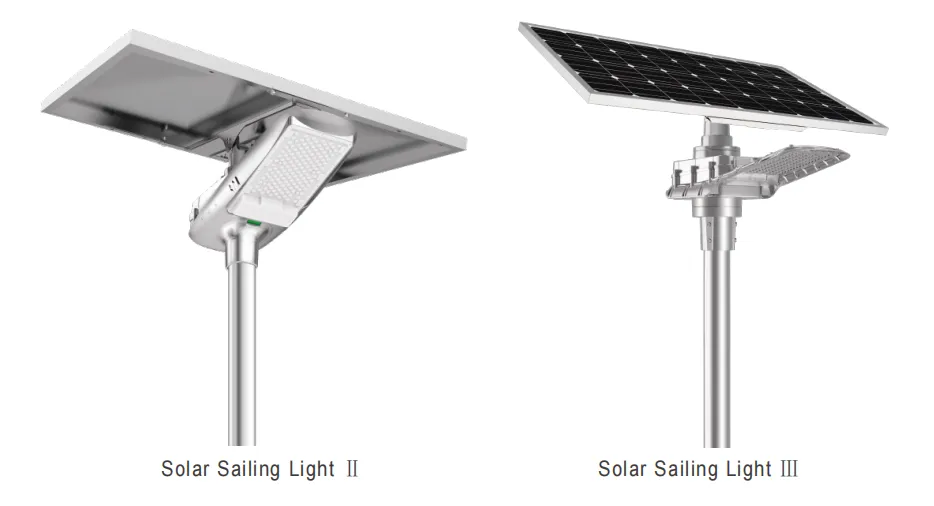
All-in-One vs Split Solar Street Lights (2026): Performance, Cost, and Which One to Choose for Your Project
May 19, 2026
Read:1658
Introduction
Solar energy, as an important support for global energy conservation and emission reduction, renewable resources, and the realization of sustainable development, especially in the field of electric power, has been supported by data showing that from 2025 to 2030, solar energy is expected to contribute nearly 80% of the world’s newly added renewable power capacity. As a major conversion carrier, solar street lights are sweeping across the world with an accelerating growth trend.
There are many types of solar street lights. This article will mainly focus on all in one solar street lights and split solar street lights, and explain them from three dimensions—functional performance, installation convenience, and operation and maintenance costs—to help you understand them clearly and find the best investment suitable for your 2026 project.
First of all, it is necessary to distinguish clearly the positioning and structure of these two types of solar street lights.
What Are All in One Solar Street Lights and Split Solar Street Lights?
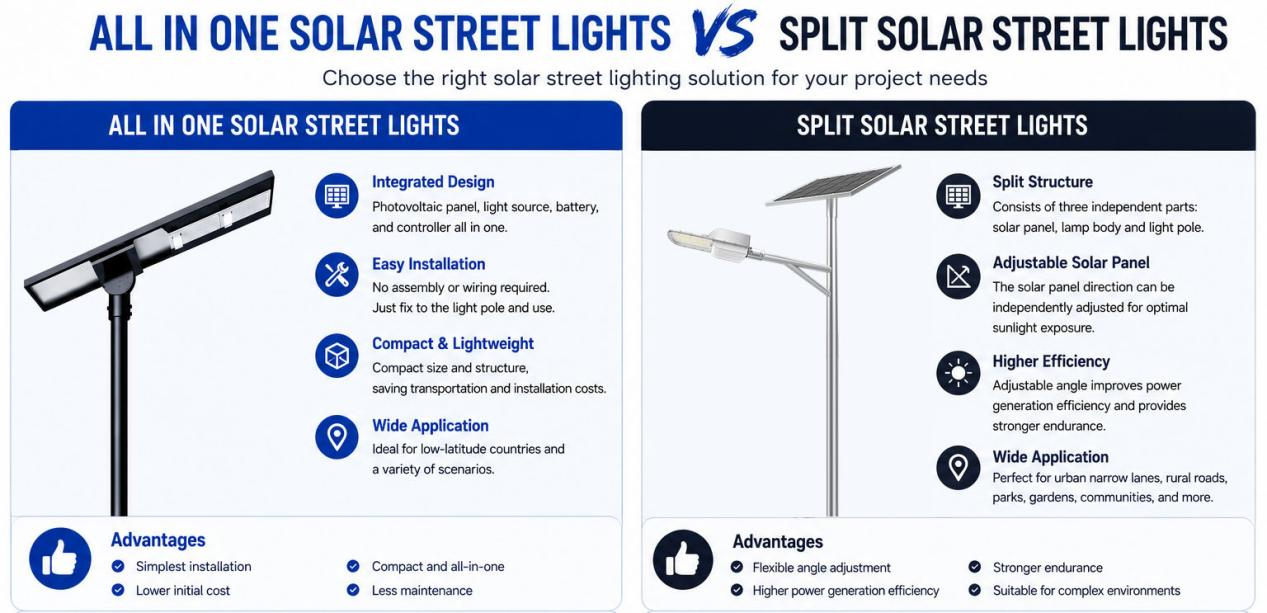
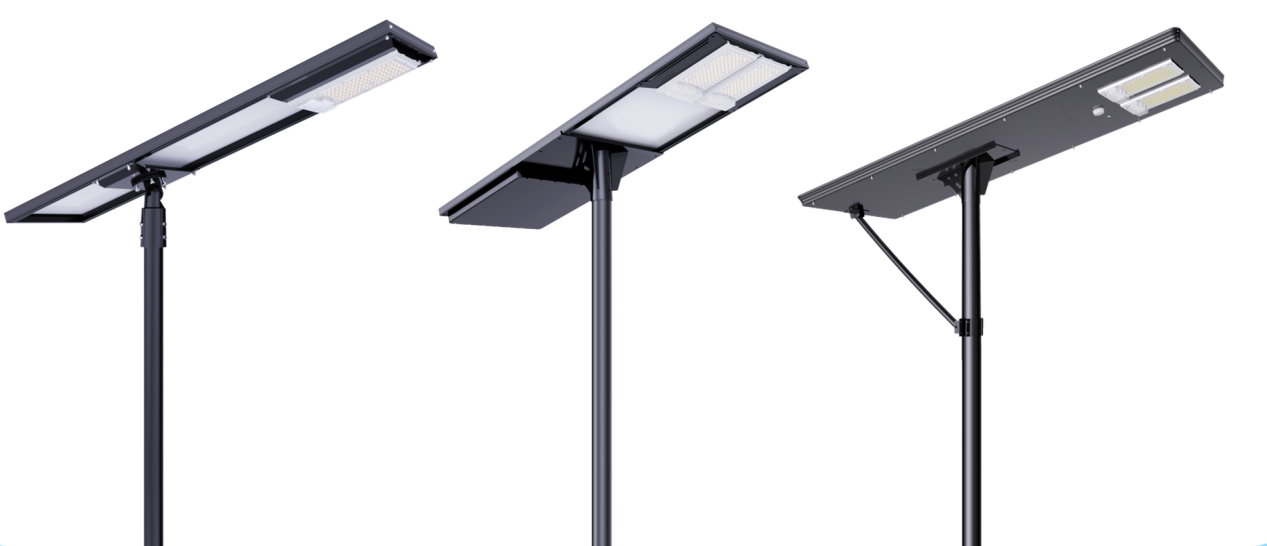
An all in one solar street light, as its name suggests, integrates the photovoltaic panel, light source, battery, and controller into one whole unit. It is compact in size, compact in structure, requires no assembly or wiring, and only needs to be fixed to a light pole before use, making installation the simplest. This type of solar street light is mainly used in low‑latitude countries, applicable to various scenarios including roads, tourist attractions, parks, squares and residential communities.
A split solar street light has certain structural differences from an all in one solar street light.It consists of three independent parts: solar panel, lamp body and light pole. Among them, the photovoltaic panel can be independently adjusted in direction and can be installed and combined according to actual on-site conditions. The angle can be adjusted appropriately, which is more conducive to power generation efficiency and provides stronger endurance, making it suitable for urban narrow lanes, rural roads, parks, gardens, communities, and other scenarios.
After understanding the basic contents of these two types, next, this article will mainly explain the differences from the following three angles:
Differences in Functional Performance Between All-in-one and Split Type Solar Street Lights
Although both are solar street lights and have roughly similar functions, which are nothing more than lighting effects, they cannot be judged so simply. It is necessary to look at them as a whole. All-in-one solar street lights and split type solar street lights each have different advantages and disadvantages under different comparison effects.
Let us first look at all-in-one solar street light. Their integrated design forms an independent lighting system that has already been pre-adapted. Once installed, it can quickly enter working status, with stable and efficient operation.It is also equipped with an intelligent controller, which can realize sensing functions, allowing the lighting effect to change when people come and go, and it also supports remote monitoring. These advantages are very obvious.
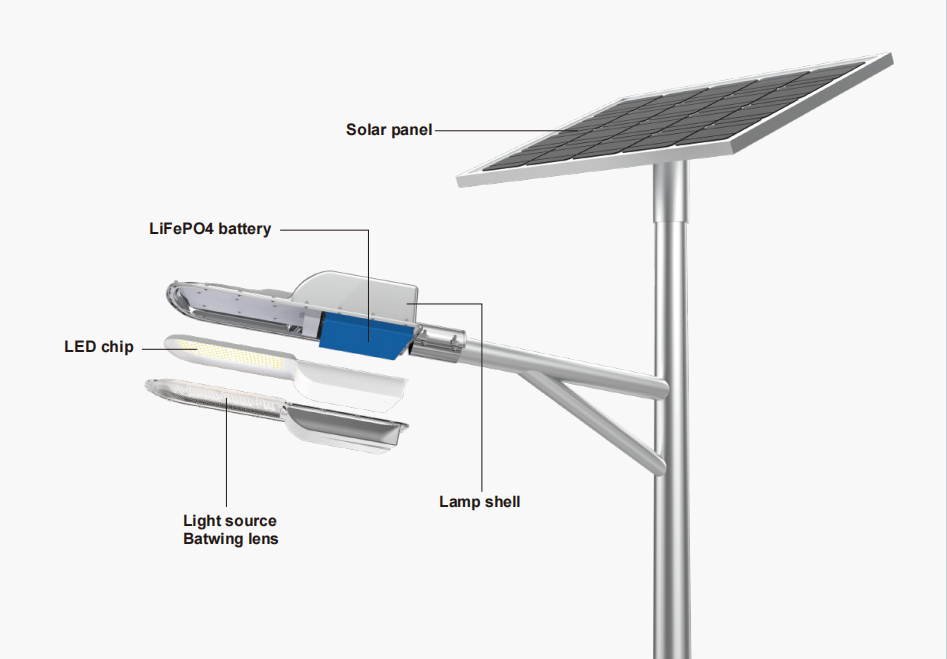
Now look at split type solar street light. Now look at split type solar street light. The separated design of lamp body and solar panel avoids heat buildup, boosts LED heat dissipation, minimizes light decay and prolongs service life. With thickened metal pole and robust bracket, the split structure bears stress evenly to withstand harsh outdoor weather.
In short: The split type solar street light features three independent parts of solar panel, lamp body and pole. It is compact in size with replaceable lamp head, cutting maintenance costs. The all in one solar street light integrates solar panel, light source and battery, boasting a concise structure for quick and easy installation.
Differences in Installation Convenience Between All in One and Split Led Solar Street Lights
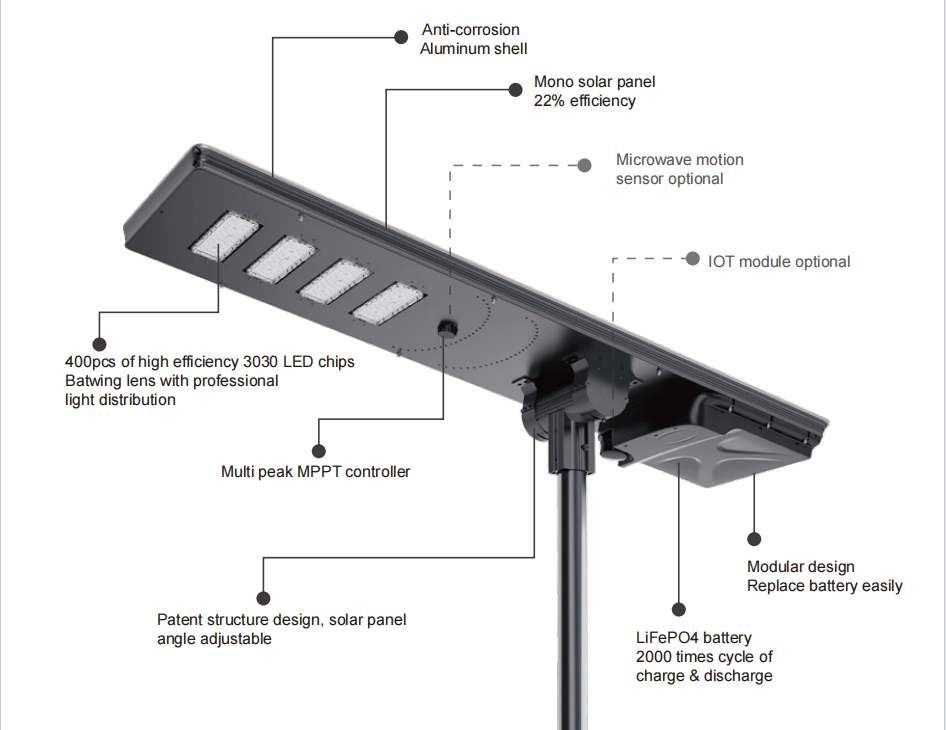
The installation of all in one led solar street light is one of their unique advantages. There is no need for large-scale trenching and wiring work. It is only necessary to determine the installation point, fix the pole, hoist the integrated lamp head, and finally carry out power-on commissioning. Installation can be completed within 15–30 minutes, greatly improving installation efficiency. This gives them a very strong advantage in application scenarios such as urgent projects and old pole upgrades.
Although the split type LED solar street light adopts an independent structural design and can be flexibly matched with components of different specifications, its installation is relatively complicated.They not only require professional installers, but also require on-site construction details to be confirmed one by one. From the orientation and position of the solar panel to the lamp, cables, and waterproofing, design and installation experience are highly important, and this will directly affect the subsequent use effect.
Differences in Operation and Maintenance Costs Between All-in-one and Split Solar Street Lights
Compared with the visible differences in the previous two aspects, operation and maintenance costs are relatively more difficult to identify. This makes preliminary research and comparison even more necessary. But there is one key point: do not only look at the initial cost; look at the total project cost.
Due to their installation convenience and relatively lower manufacturing costs, all in one solar street lights reduce the overall implementation cost in the early stage. However, once a fault occurs in the later stage, the entire lamp head can only be replaced, and maintenance is not so flexible.
Because of their separated design, smart split solar street lights are assembled from various components, which causes their initial cost to be higher than that of all-in-one solar street lights. However, their independent modules are conducive to flexible inspection and replacement, and repair time can be greatly reduced.
Overall, in the comparison between all in one solar street lights and split solar street lights across these three dimensions, each has its own advantages and limitations. The overall view is as follows:
Comparison Dimension | ALL in One Solar Street Light | Split Solar Street Light |
Product functional performance | Integrated with solar panel, LED light source and battery, it features a concise and compact overall structure | It adopts an independent three-part structure of solar panel, lamp body and light pole. Compact in size, the lamp head can be separately replaced for easy maintenance |
Installation convenience | Simple installation, no wiring required, convenient and efficient construction | Many and complex installation steps, requires preliminary design and planning, high construction requirements |
Operation and maintenance cost | Relatively friendly overall initial investment, fewer fault points, suitable for projects that need fast implementation and less later concern | Relatively higher initial investment, but independent components make later inspection, replacement, and expansion more flexible, suitable for large projects with long-term operation |
How to Choose a Suitable All in One Led Solar Street Light or Split Led Solar Street Light?
No universal standard applies here. First of all, comprehensive consideration should be taken based on your project requirements, local environmental climate, application scenarios, urgency level, expected lighting effects and other factors. The second step is to require the solar street light supplier to provide a project-matched solution. Thirdly, configure suitable product parameters, focusing on battery specifications, controllers, lighting efficiency, lumens, housing materials, and whether appearance adjustments are required. The fourth step is to comprehensively consider different factors and make a summary in order to select the most suitable product.
Conclusion
Whether it is an all in one solar street light or a split solar street light, the decision needs to be based on several aspects, including project requirements, scenario matching, and cost balance. There is no absolutely optimal choice, only a suitable choice. Instead, the optimal solution for each project shall be carefully evaluated.
FAQ
What is the biggest difference between all in one solar street lights and split type solar street lights?
The main difference lies in the structural design. All in one solar street lights use Modular Design, while split solar street lights use an independent design for each component. Each has its own features and advantages.
Are split solar street lights necessarily more expensive?
This needs to be judged from the overall cost perspective. Generally speaking, all-in-one solar street lights have higher upfront costs. However, they feature easy transportation and assembly, with relatively controllable labor costs. We shall comprehensively consider the overall project requirements to provide the final solution.
Which type of solar street light is more suitable for municipal, park, or rural road projects in 2026?
For scenarios such as parks, rural roads and community branch roads, split‑type solar street light solutions are usually more cost‑effective. For municipal main roads, complex roadways or high‑standard projects, all‑in‑one solar street light solutions deserve priority evaluation. The procurement logic for 2026 has become increasingly clear: the focus of comparison is no longer on which type of solar street light is better, but on which solution better suits the current project.