Solar Garden Light Manufacturer in China: How Buyers Can Evaluate Factory Strength, R&D, and Project Support
Jul 29, 2026
Read:640
Quick Answer
When buyers compare solar garden light suppliers in China, the real question is not just who offers the lowest quote. It is who can turn a lighting requirement into a system that can be calculated, tested, produced consistently, and supported after delivery.
A reliable manufacturer should be able to explain more than wattage and appearance. Buyers should expect clear information about luminous output, battery capacity, solar panel sizing, rainy-day endurance, quality control, test documents, and project support. That is the level where supplier differences start to matter.
Introduction
Many solar garden lights look similar in catalogs. The housing shape is similar. The product photos are similar. Even the headline specifications can sound similar. Then the quotations arrive, and the gap between suppliers suddenly becomes much wider than expected.
That usually tells buyers one thing: they are not just comparing products. They are comparing manufacturing depth, configuration logic, testing discipline, and delivery reliability.
In practical sourcing, the risk is rarely that a supplier cannot assemble a lamp. The bigger risk is that the supplier cannot explain how the system will behave once the project is installed. Buyers need to know whether the product data is real, whether batch quality will stay consistent, whether the R&D team can size the system for local conditions, and whether support continues after delivery.
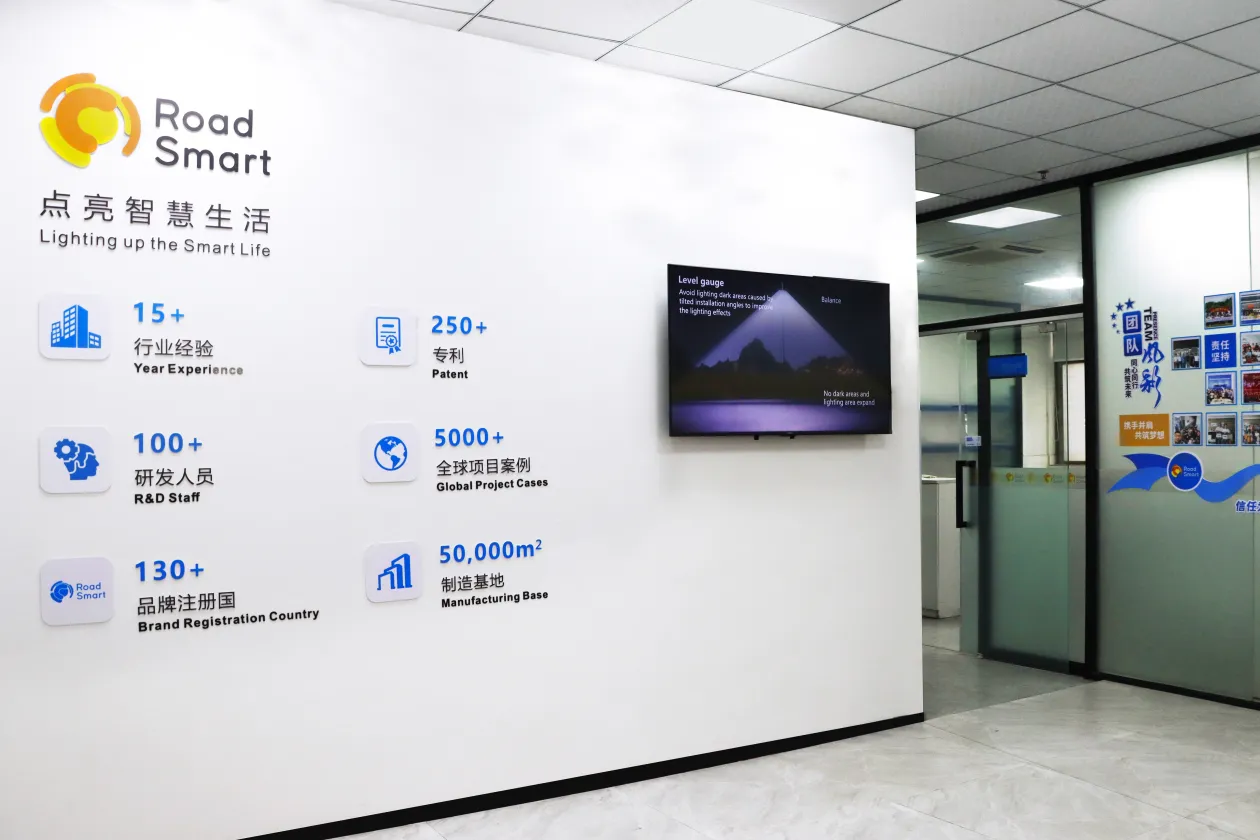
This guide takes that buyer-first view. It explains what overseas buyers should actually check when evaluating a solar garden light manufacturer in China, and how RoadSmart presents its factory, R&D, testing, compliance, and project support as part of that evaluation.
What Buyers Should Check Before Choosing a Solar Garden Light Manufacturer?
Before discussing any one supplier, it helps to set the buying framework first.
At minimum, buyers should confirm:
· Whether the supplier is a real manufacturer or mainly a trading layer
· Whether product specifications are tied to actual test conditions
· Whether the factory can maintain batch consistency
· Whether the R&D team can size the system based on site conditions
· Whether certifications and test reports match specific models
· Whether spare parts, technical support, and project follow-up remain available after delivery
This list sounds basic, but it is where many sourcing decisions go wrong. In B2B lighting projects, the biggest problems often appear after the order is placed, not before.
Who Is RoadSmart?
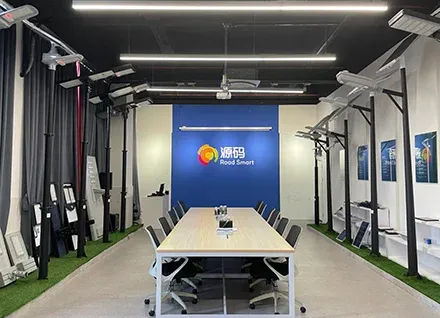
RoadSmart was established in 2011 and has long been engaged in the research, development and production of solar street lights, solar garden street lights, intelligent controllers and related photovoltaic lighting systems. Its products have been used in more than 120 countries and regions. [1]
In the field of garden lighting, the solar garden street lamps provided by RoadSmart are not small ground-inserted lights mainly used for decoration, but lighting equipment designed for public spaces and engineering projects. The products are usually installed on 3- to 6-meter light poles to provide stable nighttime lighting for park pathways, community roads, campuses, hotel grounds and commercial landscapes.
For different projects, lights cannot be selected simply according to “wattage.” RoadSmart adjusts the solar panel, battery capacity, LED output and control program based on the installation location, road width, light pole height, target brightness, daily operating time and number of consecutive rainy days. [1]
What RoadSmart Actually Sells in This Category?
The source material presents RoadSmart as a supplier of engineering-grade solar garden street lights with different brightness ranges, panel sizes, battery capacities, and recommended installation heights.
Three examples are highlighted:
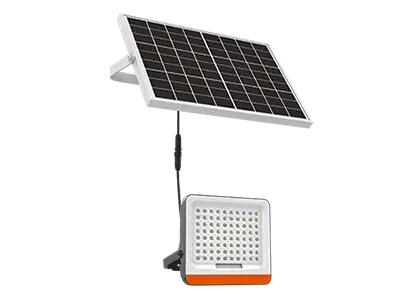
· Solar Beatle Light: 1,600 to 5,400 lumens, 25W to 80W panel, 64Wh to 256Wh battery, recommended for 4 to 5 meter poles
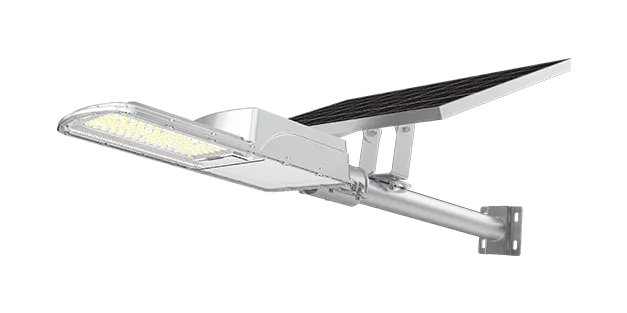
· YL-30P: 1,800 lumens, 30W panel, 80Wh battery, recommended for 3 to 5 meter poles
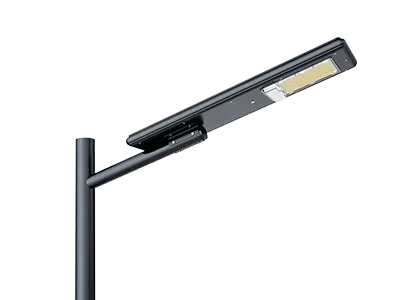
· RSK-40: 4,000 lumens, 42W panel, 144Wh battery, recommended for 4 to 6 meter poles
The useful point here is not that one model is simply "better" than another. It is that different models fit different project conditions. A supplier becomes more credible when it explains those differences clearly instead of treating every product as a one-size-fits-all option.
Why Wattage Alone Is a Weak Buying Metric?
This is one of the most common sourcing mistakes in solar lighting. Buyers often start with wattage because it is the easiest number to compare. Suppliers know that, so it becomes the most visible number in product names and quotations.
But in project work, wattage alone does not tell the full story. Buyers also need to understand luminous output, battery energy, solar panel sizing, control strategy, runtime target, and the number of consecutive rainy days the system is expected to support.
That is why better suppliers usually ask for project inputs before recommending a model. Road width, installation height, daily runtime, local sunlight, and target illuminance all affect the final configuration. A realistic supplier conversation should feel closer to system matching than simple catalog picking.
How RoadSmart Positions Its System Design Capability?
RoadSmart adjusts the size of the solar panel, battery capacity, LED output power, and control logic based on factors such as installation location, road width, light pole height, target brightness, daily operating time, and number of consecutive rainy days.That is exactly the kind of explanation buyers should look for.
In practice, a manufacturer becomes more trustworthy when it can explain:
· How panel input, battery storage, and LED load are balanced
· What runtime assumptions are being used
· How the system behaves in the worst local month
· Whether the dimming program is fixed, time-based, or sensor-driven
· What tradeoffs appear if the budget or lighting target changes
Without that level of discussion, the quotation may look complete while the design logic behind it remains vague.
Manufacturing and Quality Control: What Matters More Than a Factory Photo?
Many suppliers can show a factory image. That is not the same as proving production discipline.

RoadSmart operates a factory of about 12,000 square meters, uses 8 automated production lines, and can produce roughly 15,000 sets of solar street lights and integrated lighting systems per month. It also states that the production process includes raw-material inspection, LED and controller assembly, battery-pack matching, complete-light functional testing, aging operation, and outgoing inspection, with IQC, IPQC, and OQC procedures plus 72-hour aging tests on finished products.
For buyers, the credibility signal is not the square-meter number by itself. It is whether the supplier can describe how consistency is controlled between batches. That is where large outdoor projects either stay stable or start creating complaints.
R&D and Testing: The Part Buyers Usually Ask About Too Late
Once a project reaches installation, the most painful problems are often the ones that were never discussed in technical detail during procurement.
Battery cycle life is a good example. Buyers ask, "How long will the battery last?" But that question actually contains two different questions: how many hours the light can run each night, and how many charge-discharge cycles the battery can sustain over time. Those are not the same thing.
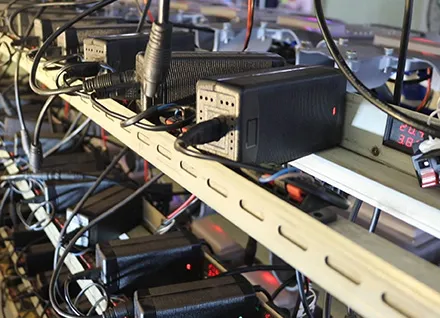
RoadSmart uses LiFePO4 batteries. Even so, buyers should still ask for model-specific test conditions, because cycle life depends on depth of discharge, cell quality, temperature, and controller protection. That is consistent with broader battery-aging guidance such as NREL battery lifespan research.
The same logic applies to photovoltaic performance. A claim such as "more than 21% conversion efficiency" sounds positive, but it should not be evaluated in isolation. Buyers still need to check actual panel dimensions, rated power, shading risk, and site sunlight during the worst local month.
Certifications and Test Reports: What Buyers Should Verify
Certifications help, but only when they are tied to the actual product being quoted.
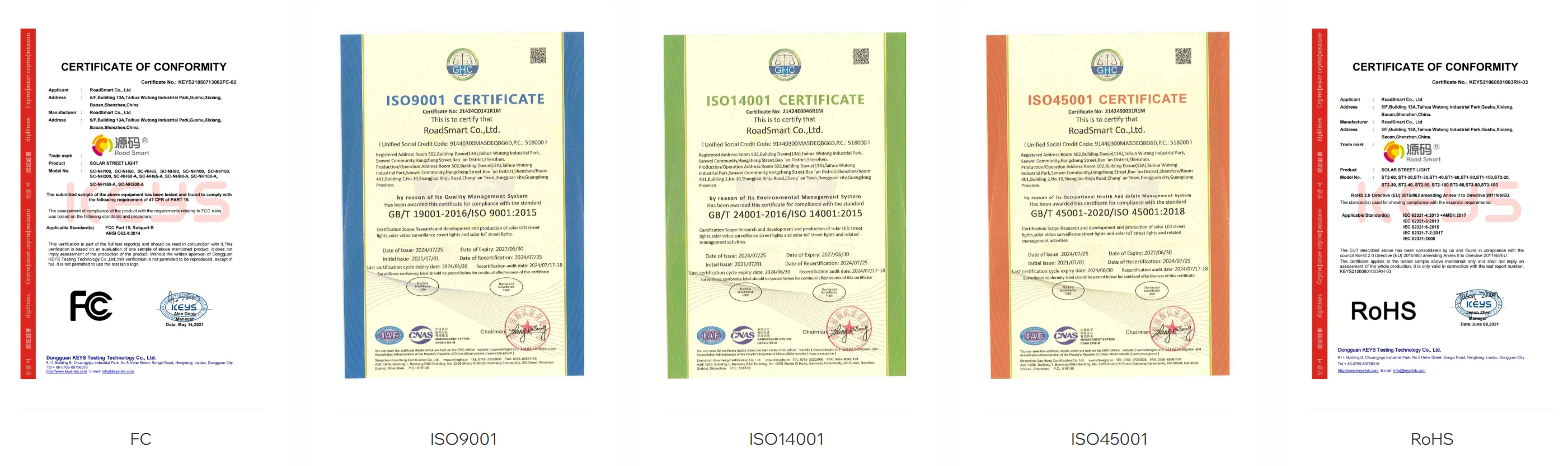
RoadSmart can provide CE, RoHS, FCC, and related IEC test documents, and that the company has ISO 9001, ISO 14001, and ISO 45001 management systems. That can support trust, but buyers should still verify whether the certificate or report matches the model, configuration, and component scope being discussed.
This matters especially for protection ratings. A supplier may reference IEC 60529 IP Code testing, but the useful procurement question is narrower: does the IP test cover the complete light, including the battery compartment and external connectors, or only part of the enclosure?
The same caution applies to optical performance claims. If a supplier discusses luminous output, buyers may want to understand whether the test basis aligns with recognized measurement standards such as IES LM-79 optical and electrical testing, especially for project comparison work.
How to Choose the Right Solar Garden Street Lamp Model?
Different solar garden street lamp models cannot simply be divided into “high-end and low-end” categories. A suitable solar garden street light should match the site conditions. Before selecting a model, at least the following information needs to be confirmed:
·Road or pathway width;
·Light pole installation height;
·Planned lighting time each night;
·Local sunlight and rainy season conditions;
·Number of consecutive rainy days that need to be supported;
·Target brightness or road surface illuminance;
·Project budget and subsequent maintenance requirements.
Product Model | Luminous Flux | Solar Panel | Battery Capacity | Recommended Installation Height |
Solar Beatle Light | 1,600—5,400 lm | 25—80W | 64—256Wh | 4—5m |
YL-30P | 1,800 lm | 30W | 80Wh | 3—5m |
RSK-40 | 4,000 lm | 42W | 144Wh | 4—6m |
The above parameters are suitable for preliminary comparison, while the final configuration still needs to be determined based on the project location, road dimensions, operating time, target illuminance and number of consecutive rainy days. For engineering projects, RoadSmart can further match the solar panel, battery, LED output, control program and installation structure.
Project Support Beyond the Product Itself
The source article says RoadSmart can provide requirement analysis, product specifications, IES files, DIALux simulations, technical drawings, bills of materials, and quality-control documents, along with follow-up on samples, production progress, outgoing inspection, installation guidance, and spare parts.
For many overseas buyers, this is where supplier differences become visible. A quote is only the beginning. Documentation, simulation support, sample handling, and post-production coordination are often what determine whether a project moves smoothly or becomes hard to manage.
FAQ
Is RoadSmart a manufacturer or a trading company?
Based on the provided source material, RoadSmart presents itself as a company with its own R&D and production systems, offering standard products, OEM/ODM manufacturing, and engineering project configuration support.
How many rainy days can solar garden lights support?
The article source says common project configurations can support about 3 to 5 consecutive rainy days, but the actual result depends on local sunlight, panel size, battery capacity, LED load, and dimming strategy.
What should buyers ask about LiFePO4 battery life?
They should ask for model-specific cycle data, depth of discharge, temperature assumptions, and capacity-retention conditions, not just a broad lifespan claim.
Can IP65 solar garden lights stay underwater for a long time?
No. IP65 is suitable for normal outdoor rain and spray exposure, but it does not mean the light can remain submerged for long periods. Flood-prone areas usually require different installation planning or a different protection strategy.
Does RoadSmart support customization?
According to the source article, RoadSmart supports adjustments to brightness, solar panel size, battery capacity, operating program, light color, appearance, logo, packaging, and installation structure.
Conclusion
When buyers evaluate a solar garden light manufacturer in China, the real issue is not whether the supplier can provide a lamp that looks acceptable in a catalog. It is whether the supplier can turn site requirements into a system that can be explained, tested, produced consistently, and supported after delivery.
Using the source material provided, RoadSmart positions itself around several of the signals that serious buyers usually look for: engineering-grade product scope, factory production capability, system-design logic, quality-control processes, certification support, and experience with overseas project documentation and follow-up.
For buyers planning solar garden lighting projects, the most useful next step is to prepare the site inputs first, then evaluate whether the supplier can respond with a configuration that makes technical sense rather than just an attractive product listing.
References
- 2026 Company Profile and Internal Product/Project Information, RoadSmart Co., Ltd., provided in the source document.
- ISO 9001:2015 - Quality Management Systems - Requirements, International Organization for Standardization (ISO).
- ANSI/IES LM-79-19, Optical and Electrical Measurements of Solid State Lighting Products, Illuminating Engineering Society (IES).
- Battery Lifespan Research and Lithium-Ion Battery Degradation Factors, National Renewable Energy Laboratory (NREL).
- IEC 60529 - Degrees of Protection Provided by Enclosures (IP Code), International Electrotechnical Commission (IEC).