Residential Street Lights: What It Is and Why It Matters
Feb 10, 2026
Read:1687
Source: Yin Zhenkun
Evaluating residential street lighting involves strictly balancing driving safety, pedestrian visibility, and light pollution control. For municipal engineers, estate developers, and project contractors, selecting the correct layout requires adherence to strict engineering specifications while optimizing lifecycle costs. A well-specified residential street light focuses on controlled distribution, high uniformity, and minimal glare.
What Is a Residential Street Light?
A residential street light is a lighting system designed for neighborhood and community roadways, providing consistent and uniform illumination in residential environments. It plays an important role in improving nighttime visibility, supporting safe movement for pedestrians and vehicles, and enhancing overall community safety and comfort.
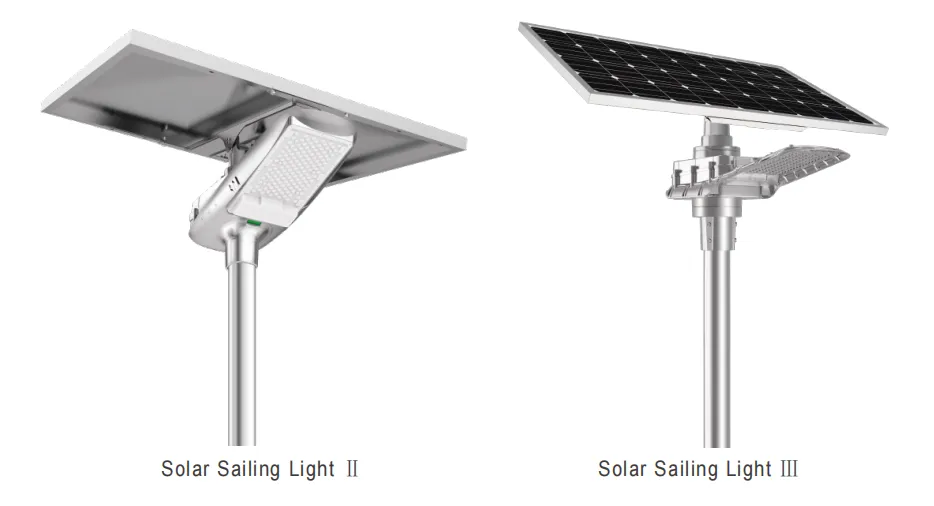
Structurally, a residential street light typically includes a light source (such as LED or solar technology), a pole system for installation, a driver or control unit, and a power supply that can be either grid-connected or solar-based. These components work together to maintain reliable operation under different weather and lighting conditions.
Based on different application needs, residential street lighting can be implemented through LED-based systems, solar-powered solutions, or traditional grid-powered setups. LED lighting is widely valued for its energy efficiency and long service life, solar systems are preferred for sustainable and off-grid installations, while grid-powered options are commonly used where stable and continuous illumination is required.
How Important Are Street Lights?
Street lighting plays a crucial role in maintaining safety and improving quality of life in residential areas. Proper illumination enhances nighttime visibility, supports safer movement across communities, and contributes to a more secure and well-organized living environment. In modern infrastructure, residential street lighting systems are considered an essential part of urban and suburban planning.
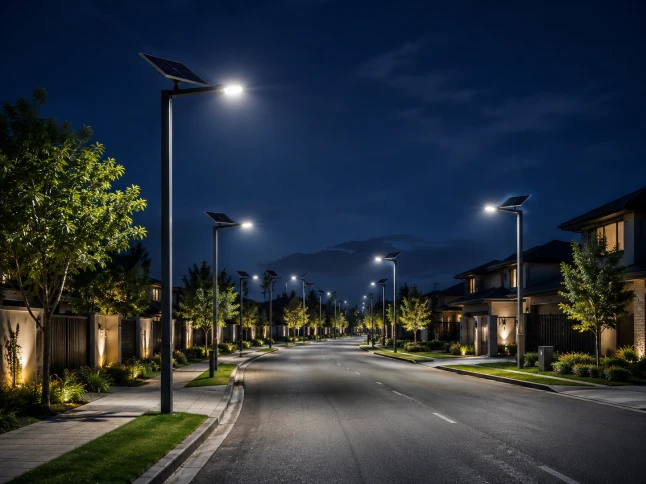
Well-designed street lights provide consistent illumination across roads, sidewalks, and intersections. This helps drivers identify road conditions earlier and allows pedestrians to move more confidently in low-light environments, reducing navigation uncertainty in residential streets.
Effective residential street lighting reduces visual blind spots and improves depth perception for drivers. By increasing reaction time and spatial awareness, properly distributed lighting significantly lowers the risk of collisions in community roads, junctions, and parking access points.
A well-planned lighting system helps eliminate dark zones and shadowed areas that may pose safety concerns. Continuous illumination from LED street lights or solar street lights improves overall visibility, which can discourage unauthorized activity and enhance perceived neighborhood security.
Public areas such as walkways, parks, and community entrances benefit greatly from stable lighting coverage. With reliable residential street lighting systems, these spaces remain accessible at night, encouraging safer pedestrian activity and improving overall community usability after sunset.
Modern street lighting systems are increasingly integrated into smart city frameworks, combining energy-efficient technologies, automated controls, and adaptive brightness functions. These systems not only reduce energy consumption but also support data-driven urban management and sustainable development strategies.
Proper lighting design directly influences how safe, efficient, and comfortable a residential environment feels, making residential street lights a fundamental component of modern infrastructure planning.
Residential Street Lighting Layout & Technical Specifications
* Recommended engineering parameters derived from international municipal planning frameworks.
| Application Zone | Recommended Pole Height | Typical LED Wattage | Optimum Pole Spacing | Solar Hardware Solution |
| Local Neighborhood Streets | 4m – 6m (13ft–20ft) | 20W – 60W | 14m – 24m (3-4x height) | Integrated All-in-One |
| Residential Collectors | 6m – 8m (20ft–26ft) | 60W – 120W | 21m – 32m (3.5x height) | All-In-Two Split System |
| Intersections & Curves | 8m – 10m (26ft–33ft) | 80W – 150W | Photometric Verified | Intelligent IoT System |
Free Photometric Planning Support
Final pole spacing and luminaire tilt angles must be verified via professional simulation codes to avoid dark spots.
Core Engineering Scope: What Residential Lighting Covers
A complete industrial-grade residential street lighting plan must cover three interconnected geometric zones:
- Roadway Visibility: Ensuring adequate horizontal illuminance ($E_{avg}$) for vehicles navigating local streets at low speeds.
- Pedestrian Comfort: Illuminating sidewalks, walkways, and crossings uniformly to eliminate blind spots and reduce crime risk.
- High-Risk Points: Delivering enhanced vertical illuminance at curves, T-junctions, and community entrances.
Modern systems utilize advanced LED residential street lights engineered with asymmetrical Type II or Type III distribution optics. These precise lenses place light precisely on the pavement, avoiding sky glow or light trespass into residential windows.
Technical Design Standards for Residential Areas
While regional geopolitical codes vary, professional project engineering focuses on these strict lighting metrics:
- Target Illuminance & Uniformity: Maintaining average-to-minimum uniformity ratios (typically $U_0 \ge 0.3$ or $4:1$) to mitigate dangerous dark patches.
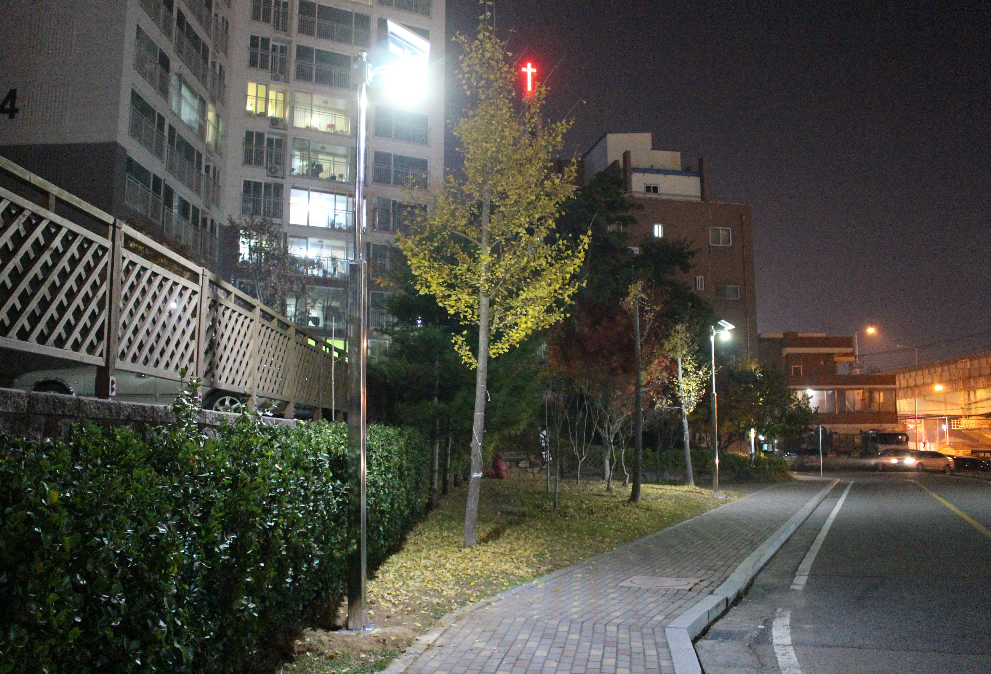
- Glare and Cut-off Control: Selecting full cut-off or semi-cut-off fixtures to protect driver visibility and eliminate disability glare.
- Light Trespass Mitigation: Controlling back-light distribution to ensure zero light leakage into nearby bedroom windows.
- Structural Integrity: Verifying wind load ratings, IP66 waterproof grading, and IK08+ anti-collision finishes for long-term outdoor reliability.
Optical Classifications: Commercial Standards vs. Decorative Lighting
Understanding optical differences prevents field deployment failures. Residential road layouts must never compromise structural optics for aesthetics:
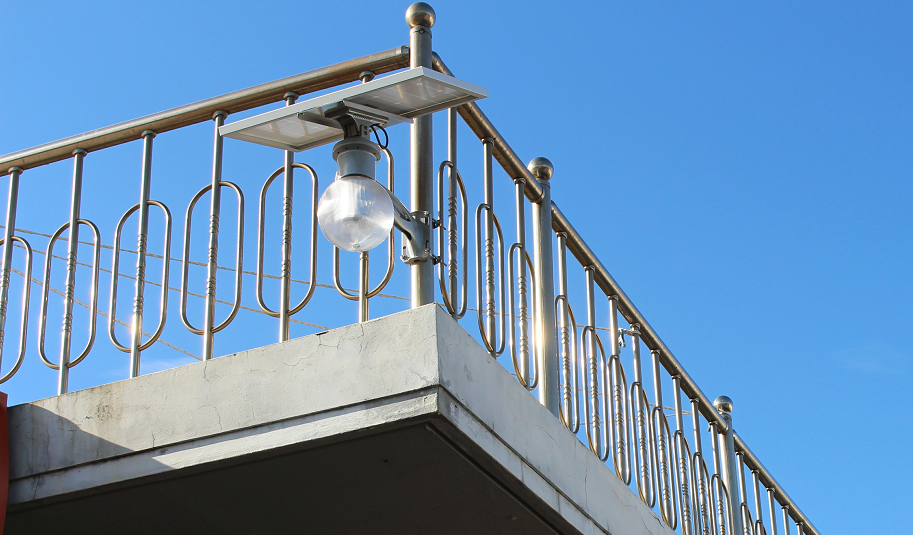
- Decorative Post-Top Lights: Ideal for architectural ambiance, but typically feature symmetrical Type V distribution, leading to weak roadway performance and severe light spill.
- Parking-Lot Luminaires: Engineered for wide, open area spacing rather than narrow, continuous roadway sections.
- Highway/Arterial Fixtures: Feature excessively harsh, high-lumen outputs that create visual fatigue and resident complaints in neighborhood zones.
What Is the Difference Between a Street Lamp and a Street Light?
Although the terms are often used interchangeably, street lamp and street light can have slightly different meanings depending on context within residential street lighting systems and urban infrastructure.
A street lamp usually refers to the physical lighting fixture itself, including the lamp head, housing, and pole-mounted structure. It focuses more on the hardware components used in street lighting installations.
A street light generally refers to the overall lighting system or the illumination it provides in a roadway environment. It includes not only the fixture but also the functional lighting output used in residential street lights and public road networks.
In most real-world applications, both terms describe the same infrastructure. However, technically the difference can be summarized as:
Lamp = physical fixture component
Light = complete lighting system or lighting function
---Do Street Lights Use a Lot of Electricity?
Energy consumption in street lighting systems depends mainly on the lighting technology used and how efficiently the system is designed and operated. In modern residential street lighting systems, the shift toward LED and solar solutions has significantly reduced overall power demand compared to traditional setups.
---Street Lighting Energy Comparison
| Type of Street Light | Electricity Usage | Efficiency | Key Characteristics |
| High-Pressure Sodium | High | Low | Higher energy demand and more heat output |
| LED Street Lights | Low | High | Energy-efficient with stable light performance |
| Solar Street Lights | Very Low (grid usage) | Very High | Runs on solar energy, minimal grid dependence |
Older high-pressure sodium systems typically require more electricity due to lower conversion efficiency, resulting in higher operating costs and less optimized light output.
By comparison, LED street lights deliver the same or better illumination with much lower energy consumption, making them widely used in residential and urban lighting projects where efficiency and long-term cost control are important.
Solar street lights further reduce reliance on grid electricity by using photovoltaic panels and battery storage, making them suitable for areas focused on sustainability or off-grid operation.
Overall electricity usage is influenced by factors such as fixture wattage, daily operating time, and system layout. These elements directly affect how much power a lighting network consumes.
With continued adoption of LED and solar technologies, modern street lighting systems are becoming increasingly energy-efficient while maintaining reliable illumination quality.
Key Considerations for Solar Residential Street Lighting
Deploying residential solar street lights is highly cost-effective in projects where grid cabling costs are financially prohibitive. However, commercial hardware requires strict calculations:
- Shade Analysis: Account for tree canopies and building setbacks that block PV panel sun exposure.
- Autonomy Design: Calculate battery sizing based on the lowest-solar month data to guarantee continuous performance during continuous rainy spells.
- Smart Dimming Profiles: Implement PIR motion sensors or time-slice intelligent dimming configurations via IoT platforms to optimize power consumption throughout the night.
Common Engineering Mistakes to Avoid in Residential Street Lighting Systems
- Over-specifying system wattage instead of auditing raw delivered lumens and directional light distribution.
- Neglecting vertical lux requirements on sidewalks, focusing solely on the asphalt pavement.
- Under-sizing commercial solar panels and lithium batteries, leading to premature system blackout in winter.
- Selecting rigid 100% power profiles without integrating localized smart-dimming automation.
Ready to Optimize Your Residential Lighting Project?
As an ISO 9001/14001/45001 certified manufacturer, RoadSmart delivers tailored OEM/ODM hardware and comprehensive photometric planning for clients across 120+ countries.
Contact Our Engineering Team