


RSA Series Modular Solar Street Light
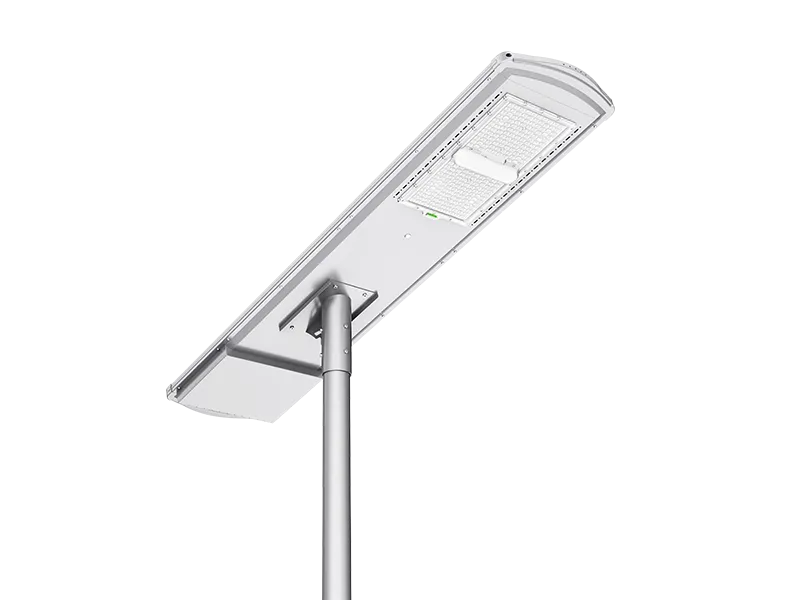
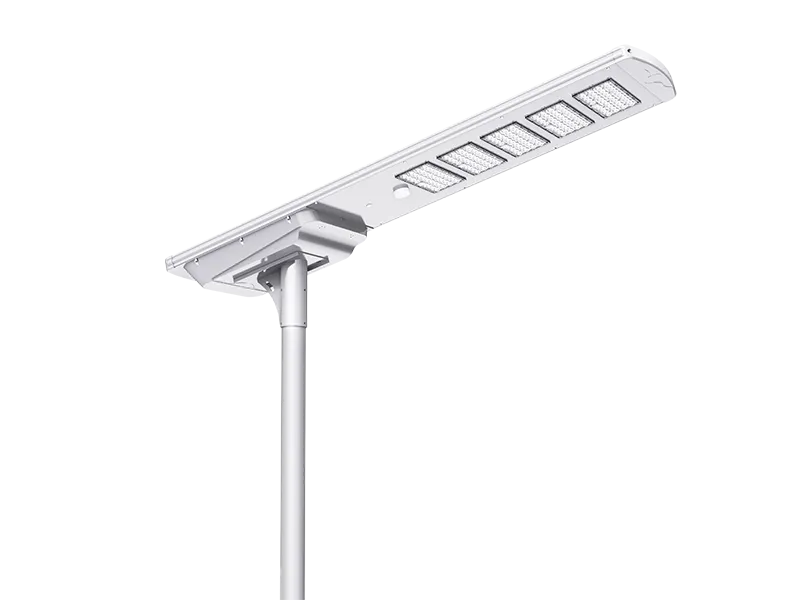
RSA brings a modular LED assembly, MPPT solar charging and LiFePO4 storage into an integrated road-lighting fixture. Its aluminum body and batwing optics form the basis for lighting factory access routes, industrial park roads and municipal streets.
The four-model range covers 5,100–18,000 lm. For industrial sites, the starting point is the work taking place after dark: vehicle circulation, shift changes and movement along the perimeter. Build the lighting arrangement around those routes, then match the RSA configuration to the installation.
- Modular LED lighting assembly
- MPPT charging with LiFePO4 storage
- 150° × 70° batwing distribution
- Rotating mounting holder


RSA Series Product Video
See the RSA fixture from different angles before reviewing its construction and configuration data below.
RSA Series Specifications and Model Selection
RSA-40, RSA-60, RSA-100 and RSA-160 are four modular solar street light models. Compare each model’s solar panel, LiFePO4 battery, luminous flux and recommended mounting height against your project requirements.
| Type | RSA-40 | RSA-60 | RSA-100 | RSA-160 |
| Solar panel | 60W / 6V | 90W / 18V | 120W / 18V | 160W / 18V |
| LiFePO4 battery | 240Wh | 432Wh | 640Wh | 832Wh |
| Luminous flux | 5,100 lm | 9,500 lm | 13,600 lm | 18,000 lm |
| LED quantity | 200 pcs | 250 pcs | 300 pcs | 350 pcs |
| Mounting height | 6–7m | 6–8m | 8–10m | 9–12m |
| Pole-top diameter | 60mm | 60mm | 76mm | 76mm |
How to Choose the Right RSA Model
RSA-40 and RSA-60 use a 60 mm pole top for mounting heights of 6–8 m. RSA-100 and RSA-160 use a 76 mm pole top for 8–12 m mounting.
Confirm the final model against the road layout, pole connection and required lighting performance, then record the panel and battery configuration in the order specification.
Share these project details for a configuration recommendation:
- Road width
- Pole height
- Installation spacing
- Required lighting hours
- Backup-day requirements
Modular LED Design and Thermal Management
The light-emitting assembly, housing and optics each have a different role in the RSA construction. Understanding those roles is useful when reviewing both the lighting design and future service requirements.
Modular LED Construction
The RSA modular solar street light uses separate LED sections within the integrated fixture. For maintenance and spare parts, identify the exact RSA model and module version, then confirm the compatible parts and servicing procedure with RoadSmart.
Aluminum Body for Heat Dissipation
The aluminum housing helps dissipate heat from the lighting assembly during operation. On industrial sites, ambient temperature and the required nightly operating period belong in the specification review, particularly where the light runs through a full night shift.
Batwing Solar Street Light Optics
A 150° × 70° lens directs light across and along the road. Its orientation matters when a site has traffic lanes beside a fence, a footpath or a building frontage. Review coverage on the actual layout, including the spaces between poles and the edge of the intended lighting area.
RSA Industrial Solar Street Light Applications
An industrial solar street light layout should follow how the site moves after dark. Identify vehicle routes, staff access and perimeter activity separately; the same lighting arrangement may not serve all three well.

Industrial Park Roads
A solar street light for industrial parks needs to work with the planned traffic routes and pole positions. Mark bends, junctions and turning areas on the site plan, then assess where the RSA optics and mounting height can provide the required coverage.

Factory Perimeters and Sidewalks
When planning solar lighting for factory perimeter routes, define the walkway width, fence line and areas that need to remain visible. Nearby buildings or stored materials can obstruct light or shade the solar panel, so these belong on the layout alongside the proposed pole positions.

Factory Entrances and Shift Change Routes
Gateways can bring vehicles and staff into the same area at changeover times. Specify when the route is busiest and whether lighting is also needed between shifts. This establishes a useful operating schedule for reviewing battery storage and nightly demand.
Inside the RSA Fixture and Mounting Assembly

Monocrystalline Solar Panel
The panel sits above the fixture and supplies energy for charging. Its rating changes with the selected RSA model.
MPPT Solar Controller
MPPT charging control is part of the integrated system, linking the solar panel with battery charging. The controller configuration should be included in the order specification.
LED Boards and Lens Sections
The drawing shows the LED boards and their corresponding lens sections separately. LED quantity varies by model, from 200 to 350 across the range.
Battery Capacity Across the RSA Range
RSA is a solar street light with LiFePO4 battery storage options from 240 to 832Wh across its four models. Identify the battery configuration together with the model when ordering or requesting parts information.
Status Indicator and Switch
RSA has an exterior system status indicator and a separate light-switch button. Obtain the indication guide for the supplied controller so the site team can interpret its indications during commissioning or troubleshooting.
Rotating Mounting Holder
The holder shown in the RSA drawing allows angular positioning at the mounting connection. Confirm the permitted angle and fixing arrangement for the supplied model before installation.
RSA on Suburban and Urban Roads
The Philippines references show two uses of RSA in solar roadway lighting: RSA-60 on suburban access routes and RSA-100 on urban roads. Each project links to its own location and application details.
RSA-60 on Suburban Roads in the Philippines
The RSA-60 project serves suburban roads and community access routes. This model combines 9,500 lm with a 90W / 18V solar panel and 432Wh LiFePO4 storage.
RSA-100 on Urban Roads in the Philippines
The urban road project uses RSA-100 for city traffic routes and public outdoor areas. The model configuration pairs 13,600 lm with a 120W / 18V panel and 640Wh LiFePO4 storage.
Working with RoadSmart on RSA Specifications
RoadSmart supports product supply, installation guidance and technical communication with project teams. For an RSA enquiry, include the required fixture configuration and the site drawing so equipment and layout questions can be reviewed together.
From RSA Specification to Site Handover
Before the RSA order moves into production, record the approved fixture version and mounting connection alongside the model quantities. The same record can then support installation handover and later parts enquiries.
Provide a marked site plan and operating schedule. Confirm the RSA models, panel and battery configurations, and any agreed custom all in one solar street light requirements.
Record quantities by model and confirm the approved configuration, packaging and identification requirements. Keep requested changes in the agreed order documents.
Confirm the mounting arrangement and obtain the applicable installation and controller guidance. Include the model identification and parts contact in the site's maintenance records.
When reporting a fault, provide the model, observed indicator state and photographs of the affected part. Agree any replacement requirements against the supplied fixture version.
RSA Series Project Delivery Process
Share your project layout and lighting requirements to begin model selection and configuration. The process covers requirement review, model confirmation, production preparation, installation and project follow-up.


1. Project Requirements
● Road type and width
● Pole height and installation spacing
● Lighting hours and backup-day requirements


2. Model and Configuration
● Compare RSA-40 to RSA-160 models
● Review panel, battery and lumen options
● Confirm the project configuration


3. Order Preparation
● Confirm selected models and quantities
● Review order specifications
● Prepare production and packaging


4. Installation and System Check
● Prepare poles and installation locations
● Mount the selected fixtures
● Check the system after installation


5. Operation Guidance
● Product operation instructions
● Basic maintenance guidance
● Product documentation


6. After-Sales Support
● Product use and maintenance questions
● Support needs reviewed by project
● Spare-parts requirements confirmed as needed


7. Project Follow-Up
● Collect installation and site feedback
● Review operating requirements
● Confirm any follow-up support needs
Plan Your RSA Installation
Upload a site plan marking the roads, factory entrances, perimeter paths and proposed poles, plus location, lighting levels, night-shift schedule, backup requirement and quantity. For existing poles, include their height and top dimensions. RoadSmart will review the RSA configuration and prepare a quotation.
Request a Professional Solution
Please submit your project details on the right. Our team will provide a professional solution and quote via email within 24 hours.
Related Products


FAQ
Q: Can RSA illuminate a factory perimeter throughout a night shift?
RSA can be considered for factory perimeter lighting. Establish the required brightness, operating period and low-sunlight backup requirement, then review the model's energy configuration for the site. For continuous overnight use, state the entire shift duration rather than only the busiest hours.
Q: Which RSA model reaches 18,000 lm?
RSA-160 provides the 18,000 lm configuration, paired with a 160W / 18V solar panel and an 832Wh LiFePO4 battery. Its recommended mounting height is 9-12m. The lighting design and local solar conditions determine whether it suits the proposed installation.
Q: Which pole-top sizes does RSA use?
RSA-40 and RSA-60 use a 60mm pole top; RSA-100 and RSA-160 use 76mm. Before installation, check the actual pole dimensions against the supplied holder and confirm its permitted adjustment.
Q: How should batwing optics be checked on a factory road?
Provide the road width, pole locations and the adjacent areas that need illumination. Review the light distribution against the layout, particularly at bends and along footpaths or fences. The 150 deg x 70 deg beam angle does not on its own establish a Type III classification or compliance with a road lighting standard.
Q: Can I change the number of LED modules to increase output later?
Do not assume that adding modules is a supported upgrade. LED output must work with the controller, battery and solar panel configuration. Request a review of the exact RSA model before making changes to the lighting assembly.