


RSK Series Solar Street Light with 10000 Lumen Option
Modular pole-mounted solar street light for community and urban roads
The RSK series combines a solar panel, LiFePO4 battery and LED lighting assembly in one pole-mounted fixture for community roads and urban streets. Choose from 6,000, 10,000, 15,000 and 18,000 lm configurations to match the project layout and night-time lighting requirements.
For a 10000 lumen solar street light, the RSK-80 pairs a 90W solar panel with a 384Wh battery. Compare it with the other RSK models using your pole height, road width, lighting schedule and local solar conditions.
- 6,000–18,000 lm configurations
- 240–960Wh LiFePO4 battery options
- 60–150W solar panel options
- Recommended mounting heights of 6–12m across the range


RSK Series Product Video
Take a closer look at the RSK series in the product video, then review its component details and configuration options below.
RSK Model Comparison and Luminous Flux
Compare luminous flux, solar panel capacity, battery storage and recommended mounting height together. The model name alone does not describe the complete lighting configuration.
| Type | RSK-60 | RSK-80 | RSK-120 | RSK-150 |
| Luminous flux | 6,000 lm | 10,000 lm | 15,000 lm | 18,000 lm |
| Solar panel | 60W / 18V | 90W / 18V | 120W / 18V | 150W / 18V |
| LiFePO4 battery | 240Wh | 384Wh | 640Wh | 960Wh |
| Recommended mounting height | 6–7m | 6–8m | 8–10m | 10–12m |
| Pole-top diameter | 76mm | 76mm | 76mm | 76mm |
Shared specifications: 150° × 70° beam angle; batwing lens with polarized light; 3000–7500K color temperature; operating temperature −20°C to 60°C, with charging above 0°C. All models suit a 76 mm pole top.
Choosing the Right RSK Configuration
The RSK-60 is the 6000 lumen solar street light option in this range. For a 10000 lumen solar street light, compare the RSK-80 against your required road coverage and operating schedule. The RSK-120 offers a higher output option where the lighting design calls for 15,000 lm. The RSK-150 provides 18,000 lm with a 150W / 18V solar panel, 960Wh battery and a recommended mounting height of 10–12m.
If you need a solar street light for 8m pole installations, both RSK-80 and RSK-120 include 8m within their recommended height ranges. Road width, pole spacing and the required lighting levels determine which configuration is more suitable. Confirm the nightly brightness schedule and backup requirement alongside local solar availability before final selection.
Get Model Selection SupportRSK Battery, Housing and Road Coverage
The RSK range brings energy storage, integrated construction and road-oriented optics into one series. Compare these features against the way your project will operate after dark.
LiFePO4 Battery for the RSK Series
For projects specifying a solar street light with LiFePO4 battery storage, RSK provides three capacities matched to its models: 240Wh, 384Wh and 640Wh. The choice should account for the lighting schedule and available charging energy, especially where longer operating hours or cloudy periods affect the energy balance.
Housing and Installation Details
The aluminum solar street light housing brings the main system components together in one fixture. This integrated arrangement reduces the number of separate solar lighting assemblies to mount on the pole. Pole preparation and structural suitability still need to be checked for the installation site.
Batwing Optics for Road Layouts
The 150° × 70° batwing lens shapes the light distribution for road applications. Review its orientation with pole positions and road width so the selected output serves the intended area. Luminous flux alone cannot establish the illuminance or uniformity achieved on the ground.
RSK Solar Street Lights for Residential Roads
When selecting a solar street light for residential roads, consider how vehicles and pedestrians share the space, where poles can be installed and when lighting is needed. The RSK configurations can be compared against these conditions before a project layout is confirmed.

Residential Community Roads
For community access roads, review entrances, junctions and the route between homes. RSK model selection should follow the required coverage and night-time schedule, with nearby buildings and trees checked for solar panel shading.

Narrow Urban Streets
Narrow streets may have limited space for poles or uneven setbacks from buildings. Compare the RSK mounting height ranges with the actual pole locations, and review the distribution across the road rather than assuming a lower output will always be sufficient.

Roadside Pedestrian Areas
Where solar pedestrian lighting is part of a road project, identify the walking area separately from the vehicle lane. Check whether the proposed pole location and light distribution cover both areas, or whether the pedestrian route needs a different lighting arrangement.
RSK Series Component Details
Use the component views to identify the solar panel, LED assembly, housing, status indicators and switch before installation or routine checks.
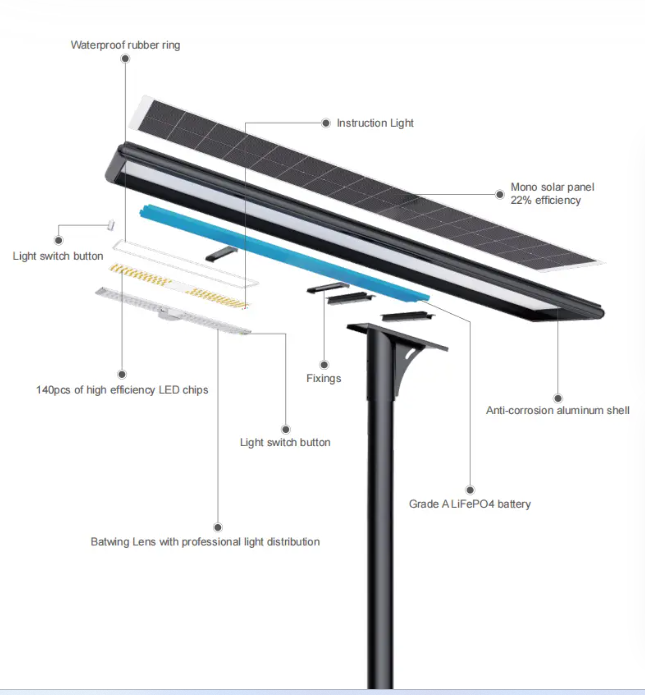
Monocrystalline Solar Panel
The panel forms the solar collection surface of the RSK series. Review its rated output and surface condition when assessing the configuration.
LED Lighting Assembly
The LED assembly and lens form the lighting side of the fixture. Compare the LED configuration with the required luminous flux when selecting a model.
Aluminum Housing
The housing encloses the integrated components. Product views show the internal layout for review before installation.
System Status Indicators
For a solar street light with battery indicator integration, RSK provides charging, battery and load status signals. Match the indication guide to the supplied controller.
On Off Button
The RSK installation instructions identify an On/Off button for activation. Confirm the switch position during commissioning and routine checks.
RSK Installation and Component Details
As a pole mounted solar street light, RSK-60, RSK-80 and RSK-120 correspond to a 76 mm pole top. Construction should follow the mounting instructions and confirm the permitted angle at the connection.
RSK Series Project References
The existing RSK references include narrow city lanes in the Democratic Republic of the Congo, a street in Cameroon and a residential area in Cameroon. These photographs show installation settings to compare with your own site.

Democratic Republic of the Congo
RSK street lighting on narrow city lanes. Review the photographed pole positions and surrounding buildings alongside your own road layout.

Cameroon Street Lighting
A street installation reference for the RSK series. Confirm your road width, pole height and required lighting levels separately when planning a new installation.

Cameroon Residential Area
A residential installation reference for projects considering a solar street light for residential roads. Share a site plan to compare the available RSK configurations with your community layout.
RSK Project Delivery and Technical Support
Begin with the road layout and operating requirements. Confirm the selected model and any agreed changes in the order specifications before production and delivery.


1. Project Requirements
● Location, road width, pole height and spacing
● Nightly lighting hours and backup requirement
● Quantity and existing pole details


2. Model and Configuration
● Compare RSK-60, RSK-80 and RSK-120
● Review any custom all in one solar street light requirements
● Confirm the configuration


3. Order Preparation
● Confirm model quantities
● Agreed specifications
● Packaging requirements


4. Installation and System Check
● Use the RSK mounting instructions
● Check activation after installation
● Check indicator states


5. Operation Guidance
● Refer to the matching operating instructions
● Available lighting modes
● Supplied version guidance


6. After Sales Support
● Provide the model
● Installation details
● Indicator observations


7. Project Follow Up
● Share operating feedback
● Changes in site conditions
● Support team review
Request an RSK Series Project Quote
Send your project location, road width, pole height, pole spacing, nightly lighting hours, backup requirement and quantity. For existing poles, include the pole-top dimensions and site photographs. RoadSmart can review these details to help identify an RSK configuration and prepare a project quote.
Request a Professional Solution
Please submit your project details on the right. Our team will provide a professional solution and quote via email within 24 hours.
Related Products


FAQ
Q: What routine maintenance does the RSK series require?
Keep the panel clear of dirt and shading, and arrange periodic checks of the fixture and mounting connections. Set the cleaning frequency according to local dust and site conditions. Follow the supplied manual and use qualified personnel for work at height or internal servicing.
Q: What do the RSK status indicators show?
The manual identifies charging, battery and load indications. Use the indicator table for the supplied version to interpret steady, flashing or unlit states. When requesting support, provide the model and a clear description or video of the observed indications.
Q: How should lighting hours and cloudy-day backup be specified?
State the nightly operating hours, required brightness periods and number of low-sunlight days the project needs to accommodate. The suitable panel and battery combination depends on these requirements and local solar availability. A quoted backup duration should identify its operating assumptions.
Q: Can the RSK series fit an existing 76mm pole?
RSK-60, RSK-80 and RSK-120 are listed for a 76mm pole top. Confirm the actual pole-top dimensions and mounting assembly against the RSK drawing, and have the pole condition and structural suitability assessed for the site.
Q: Which RSK model should I compare for an 8m pole?
Both RSK-80 and RSK-120 include 8m in their recommended mounting height ranges. Compare their output with road width, pole spacing and the required lighting levels. Pole height alone does not determine which model will meet the project requirements.
Q: Does RSK-80 mean the LED operates at 80W?
The model number should not be used as the LED power rating. RSK-80 has a listed solar panel capacity of 90W and luminous flux of 10,000 lm. If LED input power is required for a tender or comparison, request that value for the exact configuration being quoted.
Q: How do I select a 10000 lumen RSK configuration?
RSK-80 is the 10000 lumen solar street light option, with a 90W / 18V solar panel and 384Wh LiFePO4 battery. Use the road layout and lighting requirements to check its suitability, then confirm the operating schedule and backup requirement against local solar conditions.