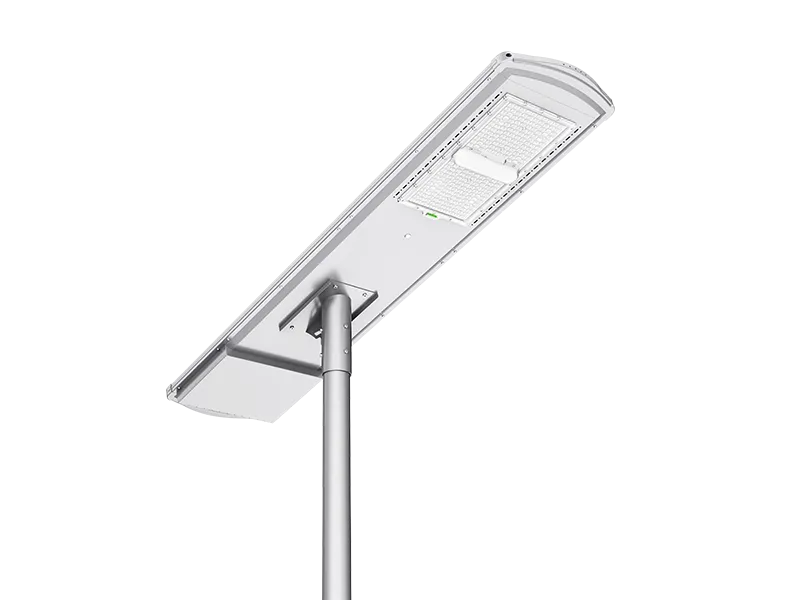
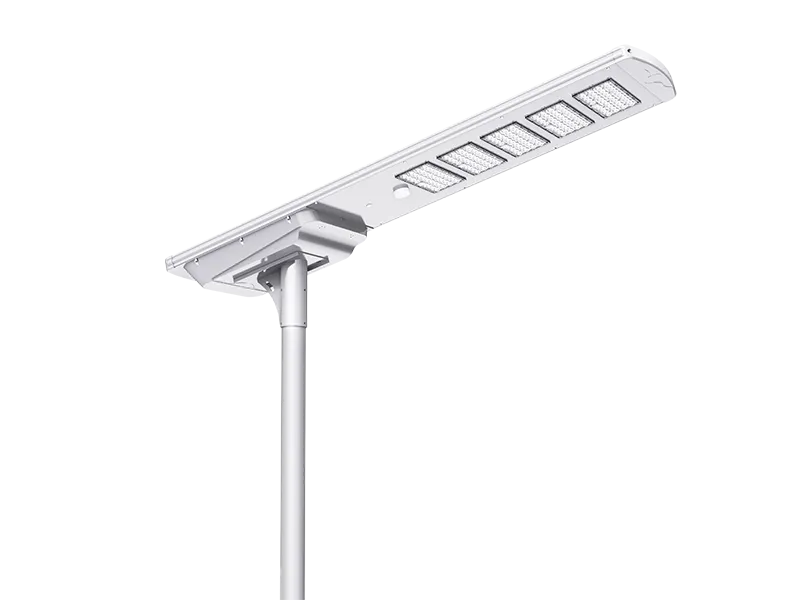
RSP Series Village Solar Street Light
Bring lighting to village routes where extending a mains supply would add site work. RSP integrates the solar panel, battery, controller and LED assembly in a single pole-mounted fixture, with three configurations for local road projects.
The village solar street light range provides 6,300, 9,000 and 12,000 lm options, each with a 60mm pole-top connection. Select the lighting points around the route people use after dark, then check the configuration against the available sunlight and required operating hours.
- 6,300 / 9,000 / 12,000 lm configurations
- 240 / 384 / 576Wh LiFePO4 storage
- 60mm pole-top connection across the range
- Integrated panel, battery and lighting assembly


RSP Output, Battery Capacity and Pole Fit
All three RSP models use a 60mm pole top, while their output, stored energy and recommended mounting heights differ. The table keeps these values together so the selected fixture can be matched to the proposed installation.
| Specification | RSP-60-P | RSP-90-M | RSP-120-M |
| Solar panel | 70W / 6V | 90W / 18V | 120W / 18V |
| LiFePO4 battery | 240Wh | 384Wh | 576Wh |
| Luminous flux | 6,300 lm | 9,000 lm | 12,000 lm |
| LED quantity | 200 pcs | 250 pcs | 300 pcs |
| Mounting height | 6–7m | 8–10m | 8–10m |
| Pole-top diameter | 60mm | 60mm | 60mm |
| Product size | 1080 × 357 × 60mm | 1248 × 417 × 60mm | 1318 × 537 × 60mm |
Common specifications: 150° × 70° batwing distribution; 3000–7500K color temperature; operating temperature −20°C to 60°C, with charging above 0°C.
Which RSP Model Matches Your Road and Existing Poles?
For a 6m pole, RSP-60-P falls within the recommended mounting range. At 10m, both RSP-90-M and RSP-120-M are listed options. Their common mounting height does not make them equivalent: the higher-output model also has a larger panel and more battery storage.
On a new road, establish the required lighting levels and coverage before setting pole height and spacing. On an existing route, measure the poles and check the proposed coverage before retaining their positions. In both cases, use the intended lighting schedule and local solar availability to complete the energy review.
Get Model Selection SupportSolar Power at Each Lighting Point
Solar powered lighting for remote sites places solar collection and battery storage at the lighting point. With RSP, the main energy and lighting components arrive as an integrated fixture, reducing the need to mount a separate panel and external battery box.
A 60mm Pole Connection Across the RSP Range
This pole mounted solar street light uses the same nominal pole-top diameter across its three models. A project with several RSP configurations can therefore start from a common connection size. Pole strength, foundations and the supplied mounting assembly still need to suit the selected fixture and site conditions.
Stored Energy for the Nightly Lighting Schedule
RSP combines LiFePO4 storage with MPPT solar charging. Battery capacity rises from 240Wh to 576Wh across the range, allowing the energy configuration to be reviewed with the lighting demand. The required operating period and the available charging energy determine the suitable choice.
Aluminum Housing with IP65 Protection
The RSP aluminum housing encloses the lighting system and has an IP65 protection rating. For outdoor locations, also check the specified charging temperature and any site-specific exposure requirements when the order is prepared.
Village Solar Street Light Layouts for Everyday Routes
A village solar street light layout should follow the route people actually take. Begin with access points, bends and junctions, then assess the connecting road sections. This gives the lighting design a clear purpose before pole positions are finalized.

Roads Within a Village
Homes, boundary walls and roadside trees can make available pole positions uneven. Place the proposed lighting points on the road plan and check both the illuminated area and the panel’s exposure to sunlight. A convenient mounting point may need to be moved if it stays shaded.

Rural Access Roads
A rural solar street light project may cover long sections with different road widths and levels of night-time use. Mark the sections that need lighting and the times they are used, rather than assuming one uniform arrangement will suit the full route.

Remote Road Sections
Where grid access is difficult, RSP can be considered as an independent solar lighting option. Site access still matters for pole construction, installation and later cleaning. Include those practical conditions in the plan, especially when lighting points are widely separated.
Urban streets, parking areas and industrial perimeters are also part of the existing RSP application scope. Final suitability depends on the lighting requirements and site layout.
RSP Panel, Lighting Assembly and Mounting Hardware
The RSP construction view shows the panel above the aluminum body, separate LED boards and lenses below it, and the battery and controller within the integrated system. The mounting holder connects the fixture to the pole.

Panel and Charging Controller
The monocrystalline panel supplies solar energy to the MPPT controller. Panel ratings are model-specific, with 70W, 90W and 120W options in the current range.
LED Boards and Batwing Lenses
The boards and lens sections make up the lighting assembly. RSP-60-P, RSP-90-M and RSP-120-M use 200, 250 and 300 LEDs respectively; the series shares a 150° × 70° batwing distribution.
LiFePO4 Battery Inside the Fixture
RSP is a solar street light with LiFePO4 battery storage integrated into the fixture. Keep the model and battery configuration together in the order record so later parts enquiries refer to the correct version.
Housing and Light Switch
The aluminum shell forms the fixture body, while the light-switch button provides the visible operating control shown in the product drawing. Follow the supplied version’s instructions for activation and checks.
Rotating Pole Holder
The construction drawing shows a rotating mounting holder. Its allowed adjustment, fasteners and installation procedure should be confirmed for the supplied RSP version before the fixture is mounted.
Preparing RSP Lights for Dispersed Installation Sites
When lighting points are spread along a route, clear model identification helps the installation team put the intended fixture at each position. Agree the equipment schedule and site responsibilities before delivery.
Match Fixtures to Lighting Points
Record the RSP model and quantity for each road section or pole group. Where the project includes custom all in one solar street light requirements, approve the changes before they are added to the order.
Arrange Access and Installation Information
Identify where poles and foundations will be prepared, how the fixtures will reach the site and which team will carry out installation. Obtain the mounting and operating information for the supplied version before work starts.
Keep a Local Service Record
Retain the model list, installation locations and commissioning notes. Include a practical plan for panel cleaning and a contact route for product or parts questions so the information remains available after installation.
Ask for RSP Technical Information
Specify the RSP model and the information needed for your project review. Leave your contact details to request the relevant configuration and mounting information.
Configuration Data
Panel rating, battery capacity, luminous flux, LED quantity and mounting height for RSP-60-P, RSP-90-M and RSP-120-M.
Mounting Information
The 60mm pole-top connection, the rotating mounting holder and the installation steps for the supplied RSP version.
Project Review
Share the route layout, pole heights, lighting hours and backup requirement so the configuration can be checked against the site.
Tell Us Where the RSP Lights Will Be Installed
Send a route sketch or marked map showing the sections that need lighting. Add photographs of the surroundings, any existing poles and areas shaded by trees or buildings. These details give the team a useful starting point for reviewing an RSP proposal. Include the project location, road dimensions, existing pole measurements, lighting hours, low-sunlight backup requirement and quantity. If a lighting standard or target illuminance applies, attach it with the enquiry.
Request a Professional Solution
Please submit your project details on the right. Our team will provide a professional solution and quote via email within 24 hours.
Related Products