Remotely Controllable, All-in-one Solar Street Lights for Farms. Is it True That Strong Light Saves Energy?
Jul 02, 2026
Read:420
Nighttime lighting on farms is not a need that can be solved simply by installing a few lights; what is needed is matching for different areas, such as warehouse areas, feed areas, pastures, and so on. It is not as simple as making the environment very bright, but is for allowing people, vehicles, equipment, and livestock to see clearly when they need to see clearly, improving traffic safety, nighttime inspection efficiency, and the safety of people and property. [1]
However, because farms are generally large in area and the points are scattered, many areas are far away from the power distribution system. If traditional grid-powered street lights are used, trenches must be dug, cables must be laid, and electricity must be connected in the early stage, and in the later stage, line aging, fault troubleshooting, and continuous electricity costs must also be faced. For remote farms, pastures, agricultural bases, and temporary expansion areas, the renovation cost will greatly increase.
Therefore, more and more projects are beginning to consider all in one solar street lights, especially products with remote control functions. It does not need to be connected to the power grid, can supply power independently, and can also adjust brightness and working modes according to different scenarios.
However, the issue that buyers are often most concerned about is: farms do indeed need strong light, but does strong light necessarily consume more electricity? Is the so-called “strong-light energy saving” truly feasible, or is it just promotional wording? Don’t worry, this article will answer from different dimensions and clear up your doubts.
Where is the Difference Between Farm Lighting and Urban Road Lighting?
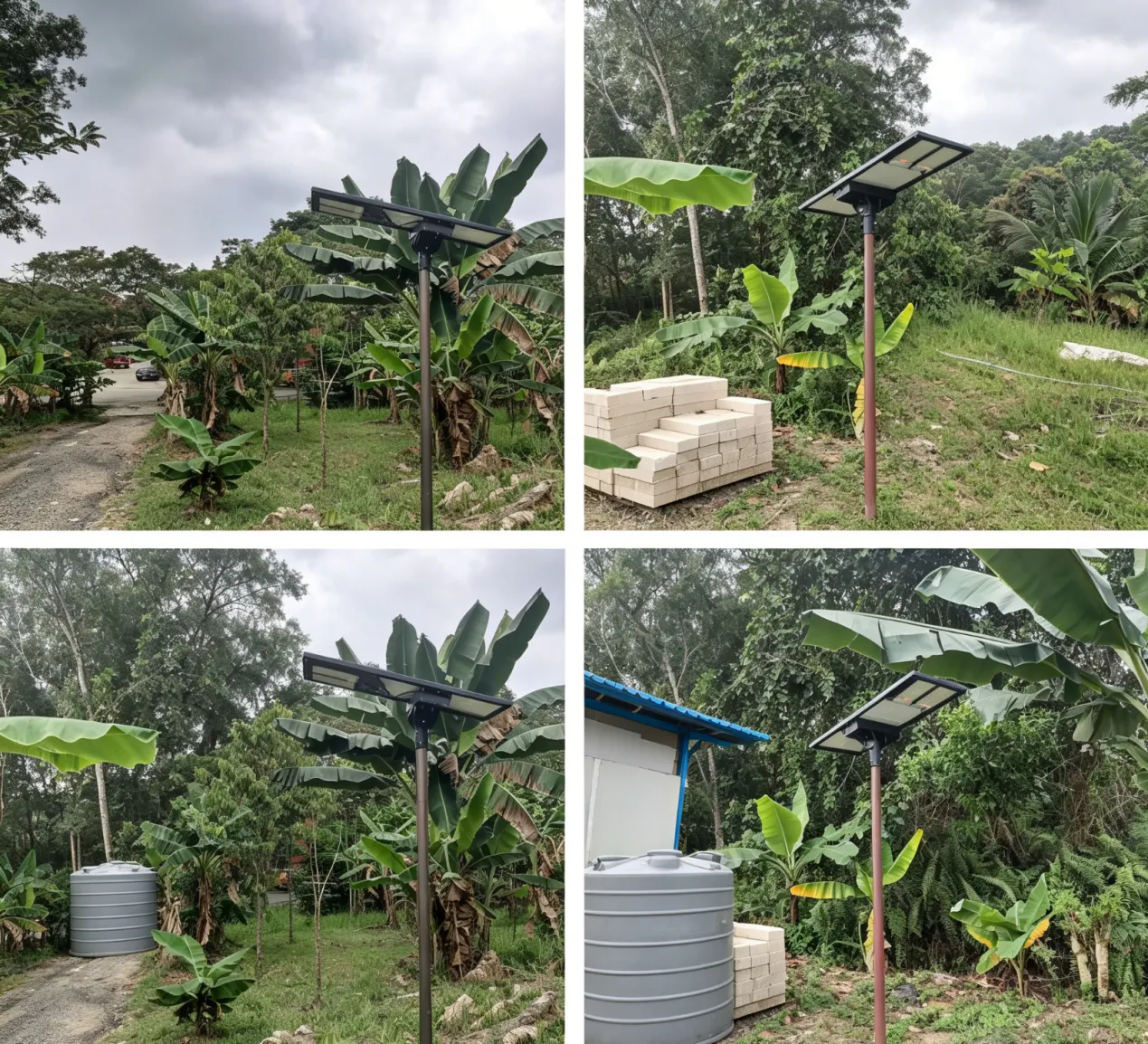
Urban road lighting usually has fixed road widths, standard light pole spacing, and a stable power grid, and the design logic is relatively clear. Farm lighting is completely different; it is more scattered and also relies more on actual usage habits.
For example, within the same farm, the main passage needs lighting for continuous vehicle traffic; the surroundings of the warehouse need to make people, goods, and equipment clearly visible; livestock areas need stable but not dazzling light; irrigation areas only need to illuminate key equipment during inspections; boundary areas may only be for safety protection and do not need high brightness throughout the night.
The farm environment itself is also more complex. Dust, mud and water, insects, rainwater, animal activity, mechanical vibration, and unobstructed strong winds will all affect the long-term operation of the lights. If the lighting structure, waterproof and dustproof capability, and heat dissipation design are not up to standard, even if the early brightness is high, later there may also be brightness decay, insufficient battery life, or frequent failures.
This means that farms cannot use one set of configurations to cover all areas, but should find lighting solutions suitable for different areas.
Urban road lighting is standardized, farm lighting is site-specific. The selection logic must shift from “fixed spec” to “scenario matching.”
What is a Remotely Controllable All in One LED Solar Street Light?
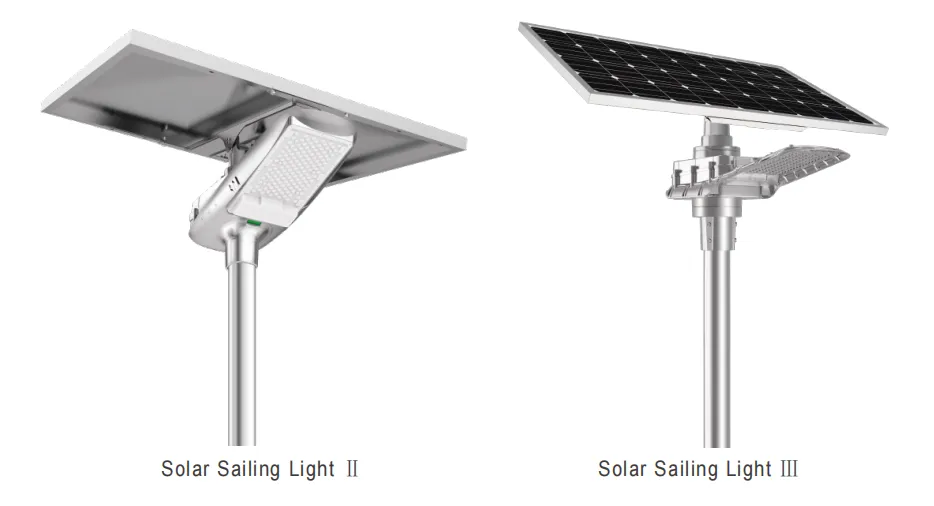
An all in one led solar street light is a lighting system that integrates the solar panel, battery, LED light source, controller, and lamp body structure together. During the day, the solar panel generates electricity and stores it in the battery, and at night, the controller automatically supplies power for lighting. [2]
One important reason it is suitable for farms is that it does not rely on the power grid. For areas such as farm roads, the outside of warehouses, pasture fences, irrigation equipment points, and remote fields, long-distance wiring is not needed during installation, construction is more flexible, and later line maintenance is also reduced.
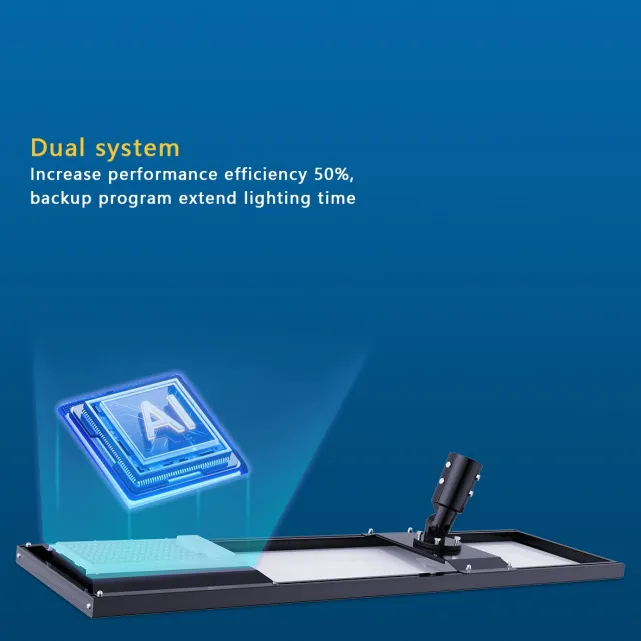
Another reason is that the all in one led solar street light has a built-in controller, which can realize remote control and allow lighting to change according to actual usage needs. When the warehouse is loading and unloading at night, the brightness can be increased; when traffic on farm roads decreases in the latter half of the night, the brightness can be lowered; boundary areas can stay at low brightness during ordinary times and automatically strengthen when people or vehicles approach, making farm lighting management more convenient while also achieving effective energy saving. [3]
Common remote-control functions available in quality all-in-one solar lights:
Brightness adjustment: Set different dimming levels per time period, such as 100% → 60% → 30%.
Working mode switch: Motion sensing mode, time-control mode, or constant-brightness mode.
Real-time monitoring: Check battery level, panel charging status, and fault alerts remotely.
Batch management: Adjust multiple lights simultaneously via app or web platform.
Automatic scheduling: Set weekly schedules based on farm activity patterns.
So, what is going on with strong-light energy saving for all in one led solar street lights? The saying of strong-light energy saving is simple, but it cannot be understood so simply as the brighter the light, the more electricity it saves. What it contains is many aspects, and truly valuable strong-light energy saving relies on system efficiency and intelligent control.
The energy-saving system of all in one led solar street lights includes LED luminous efficiency, solar charging efficiency, battery capacity, control strategy, and other aspects. Based on this set of configuration logic: efficient light emission, effective charging, sufficient energy storage, and intelligent power distribution, if any one link is missing, the effect will be discounted. Therefore, what can be affirmed is that integrated solar street lights can realize energy saving with strong light, with specific and reasonable matching. [4]
The energy-saving logic of strong-light systems:
Step 1: High-efficacy LEDs (180–210 lm/W) produce the same lumens as standard LEDs (120 lm/W) using 40% less power. A 100W standard output can be achieved with just 60–70W of high-efficacy power.
Step 2: MPPT controllers ensure 95–99% charging efficiency, converting more sunlight into usable energy.
Step 3: Smart dimming reduces output during low-traffic hours, such as 30–50% power after midnight, saving 20–40% of battery consumption.
Result: Strong light output with 40–60% less energy consumption compared to standard solar systems.
How Should Different Farm Areas Choose All in One Integrated Solar Street Lights?
All-in-one solar street lights for farms light selection should be configured according to different areas and cannot be generalized. The same all in one integrated solar street light, when used on farm roads, livestock areas, warehouses, and remote boundaries, has completely different configuration priorities.
1.Farm roads: ensure traffic safety and avoid lighting breakpoints
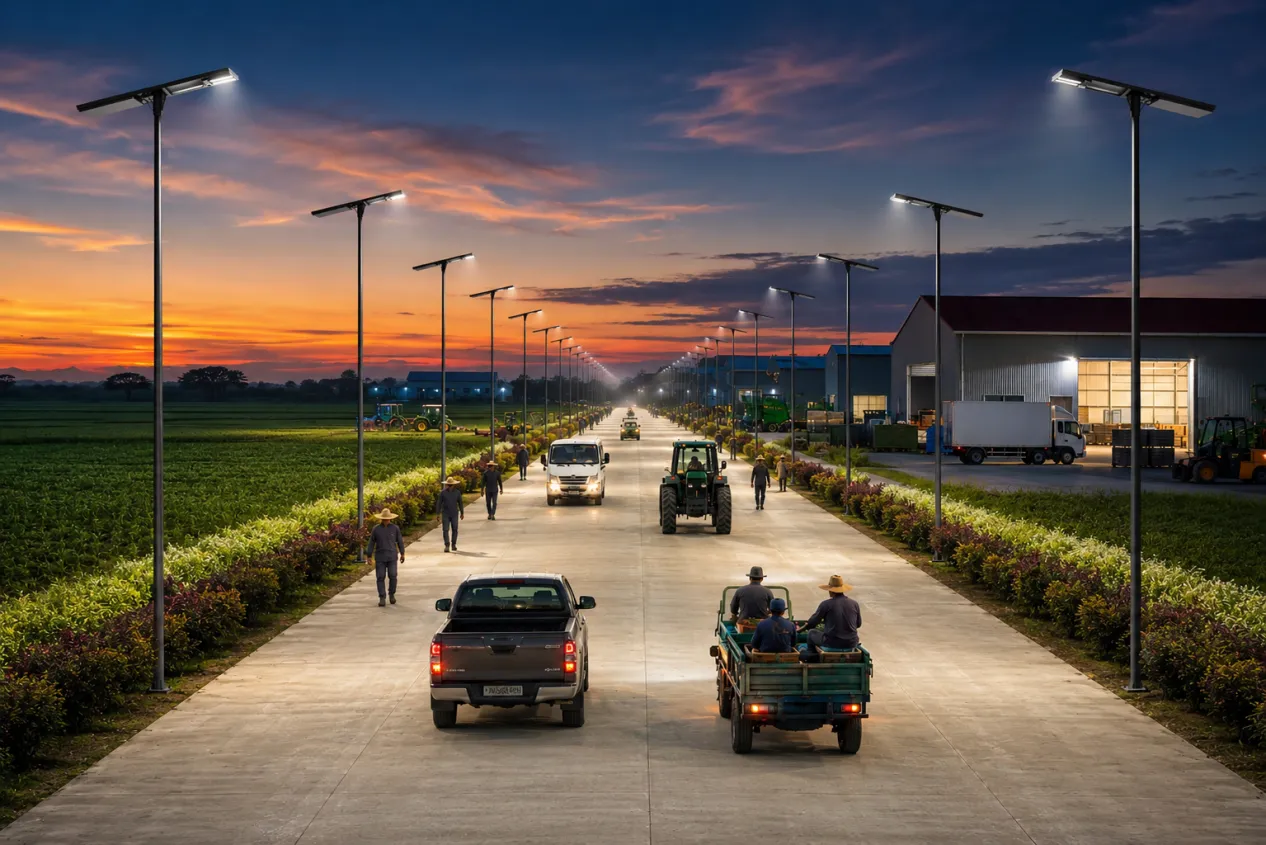
Farm roads usually connect entrances, warehouses, operation areas, farmland, and equipment rooms. At night, there may be pickup trucks, tractors, small transport vehicles, or staff passing through, so the lighting must be continuous and cannot only have one bright area under the light pole. According to the width of the road, focus on the pole height, light distribution angle, and pole spacing of the integrated solar street light, and a sensing mode can also be matched to suit roads with unstable traffic flow, with low brightness when no one is there and automatic strengthening when vehicles or people pass by.
2.Livestock areas: the light should be stable, but not dazzling
Lighting in livestock areas should not blindly pursue high brightness. Overly strong, direct, or frequently changing light may affect animal rest and also bring glare to workers. Therefore, this type of area is more suitable for choosing integrated solar street lights with medium brightness, low glare, and controllable installation angles, which can be adjusted according to fences, passages, and inspection routes.
3.Warehouses and yards: brightness, recognition, and battery life all need to be considered
Warehouses, feed areas, agricultural machinery parking areas, and loading and unloading areas have higher lighting requirements. Nighttime handling, loading, and security inspections all require clear visibility of people, vehicles, goods boundaries, and ground obstacles. This type of scenario has requirements for brightness, so it is recommended to choose integrated solar street light products with higher brightness, more sufficient battery capacity, and wider light distribution.
4.Irrigation and equipment areas: need to aim at key positions
Near irrigation pump stations, pipeline valves, equipment rooms, and control boxes, the most important thing is to allow workers to see equipment status clearly at night. Based on area needs, integrated solar street light fixtures with better directionality can be selected, and the installation angle can be adjusted according to the equipment position. At the same time, different lighting times can also be set in different time periods through remote control to reduce unnecessary energy consumption.
5.Remote fields and boundary areas: need independent power supply and low maintenance
Remote fields, fence boundaries, fish pond surroundings, orchard passages, and other areas are usually far from power sources and have high wiring costs. Here, choosing integrated solar street lights needs to have intelligent control, realizing independent power supply and reducing maintenance while also considering battery endurance, waterproof and dustproof performance, anti-corrosion capability, and installation stability.
6.Farm entrances and main passages: take both recognition and sense of security into account
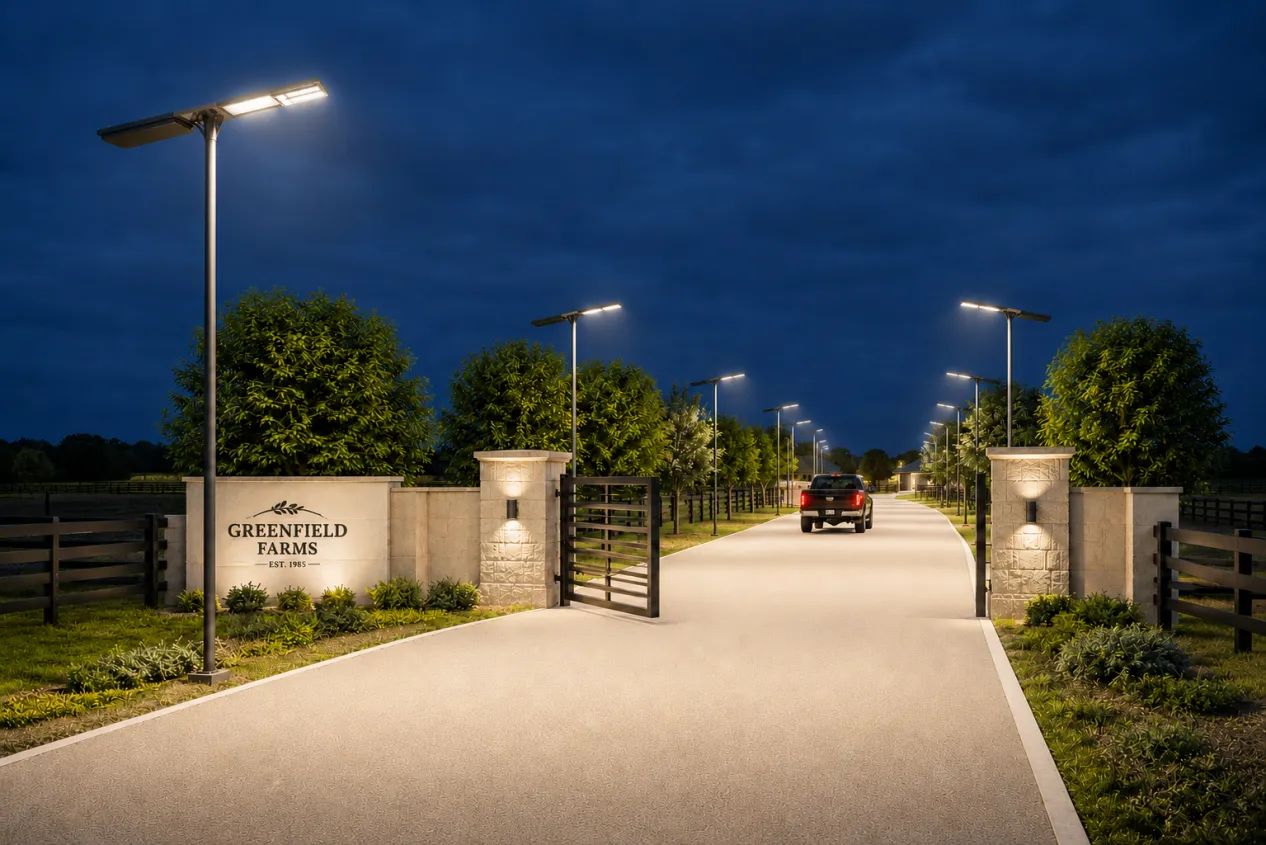
The farm entrance is a key point for vehicles, personnel, and visitors entering and exiting. The lighting needs to help identify road boundaries, gate posts, vehicle positions, and the surrounding environment. A stable brightness configuration among integrated solar street lights can be selected, but direct shining into the driver’s eyes should be avoided. If the project has image requirements, products with a cleaner appearance and more unified structure can also be selected.
Quick Reference: Farm Area Selection Summary Table
Farm Area | Recommended Power | Luminous Flux (lm) | Pole Height | Key Considerations | RoadSmart Series |
Farm Roads | 80-120W | 10,000-18,000 | 6-8m | Continuous, Sensor Dimming | ST2/RSA |
Livestock Areas | 40-60W | 4,000-8,000 | 4-6m | Anti-Glare, Warm White Light | RSA/RSK |
Warehouses/Storeyards | 120-180W | 15,000-25,000 | 7-9m | High brightness, wide beam distribution | ST2 |
Irrigation/Equipment Area | 60-80W | 6,000-12,000 | 5-7m | Directional beam distribution | RSA |
Remote Boundary | 40-60W | 4,000-8,000 | 4-6m | Large battery, high protection | RSK |
Farm Entrance | 120-150W | 15,000-20,000 | 7-9m | High visibility, anti-glare | ST2 |
Before Purchasing, Which All in One Solar Street Light Parameters Cannot Only be Looked at on the Surface?
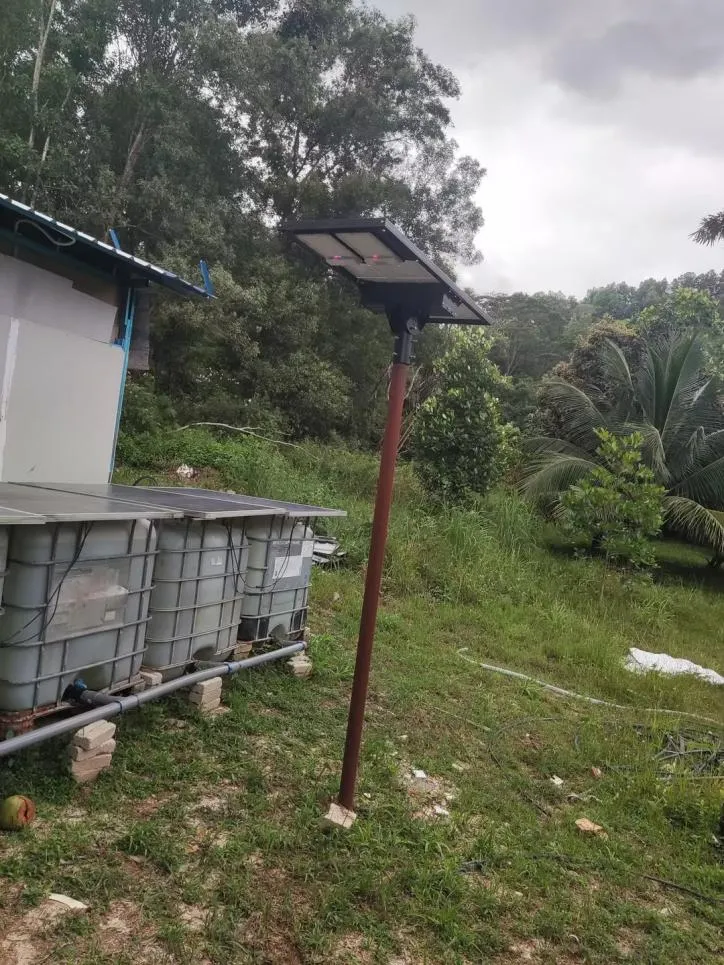
When purchase all in one solar street lights for farms, many problems are not because “the light is not bright,” but because the configuration does not match.
First, focus on LED luminous efficiency
Luminous efficiency is the main factor affecting brightness. High wattage does not necessarily equal good brightness, and it is necessary to focus on luminous efficiency, luminous flux, light distribution angle, and actual irradiation range.
Second, look at whether the solar panel is sufficient
The solar panel is responsible for generating electricity during the day, but charging efficiency will be affected by the size of the solar panel, installation angle, and site environmental shading, so the site environment needs to be fully considered.
Third, look at battery capacity and battery type
Farm lights often need to run for a long time, and some areas also need to support continuous rainy days, so battery capacity should be judged together with lighting time, brightness mode, and local climate.
Fourth, look at whether the remote control function is practical
Remote control should focus on diverse functions. Large-area farms need functions that can adjust brightness, working time, sensing mode, and operating status.
Fifth, look at protection and structure
Farm environments are diverse, and the lights need to have good waterproof and dustproof capabilities. The housing also needs to have a certain anti-corrosion performance, and the heat dissipation structure is equally important, because high temperature will affect the lifespan of all in one solar street light’s LEDs and batteries. [5]
Sixth, look at whether the all in one solar street light supplier understands the project scenario
Farm lighting is a relatively complex scenario and requires professional lighting configuration. Choosing an all in one solar street light supplier with R&D capability and practical project experience will be more reliable. RoadSmart focuses on solar intelligent street lights and can provide different configurations and control solutions according to the different needs of farm roads, storage areas, livestock areas, and remote areas. The value here does not lie in a single product, but in whether the configuration and scenario can be matched.
Summary
Remotely controllable all in one solar street lights are indeed suitable for many farm projects. They can reduce power grid wiring, lower construction difficulty, and also reduce ineffective power consumption through intelligent control. But they cannot solve all problems by casually buying a high-power product. Only when the lights are configured according to the actual needs of different farm areas, including farm roads, warehouses, livestock areas, irrigation equipment areas, and remote boundaries, can solar street lights be not only able to light up, but truly help farms reduce construction, electricity use, and maintenance pressure.
Frequently Asked Questions
Q1: Can “strong light + energy saving” really work together?
Yes. High-efficacy LEDs (180+ lm/W) produce more lumens per watt, so a 70W light can match the brightness of a standard 100W light. Combined with MPPT charging and smart dimming, strong light output is achieved with 40-60% less energy consumption.
Q2: How far can remote control reach on a large farm?
Most remote-control systems use 4G/LoRa/Sigfox networks – coverage is unlimited as long as there is cellular signal. For farms without cellular coverage, some systems offer local radio control within 1-5km range. RoadSmart can advise based on your farm location.
Q3: Can solar lights work in livestock areas without disturbing animals?
Yes. Choose lights with warm color temperature (3000-4000K), anti-glare optics, and stable no-flicker output. Avoid motion-sensing lights in livestock areas if sudden brightness changes disturb animals.
Q4: How do I ensure solar lights get enough sun on a farm with tall trees or buildings?
For shaded areas, consider split-type systems with the panel placed in an open area, or higher battery capacity to compensate for reduced charging. RoadSmart offers site assessment to identify optimal panel locations.
Q5: What is the typical ROI for farm solar lighting?
Typical payback is 3-4 years through electricity savings alone, saving $8,000-15,000/year for a 100-light system. Lower installation costs, no trenching, and reduced maintenance further improve ROI.
Q6: Does RoadSmart offer farm-specific design services?
Yes. RoadSmart provides free DIALux simulation based on your farm layout, zone requirements, and local sunlight conditions – ensuring each area, including roads, warehouses, livestock, irrigation, and boundaries, gets the right configuration.
References
- Nighttime Outdoor Agricultural Operations Fact Sheet, California Department of Industrial Relations / Cal/OSHA.
- Solar Integration: Solar Energy and Storage Basics, U.S. Department of Energy.
- Lighting Controls, U.S. Department of Energy.
- LED Basics, U.S. Department of Energy.
- IEC 60529: Degrees of Protection Provided by Enclosures (IP Code), International Electrotechnical Commission.