All in One Solar Street Lights: Complete Engineering and Procurement Guide 2026
Jul 03, 2026
Read:563
Many road lighting projects, during the preliminary budgeting stage, look like merely “buying a batch of lights.” But after they truly enter the implementation stage, the purchaser will soon find that the trouble is often not in the lamps themselves, but in the construction conditions, power access, installation efficiency, later maintenance and long-term operating costs behind the lamps. It can be seen that purchasing solar street lights is not a single choice, but multiple comprehensive considerations.
All in one solar street lights, as a relatively popular solar energy street light procurement product in recent years, are rather representative to a certain extent. In order to allow everyone to obtain practical and useful purchasing methods, this article will take the procurement guide of all-in-one solar street lights as the writing object, systematically sort out its procurement key points, engineering information, supplier screening key points and typical application scenario adaptation logic, and provide effective judgment methods, so as to select solar street light products more suitable for one’s own project.
If supplier screening is still part of your evaluation, you can also review our top solar street light manufacturers guide to compare brand positioning, engineering support, and sourcing considerations before requesting quotations.
First Judge Whether the Project is Suitable for All-in-one Solar Street Lights, Instead of Asking the Price First
The starting point of selection for the purchaser is not to first ask: how much is 100W?” or “how wide a road can 200W illuminate? Instead, it is to judge whether the project site is suitable for using all-in-one solar street lights.
You can first choose according to the scene of your own project, and all-in-one solar street lights are usually suitable for the following types of scenes: rural roads, internal roads of parks, parking lots, park walkways, campus roads, residential community roads, industrial factory areas, logistics parks, temporary construction roads, and remote areas where it is inconvenient to connect to a stable power grid. The common point of these scenarios is: wiring costs are high, points are scattered, construction periods are limited, or later electricity and maintenance costs need to be controlled.
Taking a parking lot as an example, if it is a newly built outdoor parking area, traditional municipal power lighting needs to plan lines in advance, excavate the ground, and arrange a power distribution system. Once parking spaces are adjusted or traffic flow changes later, the renovation cost will also increase accordingly. All-in-one solar street lights are relatively flexible to install, do not require large-scale underground wiring, and are more suitable for this type of project that needs rapid deployment.
But if the project is located in an area with dense high-rise buildings, serious tree shading or long-term insufficient sunlight, conventional configurations cannot simply be applied. Solar energy street lights rely on daytime power generation. If the solar panel is blocked for a long time, even if the lamp power is very high, the nighttime performance may also be unstable. For urban main roads, high-standard municipal roads or smart city unified access projects, it is also necessary to confirm the illumination standards, light distribution design and control system compatibility in advance. [2]
In other words, a good procurement decision is not to first ask “which model is cheap,” but to first confirm “whether this site is suitable.”
Engineering Information That Must be Prepared Before Inquiring About All in One Solar Lights
Many procurement problems are actually not product quality problems, but configuration deviations caused by incomplete preliminary information.
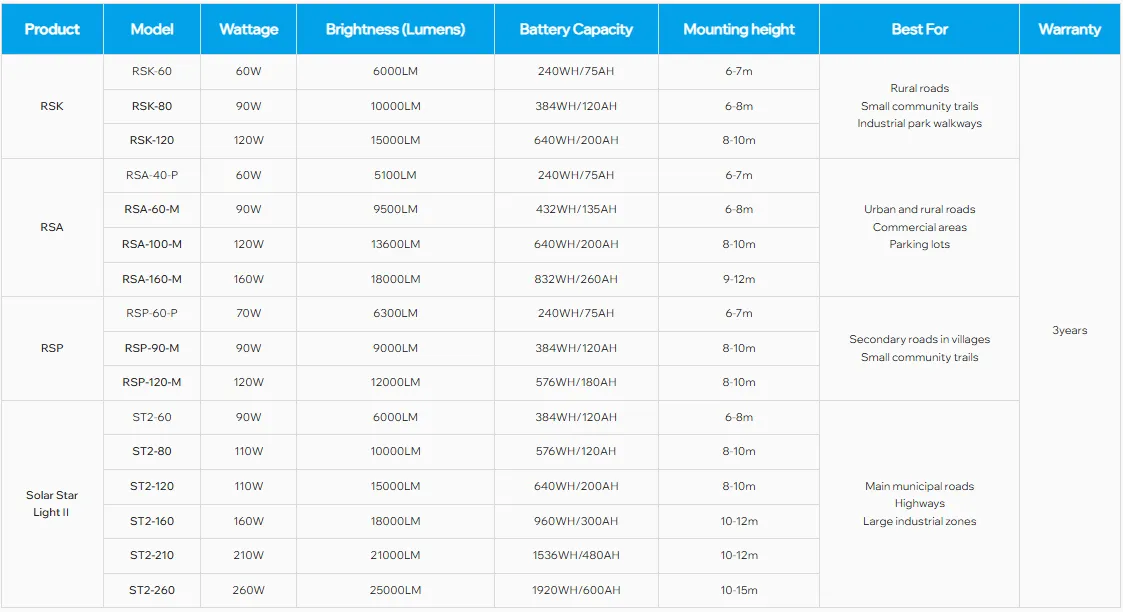
If the purchaser only tells the solar street light supplier “I want 100 pieces of 100W solar energy street lights,” it is difficult for the supplier to judge what kind of environment this batch of lights is used for. Is it a 4-meter-wide village road, or an 8-meter-wide park road? Is the light pole 5 meters or 8 meters? Does it need to be lit for 10 hours or 12 hours every day? Does the local area have continuous rainy days? All of these pieces of information will affect the final configuration.
A more professional inquiry method is to first prepare the following basic materials:
Project information | Impact on selection | Recommended content to provide |
Road width | Determines light distribution range and power demand | 4 meters, 6 meters, 8 meters, 10 meters, etc. |
Light pole height | Affects irradiation range and ground brightness | 4 meters, 6 meters, 8 meters, 10 meters |
Installation spacing | Affects lighting uniformity | 15 meters, 20 meters, 25 meters, 30 meters |
Usage scenario | Determines brightness requirements | Roads, parking lots, parks, parks, campuses |
Working time per night | Affects power consumption | 8 hours, 10 hours, 12 hours |
Sunlight conditions | Determines solar panel configuration | Average peak sunshine hours |
Backup days | Determines battery capacity | 2 days, 3 days, 5 days |
Control method | Affects energy-saving effect | Timing, segmented dimming, human body sensing, remote monitoring |
The clearer this information is, the closer the solution given by the solar street light supplier will be to the real demand. For batch projects, this step is especially important. If the preliminary parameters are unclear, the quotation may look very cheap, but later it is very easy to have problems such as insufficient illumination, insufficient battery endurance, and unreasonable installation spacing. [1]
Do not Only Look at Power, All in One LED Solar Street Lights are a System
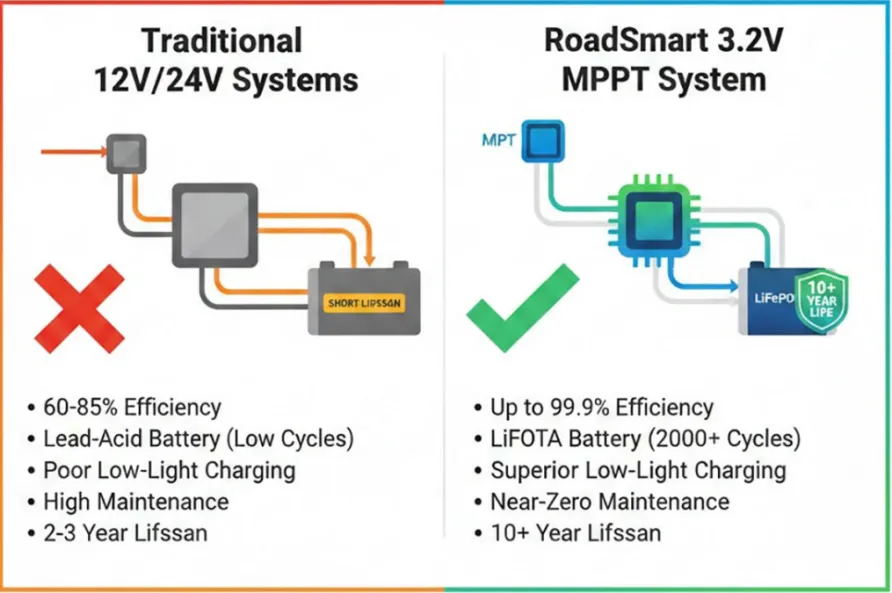
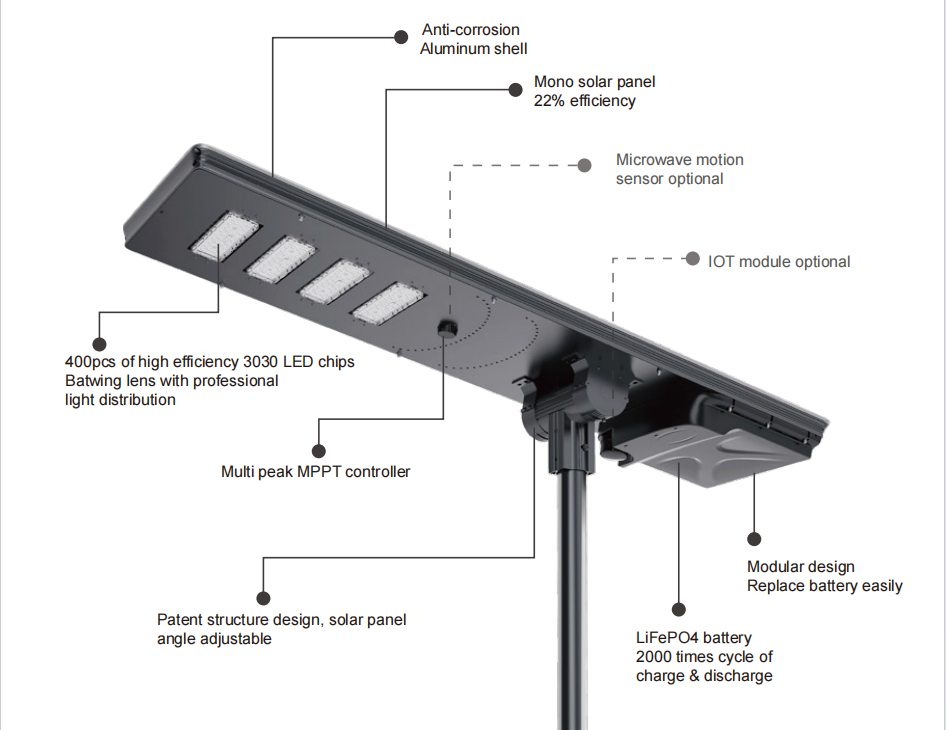
Many purchasers tend to buy solar energy street lights as ordinary LED lights, and the focus is only on “how many watts.” But all in one led solar street lights are essentially an off-grid system, and the solar panel, battery, LED, controller and lamp body structure must match each other.
The solar panel determines how much electricity can be charged during the day. Areas with sufficient sunlight can use conventional configurations, but if the project is in areas with long rainy seasons, many clouds or weak winter sunlight, the solar panel power cannot be pressed too low. If the solar panel is too small, there may be no problem on sunny days, but insufficient endurance will be exposed after continuous rainy days.
The battery determines how long it can stay lit at night, and also determines how long it can support during rainy days. When purchasing, you cannot only look at the capacity number, but also need to pay attention to the battery type, cycle life, temperature adaptability and protection system. High-temperature areas need to pay attention to battery heat dissipation and safety protection, while low-temperature areas need to consider low-temperature discharge capability.
The LED module affects actual brightness and energy consumption. It is not that the higher the power, the brighter it must be, and it also depends on luminous efficacy, lumen output, color temperature, lens and light distribution. Road lighting especially needs to pay attention to whether the light is evenly spread onto the road surface, instead of being very bright locally and very dark at the edge. [4]
The controller is the energy management core of the system. MPPT charging, overcharge and overdischarge protection, time-sharing dimming and sensing control will all affect the actual use effect. A good control system can make the electricity obtained during the day be stored and used more efficiently, instead of being simply consumed. [3]
The lamp body structure is related to long-term reliability. IP protection level, heat dissipation structure, wind resistance capability and anti-corrosion materials will all affect service life. Coastal areas need to pay attention to salt spray corrosion, dusty areas need to pay attention to sealing performance, and high-temperature areas need to focus on heat dissipation. [5]
Therefore, when purchasing all in one led solar street lights, you cannot only ask “how many watts is this lamp,” but should ask “whether this system is suitable for my site.”
The Most Common Mistakes in Bulk Purchasing All in One Solar LED Street Lights
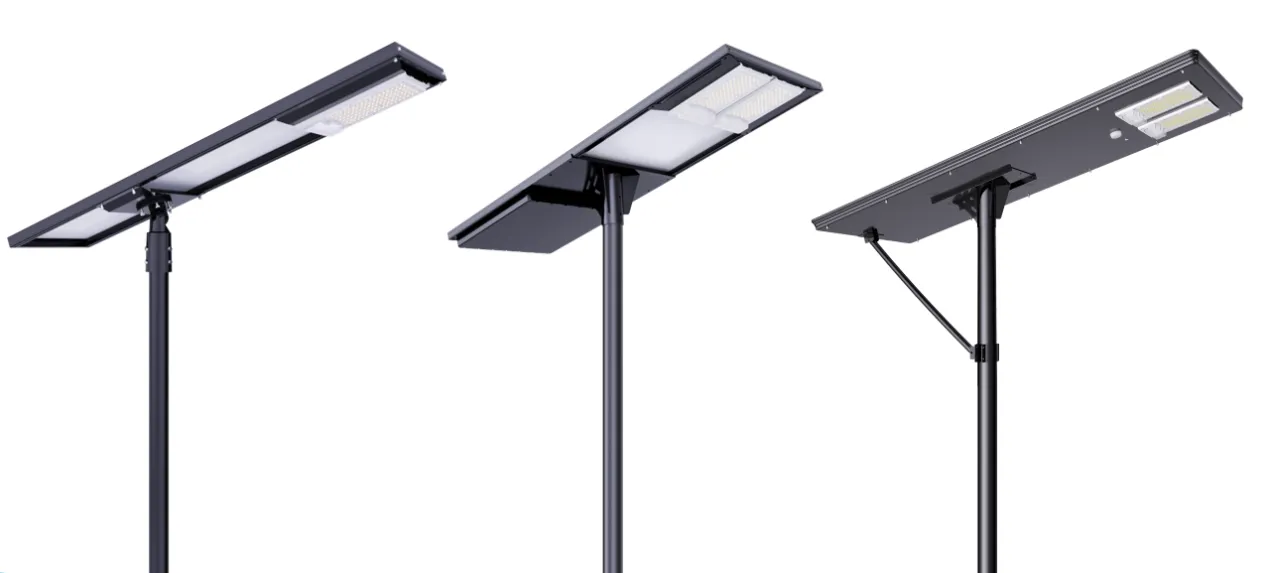
The first mistake is only comparing the price of a single light. A low price does not necessarily mean low cost. If the all in one solar street light supplier reduces the configuration in terms of battery capacity, solar panel power, controller, or housing materials, the money saved in the early stage may be spent again on later maintenance.
Request a detailed Bill of Materials (BOM) or configuration specifications and compare the total cost with similar configurations.
The second mistake is determining the power without road data. Without road width, pole height, and installation spacing, the selection of power can easily be inaccurate. A configuration that is too low will lead to insufficient lighting, while a configuration that is too high will increase unnecessary budget.
Provide at least the road width and pole height, and require the supplier to provide DIALux simulation or IES file verification.
The third mistake is ignoring the climate environment. High temperature, low temperature, rainy seasons, sand and dust, and salt spray will all affect product service life. A configuration suitable for an ordinary industrial park may not necessarily be suitable for a coastal port or desert highway.
Clearly explain the climate characteristics of the installation site to the supplier, including high temperature, low temperature, rainy season, salt spray, or sandstorm conditions.
The fourth mistake is underestimating backup days. Many solar energy street light projects operate normally on sunny days, but once continuous rainy or cloudy weather occurs, insufficient lighting duration appears. During procurement, the battery capacity and lighting mode must be confirmed according to the local weather conditions.
Request the supplier to provide configuration schemes and case studies from similar past projects to verify their engineering capabilities.
The fifth mistake is choosing a supplier without engineering support capability. A supplier that can only provide quotations but cannot give configuration suggestions can hardly support complex projects. What bulk procurement needs is not only products, but also model selection, test documents, installation suggestions, delivery plans, and after-sales communication.
Request a detailed Bill of Materials (BOM) or configuration specifications and compare the total cost with similar configurations.
How to Judge Whether an All in one Integrated Solar Street Light Supplier Is Reliable?
A reliable all in one solar street light supplier should not only provide a cheap price, but also have engineering coordination capability.
Purchasers can judge from several aspects: whether the supplier has a stable R&D team, whether it can recommend configurations according to project parameters, whether it has batch production capability, whether it has overseas project experience, whether it supports OEM/ODM, whether it can provide test reports and certification documents, whether the warranty policy is clear, and whether the after-sales response is definite.
For large-scale road, industrial park, or government projects, attention should also be paid to whether the supplier can provide long-term and stable supply. A project is often not finished after a one-time purchase. Later stages may involve replenishment, accessory replacement, system upgrades, or expansion into new areas. If the supplier lacks continuous service capability, later management costs will increase.
A truly mature all in one solar street light manufacturer does not merely sell one light, but helps the purchaser connect site conditions, lighting requirements, system configuration, and project delivery.
Supplier Quick Assessment Checklist:
Assessment Dimensions | Inspection Items | Acceptance Criteria |
R&D Capabilities | Do you have your own R&D team? Number of patents? | ≥10 patents or ≥3 years of R&D experience |
Configuration Capabilities | Can you recommend configurations based on project parameters? | Provide DIALux simulation or IES files |
Production Capacity | What is your monthly production capacity? Can you meet batch delivery requirements? | ≥5,000 sets/month |
Project Experience | Do you have similar project cases? | ≥3 similar projects |
Certifications | Are CE, RoHS, ISO, etc., complete? | At least CE+ISO |
Warranty | How long is the warranty period? Which components are covered? | ≥3-year warranty for the entire lamp |
After-Sales Service | Response time? Spare parts supply? | ≤24-hour response time |
Conclusion
Good solar energy street light procurement starts before placing an order. Solar street light procurement in 2026 should start from site conditions, and then consider system configuration, installation efficiency, climate adaptability, maintenance cost, and all in one solar street light supplier capability. Only when all these factors are matched can all-in-one solar street lights truly reduce construction complexity, improve lighting reliability, and bring long-term value to the project.
For B2B purchasers, buying all in one solar street lights is only the surface action. What they truly need to purchase is a lighting system that can operate stably in the local environment, is easy to install and maintain, and can control the total project cost.
FAQ:
Q1: What is the typical payback period for all-in-one solar street lights?
A: Typical payback is 3-5 years through electricity savings alone. After that, the system delivers free energy for its remaining 5-10 year lifespan. For projects with high electricity rates ($0.15+/kWh), payback can be under 3 years.
Q2: How do I determine the right wattage for my road?
A: Wattage alone is not enough. The right configuration depends on road width, pole height, spacing, required lux level, and local sunlight conditions. A professional supplier (like RoadSmart) will use DIALux simulation to determine the optimal configuration.
Q3: What is the difference between MPPT and PWM controllers?
A: MPPT (Maximum Power Point Tracking) controllers are 20-30% more efficient than PWM (Pulse Width Modulation) controllers, especially in low-light conditions. For commercial projects, MPPT is strongly recommended.
Q4: How many backup days do I need for my location?
A: Check your local weather data – look at the longest consecutive rainy/cloudy period in the past 3 years. RoadSmart recommends adding 1-2 days as a safety margin. Most commercial projects specify 5-7 days.
Q5: Can I mix different wattages in one project?
A: Yes, if different areas have different lighting requirements (e.g., main road vs side road). However, ensure that each configuration is independently matched to its specific site conditions.
Q6: Does RoadSmart offer sample testing before bulk orders?
A: Yes. RoadSmart supports sample orders (1-2 units) for real-world testing before bulk production. Samples can be customized to match your project specifications.
References
- Appendix A. Roadway Lighting Details, Federal Highway Administration (FHWA), Roadway Visibility Research Needs Assessment.
- Outdoor Solar Lighting, U.S. Department of Energy, Energy Saver.
- Lighting Controls, U.S. Department of Energy, Energy Saver.
- LED Lighting, U.S. Department of Energy, Energy Saver.
- Ingress Protection (IP) Ratings / IEC 60529, International Electrotechnical Commission (IEC).