Warehouse Solar Lighting: How to Choose All-in-One Street Lights for Strong Illumination, Easy Management & Cost Savings (2026)
Jul 01, 2026
Read:1073
For warehouses, logistics parks, and production factories, lighting around the park may seem like basic supporting facilities, but in fact it is directly related to site safety and operating costs. Many enterprises have long been troubled by various outdoor lighting problems: traditional municipal-powered street lights require complicated wiring construction in the early stage, and also require high electricity bills every year; ordinary split type solar street lights have scattered parts, and are extremely prone to failures in open-air environments, making later maintenance and replacement of accessories very troublesome. More importantly, many warehouses have insufficient lighting brightness at night and a large number of blind spots, which not only affects the entry and exit of trucks at night and personnel inspections, but also lays hidden security hazards and increases the risk of cargo loss and site accidents.
In such scenarios, all-in-one solar street lights have become the best choice for warehouse perimeter lighting. But many procurement and operation and maintenance personnel are prone to pitfalls when selecting models: they only look at price and power, and ignore actual lighting effects, operation and maintenance difficulty, and long-term use costs. To select solar street lights suitable for warehouse scenarios, the core only needs to focus on three key points: sufficient and uniform industrial-grade brightness, simple management capability with low burden, and cost-saving advantages throughout the full cycle. This article combines actual warehouse operation and maintenance scenarios, breaks down practical purchasing points, helps enterprises avoid selection misunderstandings, and choose all in one solar led street lighting solutions that are suitable, durable, and highly cost-effective.
Quick Specs: AIO Solar Light vs Grid Street Light vs Split Solar Light (Warehouse Scenario)
| Comparison Dimension | RoadSmart All-in-One Solar Street Light | Grid-Powered LED Street Light | Split Type Solar Street Light |
|---|---|---|---|
| Core Warehouse Applicable Zones | Perimeter walls, cargo yards, truck passages, remote storage zones | Central main gate, office square with complete power grid | Small temporary storage lots (Not recommended for long-term industrial use) |
| Site Construction Requirement | Zero trenching, no cable laying, fast pole installation | Large-scale excavation, cable, transformer, distribution box | Separate installation of panels, batteries, lamps, exposed wiring |
| Unit Equipment EXW Cost | $120–$720 (60W–260W PV panel) | $75–$300/lamp (exclude construction) | $90–$550 (scattered parts easy mismatch) |
| Full Turn-key CapEx (1km Warehouse Perimeter) | $4,100–$17,200 | $13,200–$35,000 | $6,800–$14,500 (plus later maintenance labor) |
| Compliance Standard | IEC IP66, ANSI/IES RP-8-25, CE RoHS, ISO9001 | IES RP-8-25, local industrial electrical safety codes | Only basic lighting standards, no integrated industrial anti-dust certification |
| Structural Complexity | Fully sealed integrated single unit, dustproof & anti-corrosion | Split lamp + power distribution system | Dispersed multi-part structure, multiple wiring joints |
| Core Operating Cost | Zero electricity fee, low quarterly inspection cost | Monthly fixed electricity bill + annual circuit overhaul | Frequent accessory replacement, high troubleshooting labor cost |
| Best Warehouse Match | Large logistics parks, remote factories, multi-area scattered storage zones | Central office plazas, high-traffic main gates with complete grid | Short-term temporary construction yards only |
Data Source: RoadSmart 2025–2026 Industrial Lighting Project Database, HSE Workplace Transport Lighting Standard Supplement
Note: Warehouse dust, vehicle vibration, rain & fog will aggravate failure of split solar lights and exposed grid cables; integrated AIO model minimizes outdoor failure risk.
Core Pain Points of Warehouse Outdoor Lighting
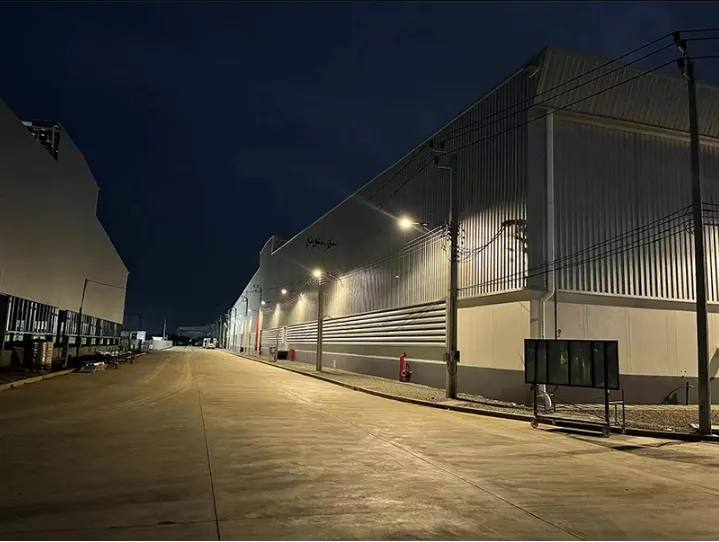
Warehouses are different from ordinary sites, with densely stacked goods, frequent vehicle traffic, and the need for 24-hour security duty, so they have extremely high requirements for the stability and coverage of lighting. Insufficient light at night and many lighting blind spots, the most direct problem is safety hazards: forklift traffic and cargo handling are prone to collisions, security personnel cannot clearly see surrounding conditions during night patrols, and blind spots along walls and corners are also prone to problems such as material theft and intrusion by outsiders. [1]
In contrast, traditional lighting solutions have long been unable to adapt to the operational needs of modern warehouses. Municipal-powered street lights not only require a large amount of construction work and high early-stage wiring costs, but the accumulated electricity bills over the years and the maintenance costs of aging lines are also fixed cost burdens for enterprises. Split type solar street lights, because photovoltaic panels, batteries, and lamps are installed separately, have many wiring points, and after long-term exposure to wind, rain, dust, and high temperatures, problems such as poor contact, battery attenuation, and lamp damage are very likely to occur, with high failure frequency and time-consuming troubleshooting, greatly increasing operation and maintenance pressure. All-in-one solar led street lights, with whole-machine integration, sealed structure, and high intelligence, are more suitable for scenarios where warehouses need long-term outdoor duty and normalized use in harsh environments, and can solve most lighting pain points from the root.
Purchasing Point One: Reject Falsely Labeled Power, and Give Priority to Real High-lumen, No-dead-angle Industrial Lighting
Many procurement selections have a typical misunderstanding: judging brightness simply by relying on lamp power, believing that the greater the power, the better the lighting effect. But in large-area outdoor warehouse scenarios, real lumen output, lighting uniformity, and effective coverage range are the core standards for measuring lighting quality, and are also the key to distinguishing industrial lamps from civilian lamps. [2]
The core needs of warehouse surrounding lighting are very clear: full coverage along walls, passages, yards, and entrances and exits, with no obvious dark areas, while providing stable fill light for surveillance cameras to ensure clear nighttime images. High-quality industrial-grade all in one solar led street lights are equipped with high-quality LED lamp beads, combined with professional optical light distribution design, so the light spreads evenly, without problems of local glare and large-area dimness, and the visual experience of driving and inspection is more comfortable.
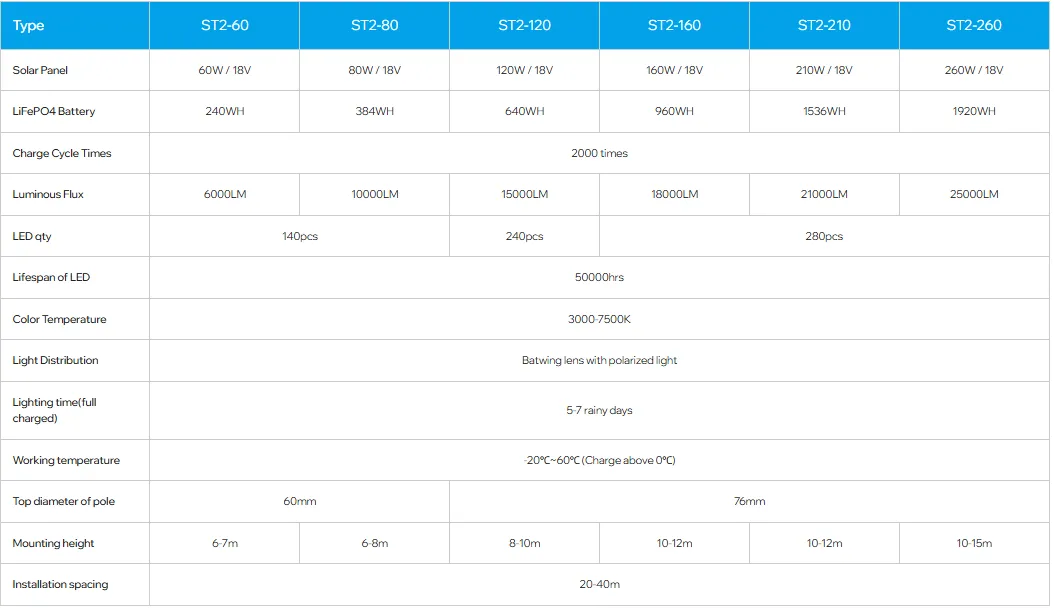
In addition, outdoor weather uncertainty in warehouses is strong, and continuous rainy days and haze weather are common. Reliable outdoor all in one solar street light models will match high-efficiency photovoltaic charging systems and large-capacity energy storage batteries, with high charging conversion rate and stable power storage, and can continue to light steadily even with no sunlight for multiple days, avoiding sudden lights-out at night and thoroughly ensuring all-weather lighting safety for warehouses. [3]
Purchasing Point Two: Focus on Low Operation and Maintenance Attributes, and Adapt to Batch Management of Large-area Warehouses
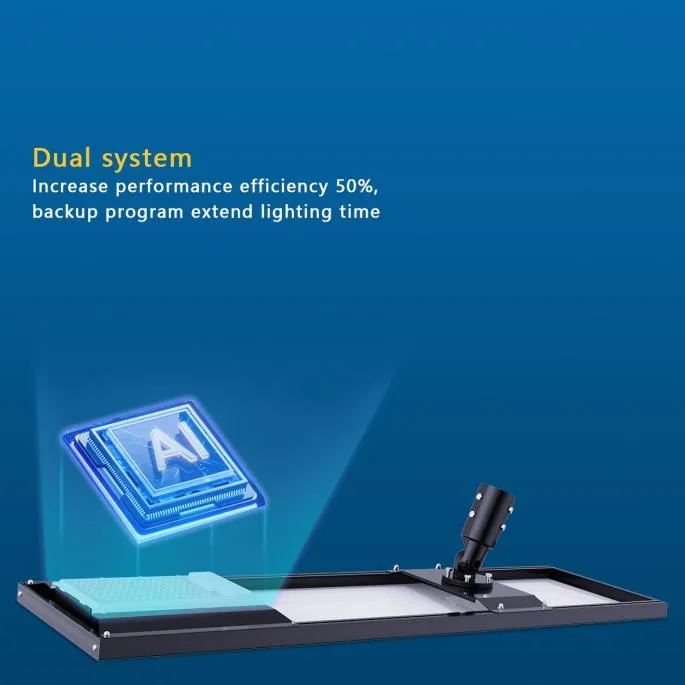
Large warehouses and logistics parks have a large number of solar street lights and scattered distribution, and if lamp operation and maintenance are complicated and control is troublesome, it will continuously consume a large amount of labor costs. Traditional street lights require manual timed switching, and after failures, they can only be checked one by one manually, which is not only inefficient, but also often causes problems such as lights not being turned on in time, forgetting to turn off lights late at night, and failures remaining undiscovered for a long time, bringing a great burden to daily operation and maintenance.
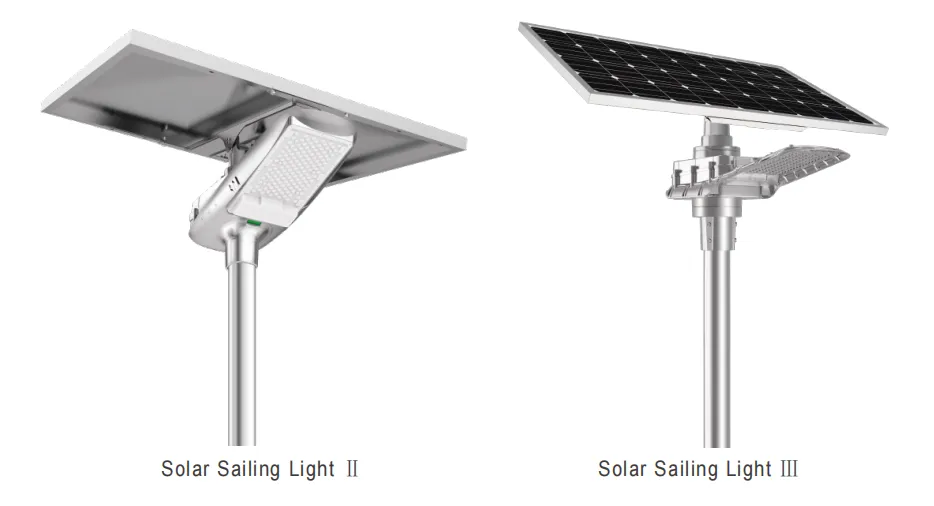
One of the biggest advantages of all in one solar led street lights is intelligence and low maintenance. The whole machine adopts an integrated design, with no exposed scattered accessories, strong sealing, dustproof, waterproof, and anti-aging performance, stronger outdoor durability, and greatly reduced failure probability. In terms of functions, it is equipped as standard with fully automatic light control and time control modes, which can automatically start and stop according to ambient brightness, requiring no manual intervention and adapting to warehouses’ all-weather lighting needs. [4]
For warehouse energy-saving and security needs, most high-quality models also support human-body sensing dimming: when there are no people or vehicles, they automatically reduce power and enter standby to reduce energy consumption; when people or vehicles are detected passing through, they immediately provide high-brightness fill light, balancing safety and energy saving. Some models suitable for large parks also support batch cluster management and fault self-checking warnings, so all in one solar led street light operation and maintenance personnel do not need to check lights one by one on site and can quickly locate faulty equipment, greatly simplifying the management process and adapting to the rhythm of efficient industrial operation and maintenance. [5]
Purchasing Point Three: Calculate the Full-cycle Cost Clearly, One-time Investment Saves Money in the Long Term
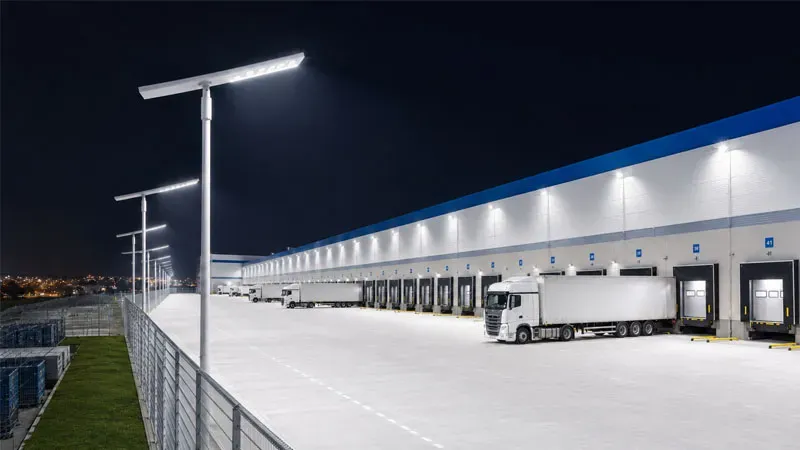
Warehouse lighting is a long-term continuous project, and model selection cannot only look at the initial purchase price, but must also calculate the comprehensive cost of the full life cycle. Many low-priced lamps seem to save money, but their failure rate is high, power consumption is high, and replacement is frequent, and the long-term accumulated hidden costs far exceed the equipment itself.
The cost-reduction advantages of all in one solar lights are reflected in multiple dimensions: relying on solar energy for self-generation, daily use has zero electricity cost; no need to lay cables and no need for civil engineering trenching, greatly saving early-stage construction and material costs. The integrated sealed structure has strong weather resistance, adapts to outdoor wind, rain, high temperature, and dust environments, and the batteries and lamp beads have long service lives, almost requiring no frequent replacement of accessories, completely saving various costs such as traditional lamp line maintenance, accessory replacement, and regular inspections.
Overall, this type of all in one solar light belongs to a one-time investment, with long-term maintenance-free use and zero energy consumption, and a short payback period. For warehouses and factory parks that need stable lighting all year round, it is a long-term lighting solution with extremely high cost performance.
Summary
The purchase of all-in-one solar street lights around warehouses is not about choosing parameters or competing for low prices, but about matching the real needs of industrial scenarios. First, priority should be given to ensuring high-lumen, no-dead-angle safe lighting effects; second, attention should be paid to intelligent maintenance-free lightweight management capability; finally, full-cycle cost savings should be considered. Grasping these three core points can help avoid falsely labeled, low-configuration, and non-durable inferior products on the market, and select professional all in one solar street lighting equipment that truly adapts to warehouse operations, is worry-free, and saves money.
FAQ
Q1: Can industrial AIO solar lights keep bright for continuous rainy days in humid factory areas?
A: RoadSmart industrial series equipped with multi-peak MPPT controller and large-capacity LiFePO4 battery, standard configuration stably light for 5-7 consecutive cloudy/rainy days; customized large battery version support 10 days, adapt to southern rainy industrial zones.
Q2: Is the illumination enough for forklift driving and surveillance camera night shooting?
A: Adopt industrial bat-wing optical lens, uniform light without glare, eliminate dark blind spots at wall corners and lane bends, luminous flux range 4,000–25,000LM optional, fully meet ANSI/IES industrial yard lighting safety standards and camera fill light demand.
Q3: How long is the average payback period for warehouse perimeter solar lighting projects?
A: For a 1–3km complete perimeter lighting project, average payback cycle 8–22 months, rely on zero electricity cost and reduced maintenance labor to offset one-time equipment investment.
Q4: Can RoadSmart customize solar lights for chemical / coastal anti-corrosion warehouse environments?
A: Support full ODM/OEM customization: anti-salt fog coating, increased battery capacity, adjusted mounting height and luminous flux, matching chemical plant, port warehouse special harsh environment demands.
Q5: What certifications are required for industrial solar lighting to pass factory bidding?
A: RoadSmart full set CE, FCC, RoHS 2.0, ISO9001, IP65 waterproof & dustproof test reports, fully meet domestic and overseas industrial park bidding qualification requirements.
Q6: Can the lighting layout be adjusted after installation when warehouse expands storage yards?
A: Yes, no cable limitation, only fixed by light pole; whole lamp can be disassembled and relocated freely, adapt to dynamic expansion of warehouse storage areas.
References
- Lighting - Workplace Transport Factsheets, Health and Safety Executive (HSE).
- ANSI/IES RP-8-25, Recommended Practice: Lighting Roadway and Parking Facilities, Illuminating Engineering Society (IES).
- Outdoor Solar Lighting, U.S. Department of Energy, Energy Saver.
- Ingress Protection (IP) Ratings, International Electrotechnical Commission (IEC).
- Lighting Controls, U.S. Department of Energy, Energy Saver.