How IoT Powers Smart City Street Lighting Networks
Feb 26, 2026
Read:1915
Source: Yin Zhenkun
IoT smart street lighting connects LED street lights, controllers, sensors, communication networks, and management software into one intelligent lighting system. Instead of relying only on fixed timers or manual inspections, city operators can monitor lighting status, adjust dimming schedules, receive fault alerts, and manage energy use remotely.
For solar street lighting projects, IoT also helps monitor battery status, solar charging performance, lighting hours, and system health. This makes it useful for municipal roads, highways, campuses, industrial zones, parking lots, and remote off-grid areas.
What Is IoT Smart Street Lighting?
IoT smart street lighting uses connected devices to make outdoor lighting easier to monitor, control, and maintain. In a traditional lighting system, each street light often works as a separate asset. In an IoT-enabled network, each light can send data, receive commands, and respond to real operating conditions.
A modern smart street lighting system usually includes LED luminaires, smart controllers, sensors, wireless communication, and a central management platform. Together, these parts allow operators to manage lighting by road section, project zone, fixture group, or individual light.
Compared with simple on/off control, IoT lighting gives project owners better visibility into energy use, equipment status, maintenance needs, and long-term system performance.
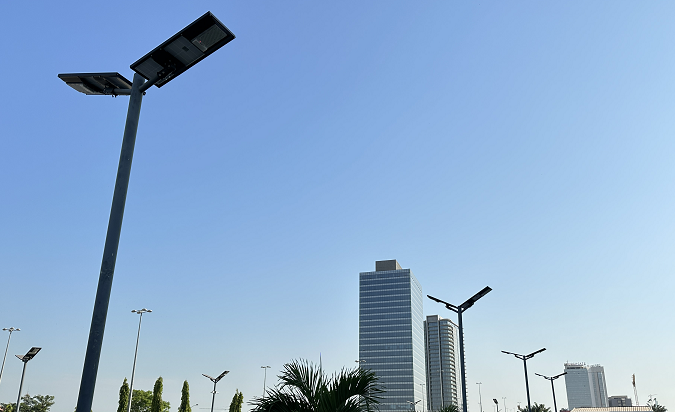
How IoT Works in a Smart Street Lighting Network
An IoT street lighting network is usually built in several layers. Each layer has a different role, from collecting field data to sending commands and displaying information in the software dashboard.
1. Connected Street Lights
At the field level, each LED street light can be equipped with a controller node, such as a NEMA or Zhaga controller. This controller allows the fixture to receive remote commands and send operating data back to the system.
2. Sensors and Local Control
Motion sensors, ambient light sensors, traffic sensors, and environmental sensors can help the lighting system respond to real conditions. For example, lights can dim during low-traffic hours and return to higher brightness when vehicles or pedestrians are detected.
3. Wireless Communication Network
Communication technologies such as LoRaWAN, NB-IoT, Zigbee, 4G, and other wireless networks can transfer data between field controllers and the management platform. The best choice depends on project scale, coverage, terrain, signal availability, and local network conditions.
4. Central Management Platform
The management platform is where operators view lighting assets, check device status, adjust dimming schedules, receive fault alerts, and analyze system performance. It turns scattered field devices into a manageable lighting network.
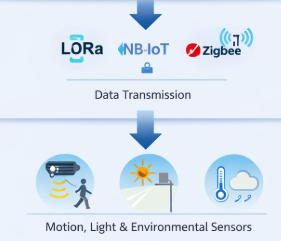
Key System Layers of IoT Street Lighting
Field Devices: LED street lights, solar controllers, batteries, sensors, and communication nodes installed on-site.
Communication Layer: Wireless networks that transmit device data and control commands between street lights and the platform.
Software Platform: A dashboard for monitoring, control, fault alerts, reports, grouping, scheduling, and maintenance records.
Project Management: Operational workflows for maintenance teams, municipal managers, contractors, and system administrators.
Core Benefits of IoT Smart Street Lighting
Remote Monitoring and Control
Operators can check the status of lighting assets without visiting every pole. They can view online or offline status, adjust brightness levels, set lighting schedules, and manage different road sections from one platform.
Adaptive Dimming
IoT lighting can support dimming schedules based on time, traffic, or motion detection. This helps reduce unnecessary energy use while still supporting safety requirements during active hours.
Maintenance Alerts
A smart street light control system can send alerts when a fixture, controller, battery, communication node, or power component has an issue. This helps maintenance teams locate problems faster and reduce unnecessary field inspections.
Energy and Performance Data
The platform can record operating hours, energy use, dimming status, battery information, and device performance. This data helps project owners evaluate system operation and plan maintenance more efficiently.
Scalable Smart City Infrastructure
Street light poles are widely distributed across cities and roads. Once connected, they can become useful infrastructure for additional smart city functions, such as environmental sensors, traffic monitoring, cameras, or other urban devices where project conditions allow.
IoT for Solar Powered Smart Street Lights
IoT is especially useful for solar powered smart street lights because solar systems depend on battery capacity, solar charging, local weather, and energy management. Remote monitoring helps operators understand whether the system is charging properly, discharging normally, and meeting the required lighting schedule.
In a solar smart street lighting project, IoT can help monitor:
- Solar panel charging status
- Battery state of charge
- Controller performance
- Lighting duration and dimming schedule
- Fault alarms and offline devices
- System operation in cloudy or rainy periods
This is valuable for highways, remote roads, industrial parks, campuses, and off-grid projects where manual inspection is difficult or time-consuming.
Common Applications
Municipal Roads
IoT smart street lighting helps cities monitor lighting assets, manage dimming schedules, and improve maintenance visibility across different road sections.
Highways and Main Roads
For long road sections, remote monitoring can help reduce inspection difficulty and make it easier to identify faults or abnormal operation.
Campuses and Industrial Zones
Campuses, factories, logistics parks, and industrial roads can use smart lighting to manage outdoor areas by zone, schedule, or traffic pattern.
Parking Lots and Public Spaces
Parking lots, parks, and public areas can use dimming and motion sensing to balance safety, comfort, and energy use.
Remote and Off-Grid Projects
Solar IoT lighting is suitable for locations where grid power is limited and regular site inspection is costly, such as rural roads, construction areas, and remote communities.
What to Consider Before Starting an IoT Street Lighting Project
A successful IoT smart street lighting project requires more than choosing a controller. The system should match the project location, communication environment, lighting requirements, and operation plan.
- Communication coverage: Check whether LoRaWAN, NB-IoT, 4G, Zigbee, or another network is suitable for the site.
- Control level: Decide whether the project needs individual light control, group control, or zone-based control.
- Lighting strategy: Define dimming schedules, motion sensor logic, operating hours, and safety requirements.
- Solar system compatibility: For solar projects, confirm controller, battery, and monitoring compatibility before installation.
- Software usability: The dashboard should be clear for operators, maintenance teams, and project managers.
- Cybersecurity: Cloud-connected municipal systems should use secure access control, encrypted communication, and reliable update management.
- Future expansion: Consider whether the system may later connect more lights, sensors, cameras, or other smart city devices.
FAQ About IoT Smart Street Lighting
What is IoT smart street lighting?
IoT smart street lighting is a connected lighting system that uses controllers, sensors, wireless communication, and software to monitor and manage street lights remotely.
How does IoT reduce street lighting maintenance?
IoT systems can send fault alerts, show device status, and help maintenance teams locate problems before sending technicians to the site. This can reduce unnecessary inspections and improve maintenance planning.
Can IoT be used with solar street lights?
Yes. IoT can help monitor solar panel charging, battery status, lighting schedules, controller performance, and system faults in solar street lighting projects.
Which communication technologies are used?
Common options include LoRaWAN, NB-IoT, Zigbee, 4G, and other wireless networks. The best choice depends on project scale, coverage, terrain, and local network availability.
Is IoT smart street lighting suitable for highways and municipal roads?
Yes. It is suitable for highways, municipal roads, campuses, industrial zones, parking lots, and smart city lighting projects that need remote control and maintenance visibility.
Conclusion
IoT smart street lighting helps cities and project owners move from basic illumination to connected lighting management. By combining street lights, controllers, sensors, communication networks, and software, operators can monitor system status, adjust lighting schedules, receive fault alerts, and improve maintenance workflows.
For solar street lighting projects, IoT also adds visibility into battery health, charging performance, and long-term system operation. This makes it a useful tool for municipal roads, highways, campuses, industrial zones, and remote off-grid lighting projects.
Planning an IoT Smart Street Lighting Project?
Tell us your road type, lighting requirements, control needs, and project location. Our team can help recommend a suitable smart solar street lighting solution.
Ask a Lighting Expert