How to Choose Waterproof Solar Garden Lights for Rainy, Coastal and Flood-Prone Areas?
Jul 27, 2026
Read:790
Quick Answer
On a typical garden path or in a residential landscape project, most buyers start with IP65. If the site takes hard rain, open wind exposure, or repeated storm weather, IP66 is usually the more realistic choice. If the fixture may sit near standing water, or there is any real chance it could be temporarily submerged, then it makes sense to evaluate the complete light at IP67 level.
Still, that kind of answer is only useful up to a point. In actual projects, lights rarely fail because someone picked the wrong IP number in isolation. They fail because one detail gets overlooked. Maybe the cable entry is exposed. Maybe the connector sits too low. Maybe water keeps collecting around the base after every storm. That is usually how the problem starts.
Introduction
When a solar garden light stops performing outdoors, the explanation people reach for is usually the same: "the waterproofing wasn't good enough." Sometimes that is true. But when you look closer, the failure point is often much more ordinary. Water gets in through a cable gland that looked fine during installation. Moisture stays trapped because there is nowhere for it to escape. A connector starts corroding months before the housing shows any obvious damage. In coastal projects, salt often starts the trouble before rain gets blamed.
This is also where buyers get tripped up by clean-looking product specs. A fixture can look convincing in a catalog, carry a respectable IP rating, and still become a maintenance problem after one wet season. On paper, it passes. In the field, it fogs, corrodes, or starts failing at the weakest point.
We see this most often in two types of projects. One is the landscaped pathway where the fixture itself is decent, but the base sits in shallow pooled water after every storm. The other is the coastal walkway where the housing still looks acceptable after a few months, but the connectors and fasteners have already started aging faster than expected. In both cases, the brochure spec was not exactly wrong. It just was not enough.
That is why the more useful question is not simply, "Is this light waterproof?" It is, "Where is this product likely to fail first, and does the design actually fit the site I am working with?"
This guide takes that practical route. Instead of treating waterproofing as one headline feature, it breaks the decision into the things buyers really have to judge: IP rating, sealing, drainage, anti-fogging design, corrosion resistance, and installation risk in rainy, coastal, and flood-prone environments.
What Makes a Solar Garden Light Truly Waterproof?
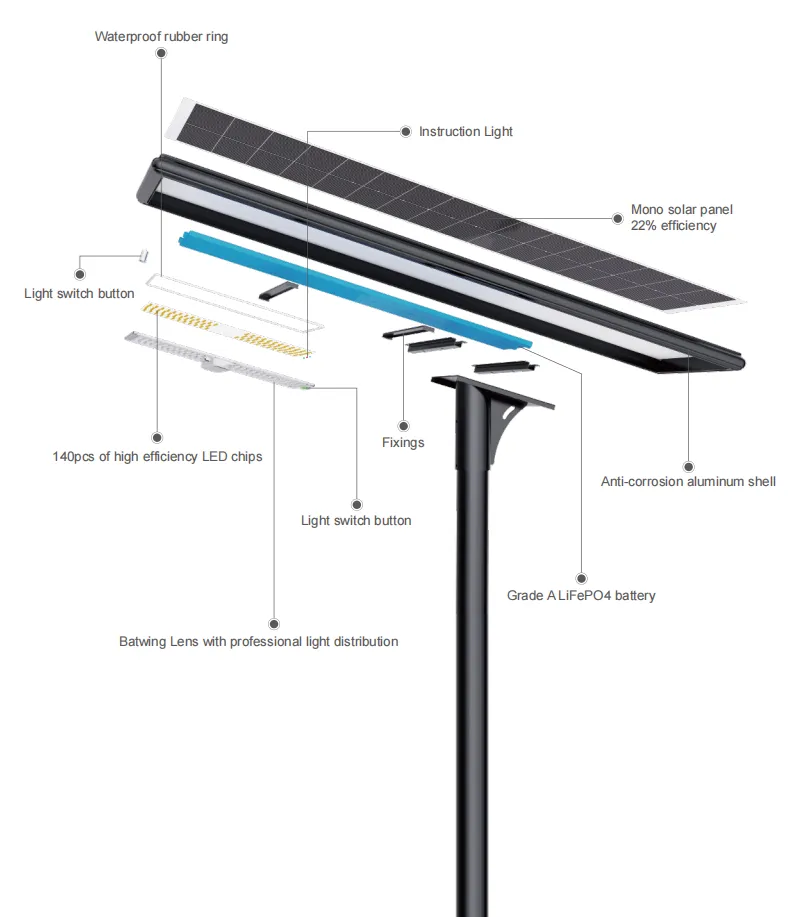
A waterproof solar garden light is not simply a fixture with a little sealant added around a few joints. It is a system designed to keep the LED, controller, battery, connectors, and internal wiring protected under defined outdoor conditions.
That protection usually depends on several parts working together:
· Sealing at joints, covers, and cable entry points
· A housing structure that minimizes weak openings
· Drainage paths that prevent standing water from staying inside or around the fixture
· Pressure-balancing components that reduce condensation
· Connectors and fasteners that can survive the actual outdoor environment
In other words, reliable waterproofing comes from system design, not from one badge on a specification sheet.
Why IP Rating Alone Is Not Enough?
IP ratings matter, but they do not answer every field-performance question.
An IP test measures enclosure protection under defined test conditions. In practice, buyers should read that claim against the IEC 60529 IP Code standard, not as a blanket promise about every outdoor condition. What it does not tell you, at least not by itself, is how the product will handle salt spray, long-term UV exposure, aging gaskets, poor cable routing, imperfect assembly, installation damage, or standing water around the pole base. Two products labeled IP66 can still perform very differently after one or two rainy seasons.
This matters even more in B2B procurement. Buyers often compare a few fixtures that look almost identical on paper, only to find later that connector quality, housing deformation, fogging, or corrosion was the real difference between them.
A more useful way to think about it is this: treat the IP rating as the entry requirement, then evaluate the full waterproof system around it.
In a real project, maintenance teams do not care whether the spec sheet looked convincing six months earlier. They care which part failed, how often it failed, and whether the issue could have been avoided during selection.
What Are the Differences Between Common IP Protection Ratings?
IP ratings indicate the degree of protection provided by an enclosure against dust and water ingress. Common ratings for solar garden street lamps include IP44, IP65, IP66 and IP67.
IP Rating | Main Protection Capability | Typical Applications |
IP44 | Protection against general splashing water | Decorative lights with shelter |
IP65 | Dustproof and protected against water jets | Ordinary gardens and community pathways |
IP66 | Dustproof and protected against powerful water jets | Heavy rain and wind-driven rain areas |
IP67 | Short-term immersion under specified conditions | Areas with occasional water accumulation |
For most ordinary outdoor environments, IP65 can usually meet daily rainfall requirements; when heavy rain is frequent or the light is fully exposed, IP66 can be given priority.
IP67 does not mean that the product can remain submerged for a long time; it only means that the product can withstand short-term immersion at a specified depth and for a specified period.
It should also be noted that a high IP rating does not mean that the solar garden street light is necessarily resistant to salt spray or corrosion. Coastal projects also need to check the metal materials, surface coatings, stainless steel fasteners and salt spray test results. [3]
The specification is only useful if you know what to ask next.
Before relying on an IP claim, confirm:
·Whether the rating applies to the complete fixture, not just one component.
·Whether external connectors have the same protection level as the lamp body.
·Whether the test report covers the finished product configuration.
·Whether gaskets, cable glands, and compartment covers are part of the tested assembly.
·Whether the supplier can explain what the rating does not cover.
That last point matters more than it may seem. A reliable supplier should be able to explain where the product is suitable, where it is not, and what extra protection is still needed in coastal or flood-prone conditions.
Design Features That Actually Affect Waterproof Reliability
Several design details usually matter more in practice than buyers expect.
Sealing rings and gasket compression
Good gasket material is not enough if compression is uneven. If screws are tightened inconsistently, or the sealing ring twists during assembly, leakage can still happen anyway.
Housing design
Die-cast aluminum housings usually help because they reduce unnecessary joints and support better heat dissipation. But buyers should not assume that "die-cast" automatically means the whole fixture is sealed well. Covers, lenses, sensors, and cable entries still need their own reliable protection.
Cable routing and connector protection
Rainwater tends to follow the easiest path. If cables are routed upward or connectors are left in weak positions, water can travel along that path straight into the system.
Pressure balancing and anti-fogging
Outdoor fixtures heat up during the day and cool down at night. Over time, that repeated expansion and contraction can create internal condensation if the light has no effective pressure-balancing design. This is one reason buyers in humid climates sometimes look at test references such as IEC 60068-2-30 damp heat testing instead of relying on IP claims alone.
Drainage
Even a well-sealed fixture benefits from smart drainage design. Water should be guided away from vulnerable points, not allowed to sit around joints, screws, or pole-base components.
How to Select Solar Garden Lights Outdoor for Different Environments?
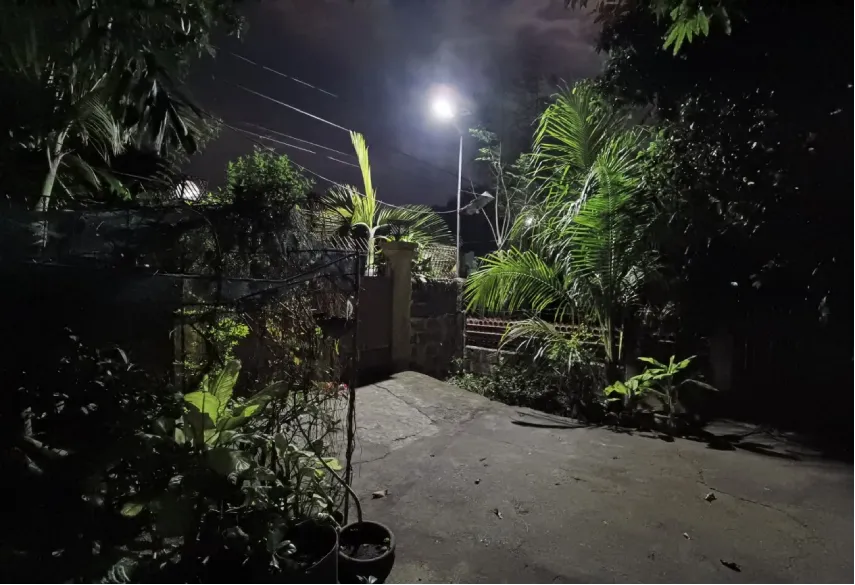
Ordinary Gardens and Residential Pathways
Common problems include daily rainfall, sprinkler irrigation and repeated contact between the solar garden lights outdoor and surface water accumulation. Generally, selection can begin with IP65 solar garden light products, with a focus on checking the die-cast aluminum housing, waterproof connectors and complete sealing rings. The olar garden lights outdoor should avoid long-term direct spraying from sprinklers, and the light pole foundation should preferably be slightly higher than the surrounding ground.
Areas with Heavy Rain and Wind-Driven Rain
Strong winds can push rainwater toward lampshade joints, sensors and the top of the solar garden street light pole from multiple directions. It is recommended to prioritize IP66 solar garden street lamps and check the sealing structures of the compartment covers, sensor openings and connectors. When there are many consecutive rainy days, the solar panel and battery capacity also need to be increased, because waterproofing cannot solve the decrease in endurance caused by low sunlight.
Around Fountains and Water Features
Continuous mist and repeated splashing are more likely than ordinary rainfall to keep lights in a high-humidity condition for long periods. When outside the direct spray range, IP66 solar garden lights can be selected; if there is direct water impact or short-term water accumulation, the IP67 rating of the complete light should be evaluated. Dedicated low-voltage underwater lights must be used inside pools, and ordinary solar garden lights cannot be used as substitutes.
Coastal and Island Areas
The main risk here is not only rainwater, but also the continuous corrosion of housings, fasteners and electrical contacts caused by salt spray.
In addition to IP65 or IP66 solar garden street lamps, the salt spray test, anti-corrosion coating, aluminum alloy surface treatment and stainless steel fasteners should also be checked. The solar panel junction box and cable connectors must also have corresponding corrosion resistance.
Areas Prone to Water Accumulation or Flooding
The greatest risk is that the water level may reach the bottom of the light pole, battery compartment, controller and external connectors. The effective approach is not simply to increase the IP rating of the solar garden street light, but to raise the foundation and install the electrical components above the expected highest water level. For occasional short-term water accumulation, the IP67 rating of the complete light can be evaluated; areas that frequently experience flooding require elevated electrical compartments, reinforced foundations and specialized flood protection designs. [5]
Application Environment | Recommended Starting Protection | Additional Considerations |
Ordinary garden | IP65 | Sprinkler irrigation, foundation drainage |
Open park areas | IP65/IP66 | Heavy rain, wind resistance, UV exposure |
Fountain surroundings | IP66 | Water mist, direct splashing |
Coastal areas | IP66 | Salt spray, corrosion protection, fasteners |
Short-term water accumulation areas | IP67 or elevated installation | Full fixture certification, highest water level |
High flood-risk areas | Customized design | Electrical compartment height, foundation safety |
A Simple Rule Buyers Can Use
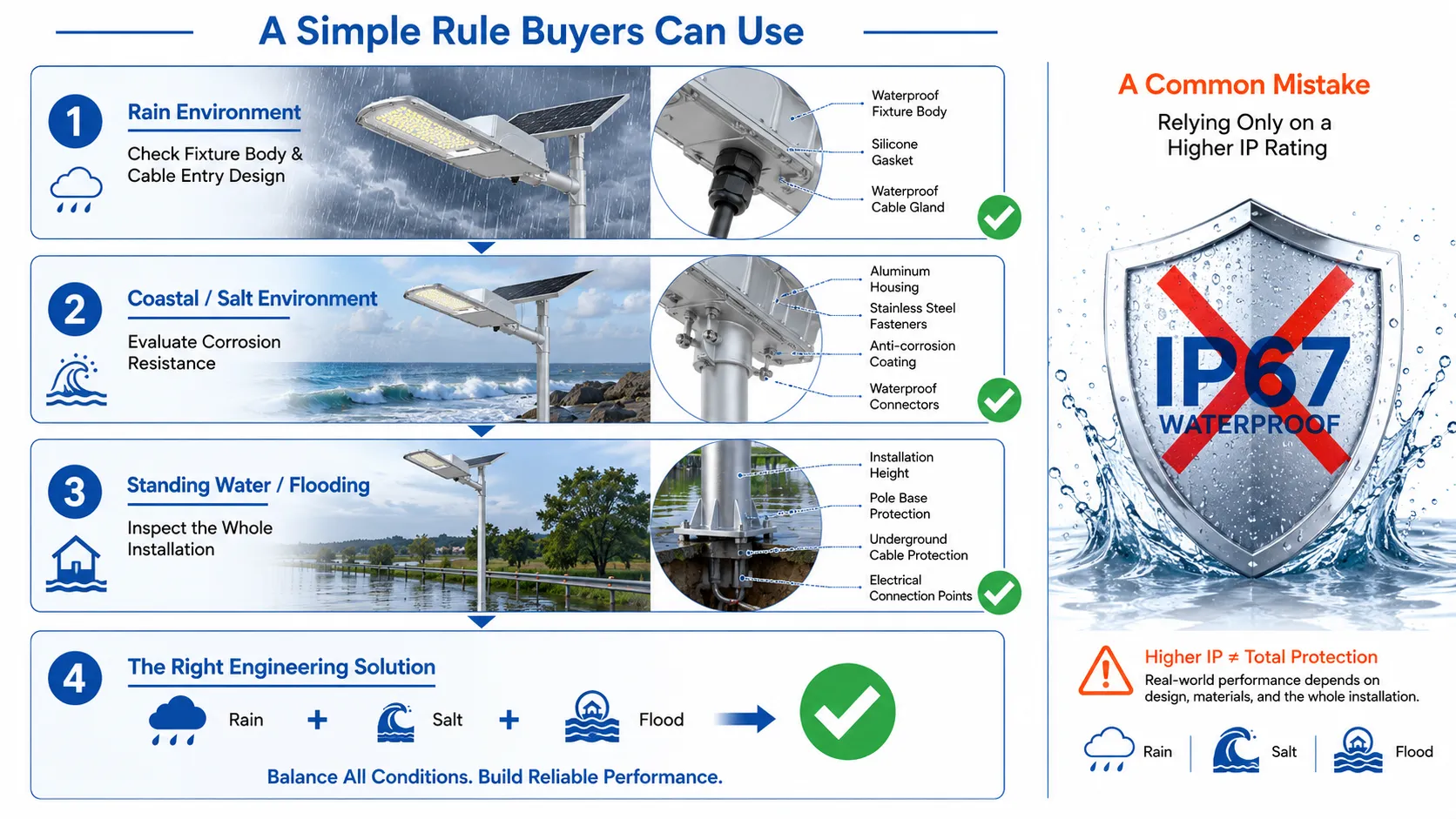
If the site is mainly dealing with rain, start by asking whether the fixture body and cable-entry design are strong enough.
If the site is dealing with salt, ask how the metal parts, connectors, and coatings will age.
If the site is dealing with standing water, stop focusing only on the lamp head and look at the whole installation height, including the base and electrical connection points.
That sequence sounds simple, but it helps buyers avoid a common mistake: trying to solve three different environmental problems with one higher IP label.
Quick Selection Guide
· Choose IP65 first for standard gardens, pathways, and light residential landscape projects with ordinary rain exposure.
· Prioritize IP66 for fully exposed projects in heavy-rain or storm-prone conditions.
· Evaluate IP67 only when short-term immersion or water accumulation is a realistic risk.
· For coastal sites, always pair IP selection with corrosion-resistance review.
· For flood-prone sites, review foundation height and electrical-compartment position before relying on a higher IP grade.What Buyers Should Check Before Ordering?
Before placing an order, project buyers should confirm more than the marketing label.
Use this checklist:
· IP rating of the complete light
· Protection level of external connectors
· Housing material and surface treatment
· Gasket quality and sealing structure
· Drainage design
· Pressure-balancing or anti-fogging design
· Salt spray resistance for coastal projects
· Foundation height and installation method for flood-risk areas
· Battery endurance during consecutive rainy days
· Replaceability of controller, battery, and connectors for long-term maintenance
This is where the buying conversation usually becomes more realistic. The more demanding the site is, the less useful it becomes to compare products only by wattage and headline IP claims.
If buyers want a baseline for outdoor product safety and testing language, it also helps to compare supplier claims against UL guidance for landscape and outdoor lighting, especially when different vendors describe waterproofing in very different ways.
Common Mistakes in Waterproof Solar Light Procurement
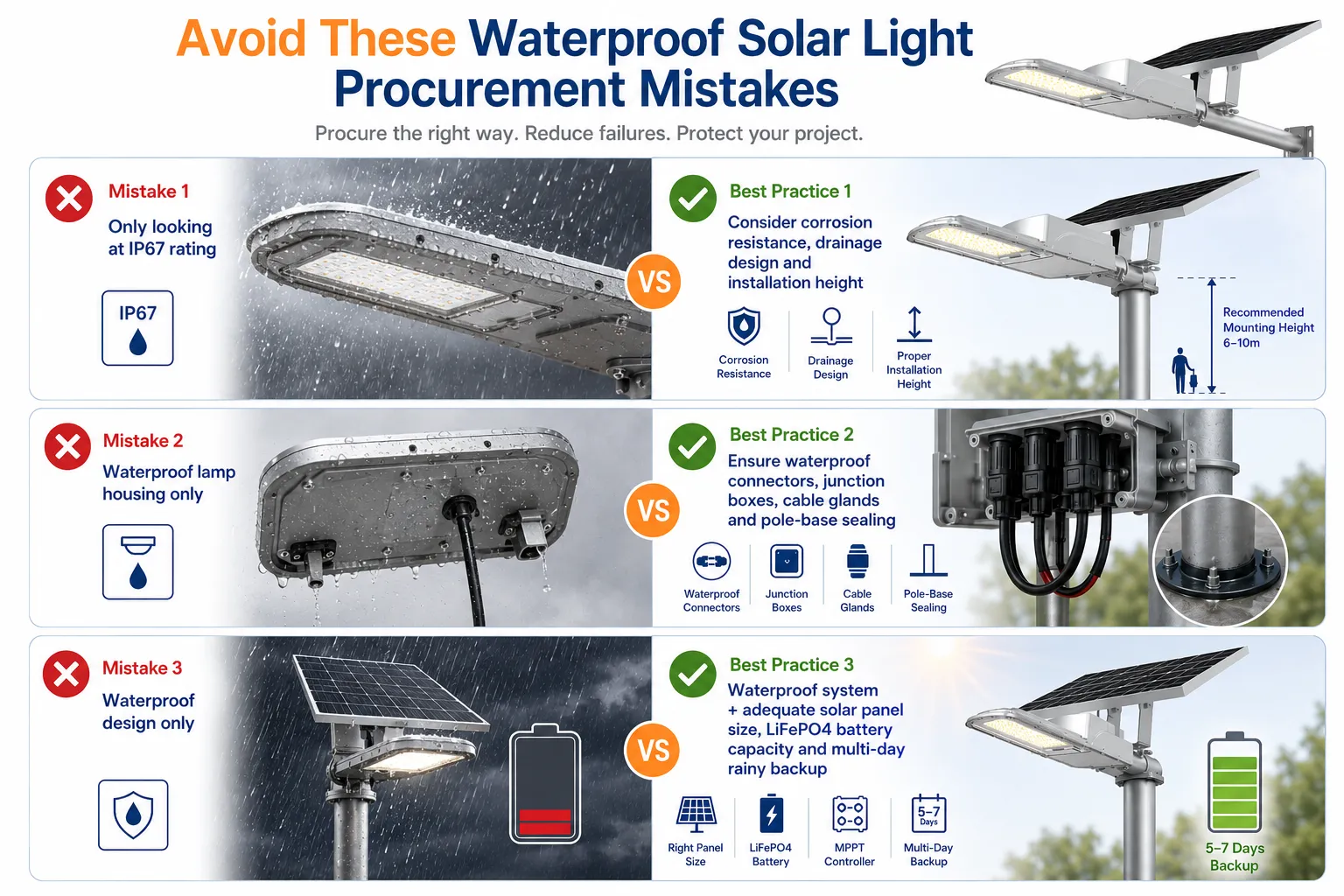
One common mistake is assuming that IP67 is always the best option. In many standard outdoor projects, it is unnecessary and distracts buyers from more practical issues like corrosion, drainage, or installation height.
Another mistake is focusing only on the lamp body while ignoring connectors, junction points, and the pole-base environment. A well-sealed head assembly can still fail if water reaches weak external electrical points.
A third mistake is overlooking the relationship between weather and runtime. In rainy regions, waterproofing alone is not enough. The system also needs enough solar input and battery capacity to keep operating through low-sunlight periods.
FAQ
Is IP65 enough for residential pathway projects?
Usually yes, as long as the site mainly deals with ordinary rainfall and does not involve regular standing water, direct pressure spraying, or unusually severe weather exposure.
When should buyers move from IP65 to IP66?
When the project is fully exposed, located in a heavy-rain region, or regularly affected by wind-driven rain from multiple directions.
Is IP67 necessary for every outdoor project?
No. IP67 is mainly relevant when short-term immersion or significant water accumulation is a realistic possibility. It is not automatically necessary for ordinary garden or pathway use.
Is a high IP rating enough for coastal installations?
No. Coastal projects also need strong corrosion resistance, suitable coatings, stainless hardware, and connector durability under salt spray conditions.
Why do waterproof solar lights still fog internally?
Internal fogging can be caused by temperature differences, trapped assembly moisture, aging seals, or poor pressure balancing, even when the fixture itself carries a strong IP claim.
Conclusion
Choosing waterproof solar garden lights is not just a matter of selecting the highest IP number. The right choice depends on the environment, the actual water exposure pattern, the corrosion risk, and whether the fixture is designed as a complete outdoor system rather than simply a sealed shell.
For ordinary garden paths, IP65 may be enough. For storm-prone open exposure, IP66 is often the better fit. For areas with real temporary immersion risk, IP67 may need to be evaluated. But in every case, buyers should still look at sealing quality, drainage, pressure balancing, connector protection, corrosion resistance, and site-specific installation details.
RoadSmart can help evaluate these factors based on rainfall pattern, salt spray exposure, water-accumulation risk, installation height, and runtime requirements, then recommend a solar garden lighting configuration that is a better fit for the actual project.
References
- Outdoor Solar Lighting, U.S. Department of Energy, Energy Saver.
- Landscape and Outdoor Lighting, UL Solutions.
- IEC 60529: Degrees of Protection Provided by Enclosures (IP Code), International Electrotechnical Commission (IEC).
- IEC 60068-2-30: Environmental Testing, Damp Heat, Cyclic, International Electrotechnical Commission (IEC).
- ISO 9227: Corrosion Tests in Artificial Atmospheres - Salt Spray Tests, International Organization for Standardization (ISO).