Are Solar Garden Street Lights Suitable for Residential Communities and Villas?
Jul 20, 2026
Read:534
Quick Answer
Yes. Solar garden street lights can be used on internal roads in residential communities, park pathways, building entrances and parking areas, and can also be installed in villa courtyards, driveways, gates and garden paths.
They can provide off-grid and environmentally friendly lighting solutions, achieve power supply without trench excavation, and effectively reduce electricity expenses; they operate completely independently of the main power grid and can ensure continuous lighting for sidewalks and driveways during power outages. Especially in European and American regions where electricity prices and underground wiring costs are relatively high, solar garden street lights can reduce the dependence of community public lighting on the power grid and save electricity costs. Some products can also integrate security cameras, motion sensors and IoT communication modules, combining lighting, security and remote management.
Introduction
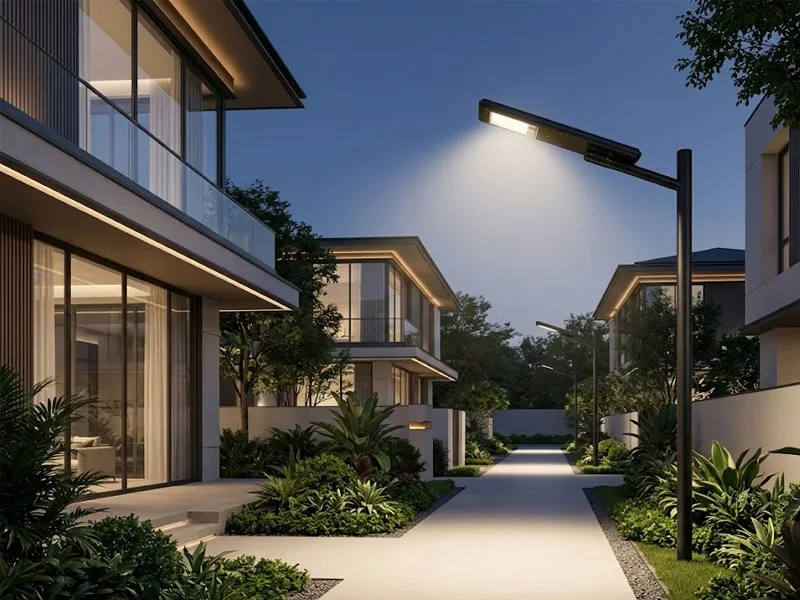
Outdoor lighting in residential communities and villas needs to operate stably over the long term. Traditional street lights not only require continuous electricity payments, but also involve trenching, cable laying, power distribution equipment installation and line maintenance. For communities where road paving and landscape greening have already been completed, adding street lights later often results in relatively high construction costs.
As an independent lighting system, solar garden street lights are no longer just single lighting devices. They can also adjust brightness according to time and human activity, and upload operating status to a management platform, becoming part of the smart management system of residential communities.
This article will start from the actual lighting needs of residential communities and villas, analyze the advantages of solar garden street lights in electricity cost savings, installation and construction, smart security, IoT remote management and long-term safe operation, and further explain how to select a suitable system configuration according to sunlight conditions, lighting coverage and usage requirements.
What Lighting Requirements Do Residential Communities and Villas Have?
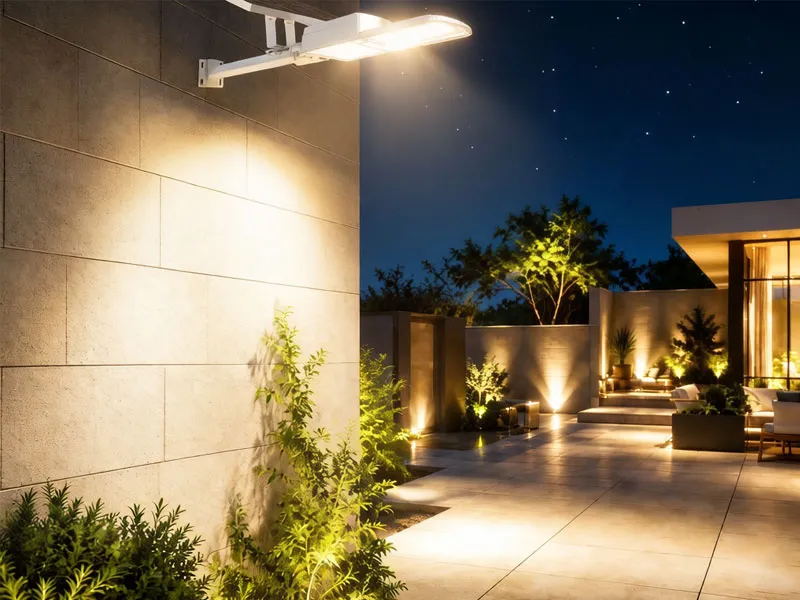
Residential communities and villas both require outdoor lighting, but their usage requirements are not completely the same.
For a broader look at solar lighting for public spaces — including parks, pathways and community areas — see our dedicated guide for planning and selecting public-space lighting.
Residential communities have larger lighting areas and more users. Internal community roads, building entrances, parking areas and public pathways need to maintain relatively uniform brightness to avoid obvious transitions between light and dark areas. At the same time, property management personnel also need to consider the operating status, maintenance efficiency and long-term costs of multiple lights.
Villa lighting areas are usually smaller, but the requirements for light appearance and lighting comfort are higher. Driveways and gates require clearer lighting, while gardens and courtyards place greater emphasis on soft light, landscape coordination and privacy. The light should not be too bright, nor should it shine directly into bedrooms or neighboring residences.
Therefore, the lighting objective of residential projects is not “the brighter, the better,” but to make roads, steps and entrances clearly visible while controlling glare and unnecessary light spill. [2]
Why Are Solar Garden Street Lamps Suitable for Residential Communities and Villas?
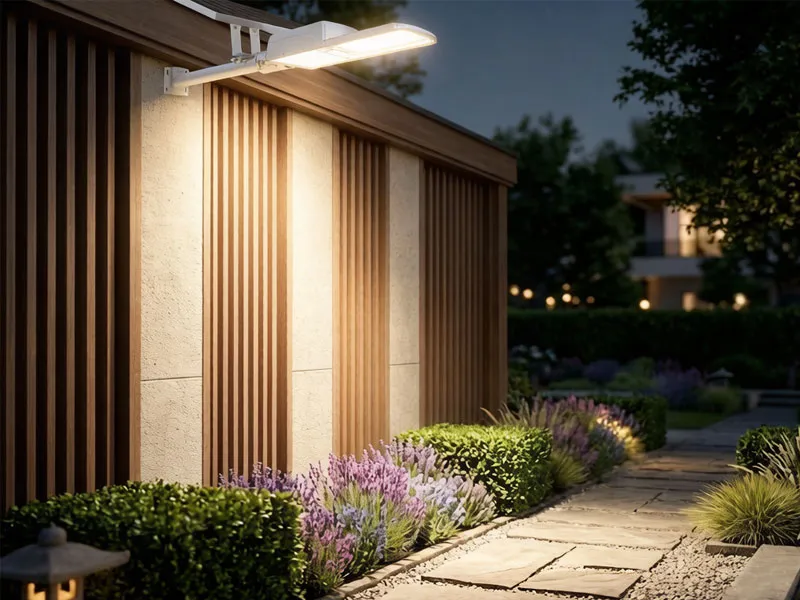
No Underground Wiring Required
Solar garden street lamps independently generate and store electricity and do not require long-distance cables to be laid from a distribution box. For communities where paving and greening have already been completed, trenching, conduit installation and road restoration work can be reduced.
Some areas in villa gardens are far from the building, and traditional wiring may be relatively complicated. Solar garden street lights can be flexibly installed according to sunlight and lighting requirements, reducing work related to electrical lines. [1]
Reduce Grid Electricity Costs for Community Street Lights
In markets with relatively high electricity prices, such as Europe and North America, public lighting is an ongoing operating expense. Solar garden street lamps use solar energy for charging during the day and consume the electricity stored in the battery at night, so they do not generate direct grid electricity costs for street lighting. For residential communities that require long-term operation, this helps reduce the impact of electricity price fluctuations on property management budgets.
However, “zero electricity cost” does not mean “zero cost.” The project still needs to consider initial procurement, installation, solar panel cleaning, battery replacement and routine inspections. Whether the project is economical should be determined by comparing the total cost over the entire service life, rather than only comparing the unit price of the lights. [4]
Security Cameras Can Be Integrated
Residential community entrances, parking areas, remote pathways and villa driveways usually have both lighting and security requirements. Project-grade solar garden lights can integrate security cameras as needed, allowing the light pole to provide both lighting and surveillance functions.
This solution is suitable for locations where power and network cables are difficult to install. The camera can transmit data through mobile networks, Wi-Fi or other communication methods, and can also be configured with local storage.
Support IoT Remote Management
Solar garden lights equipped with IoT communication modules can upload battery level, charging status, LED operating conditions and equipment faults to a management platform.
Property management personnel can remotely perform the following operations:
Check whether the lights are operating normally;
Adjust the brightness during different time periods;
Set the light-on and light-off times;
Receive low-battery or device-offline alarms;
Adjust lighting programs according to the season;
Reduce on-site inspections of individual lights.
For residential communities with a large number of lights, remote management can help property management personnel identify problems more quickly and determine whether the fault comes from the battery, solar panel, controller or communication module before arranging repairs, improving efficiency while also reducing subsequent maintenance costs. [3]
Independent Lighting During Power Outages
Traditional community street lights depend on a centralized power supply line. When the power grid fails or a line fault occurs, the lights in an entire area may go out at the same time.
Solar garden street lamps usually operate independently as individual lights. As long as the battery still has sufficient power, the lights can continue to provide basic illumination for entrances, pathways and parking areas even when the community power grid is down. Independent operation also means that when a single light fails, it usually does not affect the other lights along the entire road, helping to reduce the scope of failure.
Suitable for Long-Term Community Operation
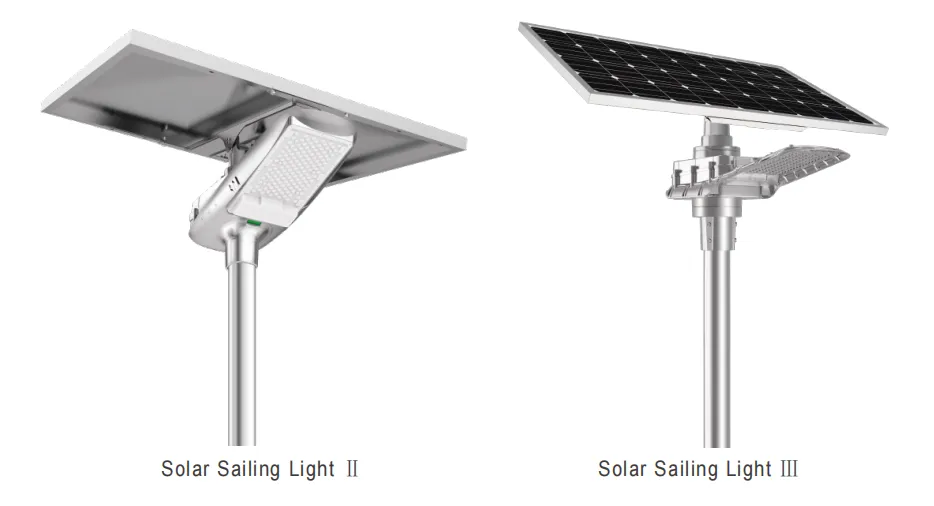
Engineering-grade solar garden street lights usually use high-efficiency LEDs, lithium iron phosphate batteries and controllers with charge and discharge protection functions. The controller can prevent battery overcharging and over-discharging and adjust the LED output according to the remaining battery level, reducing unnecessary energy consumption while lowering the pressure caused by long-term deep battery discharge and continuous full-power LED operation.
For community projects, replaceable batteries, controllers and LED modules are usually more suitable for long-term operation than “fully enclosed and non-repairable” structures.
How to Choose Suitable Solar Garden Lights for Communities and Villas?
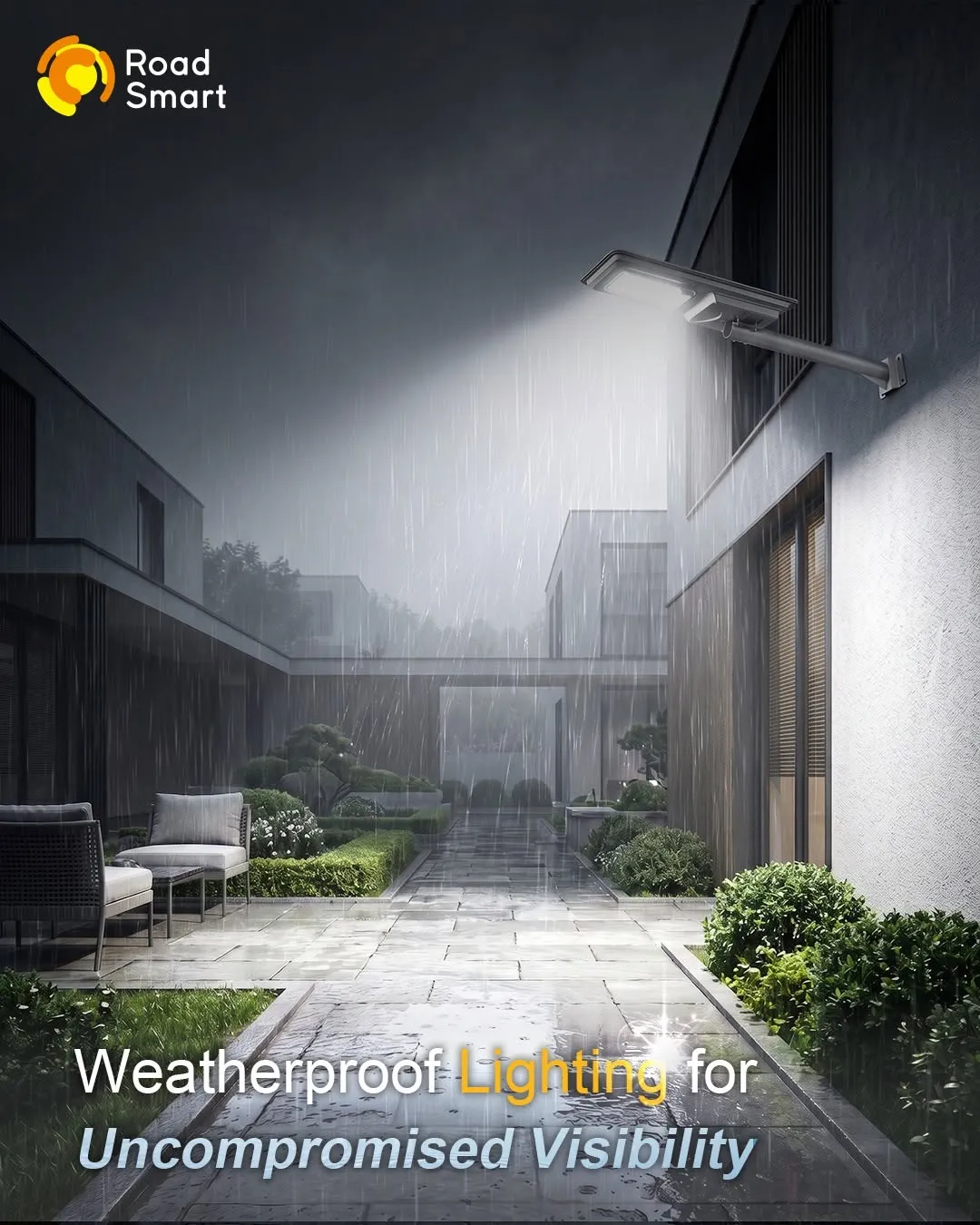
Community and villa lighting share similarities as well as differences. Therefore, before selecting products, the purpose of the installation area should first be clarified. Community main roads, pathways, parking areas and villa gardens require different brightness levels, installation heights and light distribution methods.
Second, the sunlight conditions at the installation location need to be checked. Solar panels should not remain in the shade of trees, eaves or high-rise buildings for long periods. Communities with extensive landscaping also need to consider whether tree growth will shade the solar panels in the future.
The system configuration should focus on the following:
How many hours of lighting are required each night;
Whether high brightness needs to be maintained throughout the night;
Local rainy season and winter sunlight conditions;
How many consecutive rainy days need to be supported;
Whether cameras or communication modules need to be added;
Whether motion sensing and time-based dimming are required;
Whether the battery, LED and controller can be replaced separately;
Whether the system has waterproof, corrosion-resistant and wind-resistant capabilities suitable for the local environment.
For villas, priority should be given to comfortable color temperature, low glare and an appearance coordinated with the architectural style. For residential communities, greater attention should be paid to lighting uniformity, stable batch operation, remote management and subsequent maintenance efficiency. [5]
Conclusion
Solar garden street lamps are very suitable for residential community and villa projects, especially for application scenarios where electricity prices are high, underground wiring construction is complicated, or community smart management capabilities need to be upgraded.
Compared with traditional grid-powered street lights, lamp solar garden independently generate and store electricity through solar energy, reducing the dependence of community nighttime lighting on the power grid and avoiding continuous street lighting electricity expenses. At the same time, the project can also integrate motion sensors, security cameras and IoT communication functions according to actual requirements, combining road lighting, regional security, operating monitoring and remote management into the same system.
RoadSmart can provide solar street lighting solutions configuration recommendations covering brightness, solar panels, battery capacity and intelligent control functions according to different scenarios such as residential roads, community pathways, parking areas, villa driveways and courtyards. For projects planning or upgrading residential outdoor lighting, the RoadSmart source code team can be contacted to obtain solar street lighting solutions that better match site conditions and long-term operating requirements.
FAQ
Q1: How much money can solar garden street lights save a community each year?
A: For a 50-light community, replacing traditional 150W grid-tied lights with 80-120W solar lights can save $2,500-4,000 annually in electricity costs, plus reduced maintenance (no cable repairs). Over 10 years, total savings can reach $25,000-40,000.
Q2: Can solar lights work in communities with tall trees or buildings?
A: Solar panels require direct sunlight for optimal charging. If your community has significant shading, consider split-type systems (panel placed in open area) or higher battery capacity. A site assessment is recommended to determine the best configuration.
Q3: Can solar garden lights integrate with existing community security systems?
A: Yes. RoadSmart’s project-grade solar garden lights can integrate security cameras and motion sensors, with data transmitted via 4G or Wi-Fi. This allows lighting and security to be managed through a single platform.
Q4: What happens during community power outages?
A: Solar garden lights operate independently of the grid. As long as the battery has sufficient power, they continue to illuminate entrances, pathways, and parking areas – providing critical safety lighting when grid power fails.
Q5: What is the typical lifespan of a solar garden light system?
A: Battery: 5-8 years (LiFePO₄, 2,000+ cycles); LED: 50,000+ hours; Solar panel: 20+ years. With proper maintenance, the system reliably operates for 5-8 years before battery replacement is needed.
References
- Outdoor Solar Lighting, DOE.
- Roadway Lighting Details, FHWA.
- Energy-Efficient Exterior Lighting, DOE FEMP.
- Electricity Price Statistics, Eurostat; Electric Sales, Revenue, and Average Price, U.S. EIA.
- IP Ratings / IEC 60529, IEC.