Should I Focus on Power or Configuration When Selecting Solar Street Lights?
May 27, 2026
Read:721
Quick Answer:
When choosing solar street lights, both power and configuration need to be considered, but configuration is more important. Power is only one parameter, while configuration is the key factor that determines whether a solar street lamp is good or not. Different solar street light products come with different configurations, and all of these need to be considered comprehensively.
In short: a 100W light with poor battery and low-efficiency LED will perform worse than a properly configured 60W light with LiFePO₄ and high-lumen chips.
Introduction
When purchasing solar street lights, the questions most often heard are: How many watts is this light? Do all-in-one solar street lights come in 100W power? Does buying this solar led street lights mean that the higher the wattage, the brighter it will be?
If solar led street lights are selected purely based on power, it is easy to be attracted by surface-level parameters and difficult to choose the right product. Either the product bought has inflated parameters, and the actual power is not that high at all, or it is unstable, with different problems such as becoming dim after long-term use. Therefore, when choosing solar led street lights, you cannot look only at power. What matters more is the configuration behind it.
Have you ever bought a solar street light labeled “120W” that turned out dimmer than a 60W from another brand? You‘re not alone. Many suppliers inflate wattage numbers while cutting corners on batteries, panels, and controllers. This article explains what to look for instead.
What Does the Power of a Solar Street Lamp Actually Represent?
Whether it is a solar street lamp or another type of street light, in the minds of users, power is the most intuitive standard for judging brightness. However, in reality, the power marked on a solar powered street lighting usually refers to the power consumption of the LED fixture, not the brightness as we understand it. It only represents electricity consumption. This is a point that needs to be corrected.
Secondly, higher wattage does not mean higher brightness. The actual brightness also depends on the luminous efficacy of the LED beads and the lumen output. At the same time, reasonable and scientific light distribution design is also an important influencing factor. Generally speaking, under reasonable and effective lighting configuration, an 80W high-luminous-efficiency fixture may achieve the lighting effect of a 100W fixture. There is no need to choose a high-wattage fixture. On the basis of saving energy consumption, it can also save the investment cost of the light fixture.
In addition, the power of a led solar street light needs to be configured according to specific requirements. The higher the power, the greater the consumption of the solar photovoltaic panel and battery. As long as the lighting demand is met, suitable power is enough, and unnecessary resource waste should be avoided.
Example:
Light A: Claims 120W, uses 120 lm/W LED chips → actual brightness = 14,400 lumens
Light B: Claims 80W, uses 180 lm/W LED chips → actual brightness = 14,400 lumens
Same brightness, but Light B consumes 33% less energy, requires smaller battery and panel, and costs less. This is why looking at wattage alone is misleading.
Why is the Configuration of Solar LED Street Lights More Critical Than Power?
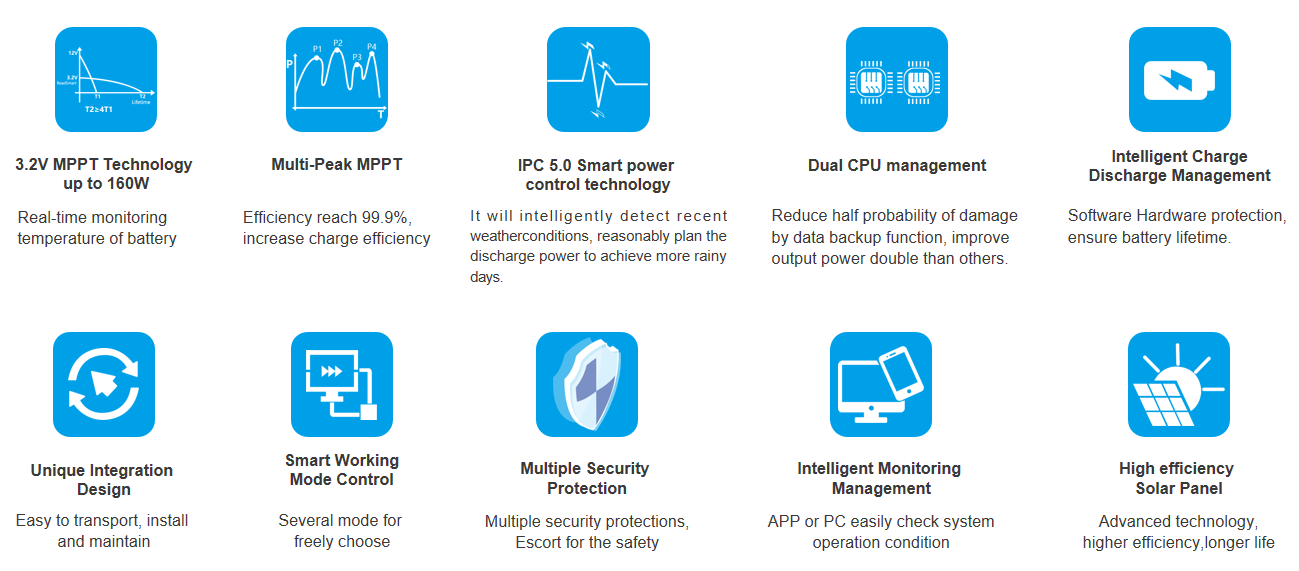
A solar led street light is an independent lighting system, different from the traditional power grid. Therefore, its internal configuration system is the key to determining the stable operation of the solar led street lights.
The core configuration of a solar led street light consists of the solar photovoltaic panel, battery, controller, LED light source, shell structure, and other parts. Every core component is very important.
Solar photovoltaic panel: As an important carrier for receiving sunlight, its main responsibility is to generate power during the day. Its materials and light-energy conversion are very important to its power generation capacity. Sufficient electricity is needed to support suitable power. If it cannot be fully charged during the day, then no matter how high the power is, it is only an empty claim.
Battery: This is the key to endurance capacity. It determines not only the lighting duration at night, but also the ability to maintain normal lighting during rainy and cloudy days. The stability and capacity of the battery are crucial. Lithium iron phosphate batteries are preferred for batteries, as they have large capacity and long endurance.
Controller: It is responsible for charging and discharging, and it is the system that controls the normal operation of the entire solar street led lights. A high-quality controller can reasonably arrange battery charging and discharging, realise automatic light switching, time-segmented dimming, and other functions, while reducing consumption.
LED light source: A high-quality LED light source can achieve low energy consumption, high brightness, and low loss. While ensuring the lighting effect, it can also improve the overall service life of the solar street led lights.
Shell structure: This provides important protection for the solar street led lights. It is necessary to fully consider the impact of different environments and climates, pay attention to the protection level and structural configuration of the lampshade material, and focus on waterproofing, high-temperature resistance, corrosion resistance, and other aspects, so as to provide protection for the solar led street lights body.
| Core Configuration | Function | Consequences of Inferior | High-Quality Standards | RoadSmart Advantages |
| Solar Panels | Daytime Power Generation | Insufficient power, incomplete charging, no light at night | Grade A monocrystalline silicon, efficiency ≥19% | Monocrystalline, efficiency 19-22% |
| Battery | Energy storage for backup on cloudy/rainy days | Short lifespan (1-2 years), falsely advertised battery life | LiFePO₄, cycle life ≥2000 times, 5-7 days backup | All LiFePO₄ series, range -20~60°C |
| Controller | Charge/discharge management, smart dimming | Overcharging damages battery, low charging efficiency | MPPT, charging efficiency ≥95%, multi-protection | MPPT efficiency 99.9%, IPC 5.0 control |
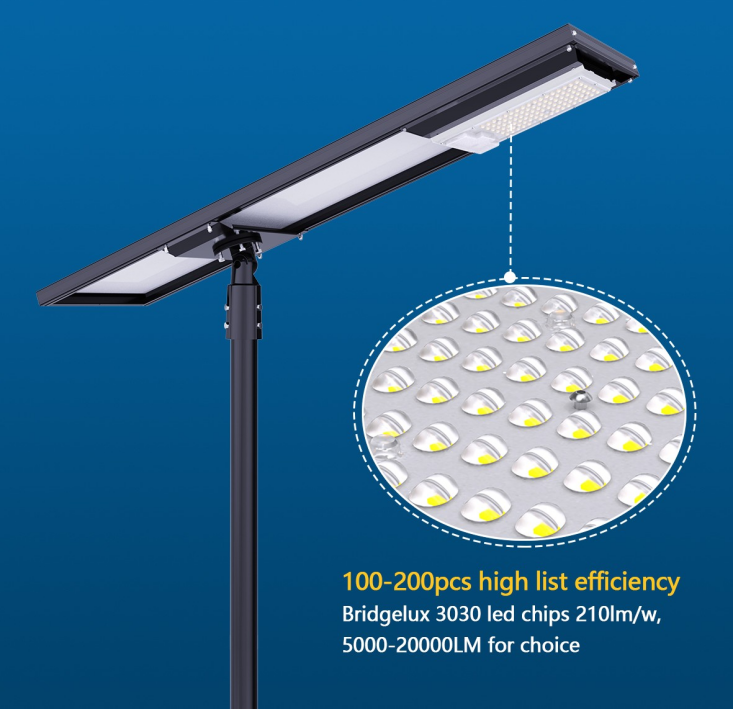
| LED Source | Illumination output | Fast light decay, brightness reduction, low lm/W | Branded chips (5050/3030), efficacy ≥160 lm/W | 180-210 lm/W, L70 ≥ 50,000 hours |
| Structure | Protection & Heat Dissipation | Water ingress, corrosion, poor heat dissipation | IP65/IP66, Die-cast Aluminum, Corrosion-resistant | IP65, Die-cast Aluminum + Salt Spray Coating |
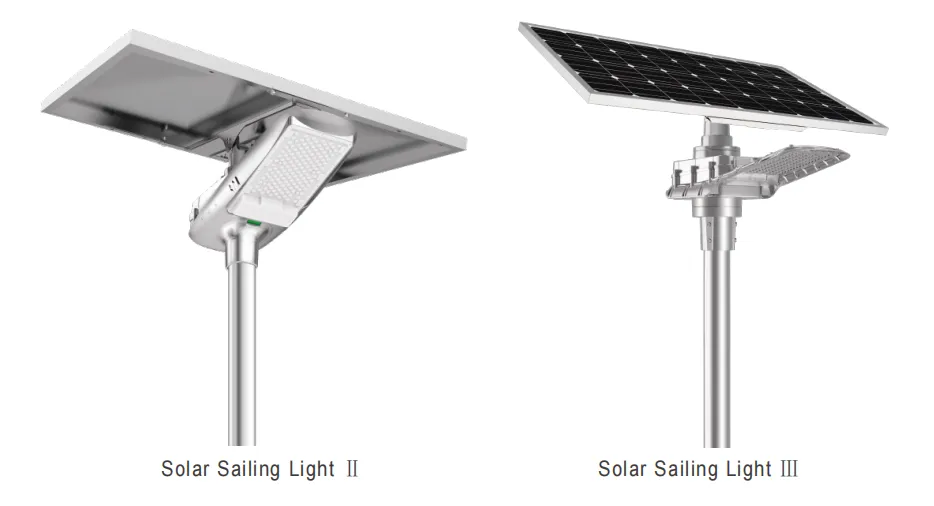
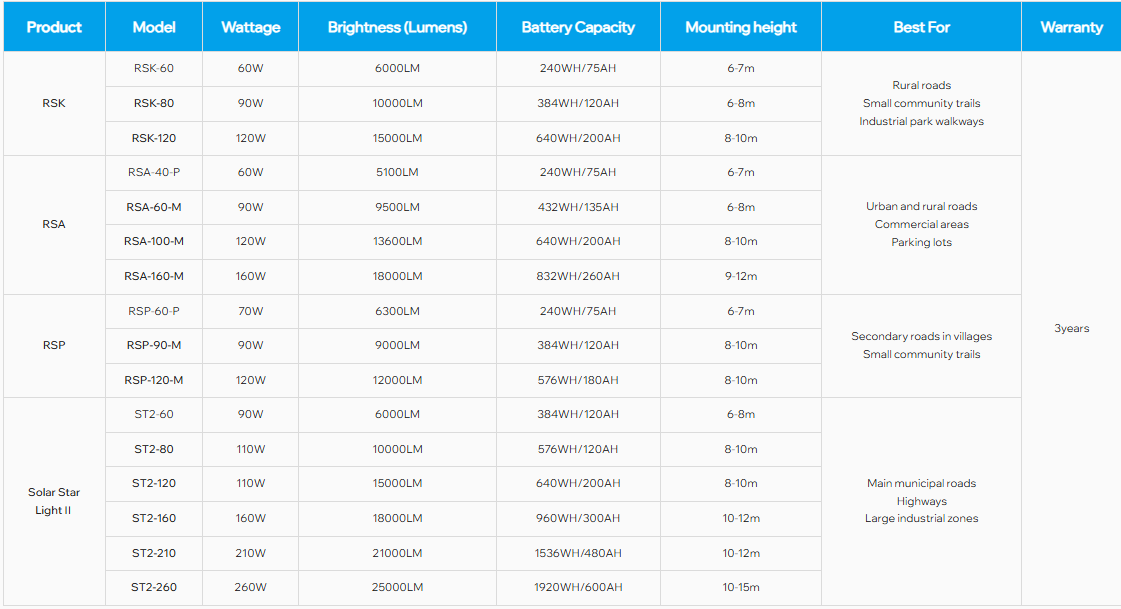
For example, the RoadSmart all-in-one solar street light series products mentioned earlier, according to the information released on its official website, clearly explain core configurations such as the solar photovoltaic panel, lumens, LED lamp beads, battery, and shell material. They also provide product parameters for selection according to different models. If needed, you can visit the relevant page to choose. In that way, the description of the above content will be more intuitive and easier to understand clearly.
How to Spot Inflated Wattage Claims:
- Compare the physical size – a genuine 120W all-in-one light requires a certain solar panel area and battery volume. A tiny fixture claiming 200W is likely fake.
- Ask for the lumen value and luminous efficacy (lm/W). A genuine 120W with 160 lm/W should output ~19,200 lm.
- Request a test report or third-party certification (e.g., TUV, SGS).
- Look at the price – if a “120W” light costs under $150, corners have been cut.
Quick Selection Logic:
Step 1: Determine required lumens based on road width, pole height, and illuminance standard (use DIALux).
Step 2: Calculate required battery capacity based on lumens, daily hours, and rainy days backup.
Step 3: Select LED chip with appropriate luminous efficacy (target ≥160 lm/W).
Step 4: Choose controller (MPPT required) and panel (monocrystalline).
Step 5: Check housing IP rating and material for local climate.
Conclusion
Now let us return to the initial question: when choosing solar street lights, should you look at power or configuration? The correct selection logic is that power can be used as a parameter, but it is not the main factor. What matters is the specific configuration of the solar led street lights, and this configuration should be determined based on the needs of the project itself.
Therefore, a suitable solar street lamp is not necessarily the one with the highest power, nor necessarily the one with the lowest price. Instead, it is a product with a reasonable whole-system configuration, the ability to adapt to the site environment, stable lighting performance for many years, and low maintenance costs in the later stage.