Top 10 Solar Street Light Manufacturers 2026 | Global Supplier Guide
Jul 16, 2026
Read:1241
Source: Yin Zhenkun
Choosing a solar street light manufacturer is not simply a matter of comparing lamp wattage or unit price. A complete solar lighting system must match the road geometry, local solar radiation, required lighting hours, rainy-season autonomy, pole structure, optical distribution, battery performance, controller settings, and long-term maintenance plan.
For municipal buyers, EPC contractors, distributors, developers, and OEM customers, the right supplier is usually the company that can explain how the complete system will perform at the project location—not the company that offers the highest advertised wattage.
This guide compares 10 solar street light manufacturers and lighting brands active in 2026. It focuses on their product direction, engineering strengths, target applications, and the questions buyersshould verify before placing an order.
Quick Answer
There is no single best solar street light manufacturer for every project.
Signify, Sunna Design, LEADSUN, and Fonroche Lighting are relevant to buyers evaluating connected lighting, autonomous public lighting, and smart-city applications. SEPCO, SOLTECH, and Greenshine are more closely positioned toward North American municipal and commercial projects. Sresky, SOKOYO, LEADSUN, and RoadSmart provide China-based manufacturing options for international projects, distributors, tenders, and OEM/ODM programs.
The final choice should depend on project location, required illuminance, battery autonomy, product structure, documentation, certifications, warranty coverage, and local service availability.
Key Takeaways
A reliable supplier should size the solar panel, battery, LED module, controller, optics, and pole as one complete system.
Municipal and EPC projects normally require IES files, DIALux calculations, technical drawings, wind-load data, test reports, and component-level warranty information.
All-in-one solar street lights are convenient for fast installation, while split and all-in-two systems offer more flexibility for larger roads and longer autonomy.
Certificates should match the exact product model and manufacturing entity, not simply display a general company logo.
Buyers should compare total project risk and lifecycle support instead of selecting a supplier solely by unit price.
The companies below represent different supplier models and are numbered for navigation rather than presented as a universal performance ranking.
How We Selected These Solar Street Light Manufacturers
This guide was reviewed and updated in July 2026 using publicly available information from company websites, product pages, project references, technical documents, and corporate announcements.
The following factors were considered:
Solar Street Lighting Specialization
Priority was given to companies with active solar street lighting products rather than businesses that only supply conventional grid-connected LED luminaires.
Product and System Coverage
The review considered whether the supplier offers all-in-one, all-in-two, split, hybrid, smart-controlled, decorative, commercial, or project-specific systems.
Engineering and Documentation Support
For B2B projects, useful support can include photometric design, IES files, DIALux layouts, installation drawings, energy calculations, pole recommendations, and tender documents.
Project Evidence
Published project locations, installed models, application conditions, lighting requirements, and system configurations provide more value than general claims about global experience.
Environmental Adaptability
The manufacturer should be able to configure systems for deserts, tropical climates, coastal environments, cold regions, high-wind areas, and locations with extended rainy seasons.
Certifications and Quality Control
Buyers should check management system certification, luminaire test reports, battery documents, ingress protection, impact protection, EMC compliance, and region-specific requirements.
Warranty and After-Sales Support
Warranty coverage should be reviewed by component, including the solar panel, battery, controller, LED module, housing, pole, and accessories.
Editorial Disclosure
This comparison is published by RoadSmart Solar and includes RoadSmart as one of the manufacturers reviewed. The same sourcing criteria have been used across all entries. Buyers should independently verify current specifications, certifications, project references, warranty terms, and local service availability before making a procurement decision.
Top Solar Street Light Manufacturers Comparison
No. | Brand Manufacturer | Main Base | Best Suited For | Representative Solar Lighting Direction |
1 | Signify | Netherlands | Public infrastructure, connected lighting and hybrid solar projects | SunStay Pro gen2, SunStay Pro gen2 mini, Philips SunStay |
2 | Sunna Design | France | Autonomous municipal, rural and connected solar lighting | iSSL, UP, EverGen and SunnAPP |
3 | Leadsun | China with global regional teams | Smart public lighting, parking lots, pathways and turnkey projects | AE3C, AE5, AE6, VertHex and wireless control |
4 | Fonroche Lighting | France | Large autonomous road and public infrastructure projects | Smartlight, Helia, Sunset and POWER365 |
5 | SEPCO | United States | Custom-engineered North American municipal and commercial projects | Solar street, roadway, parking, pathway and remote power systems |
6 | Sresky | China | Integrated solar street lights and distributor-oriented products | Atlas, Basalt, Thermos, Raptor and smart control technologies |
7 | SOLTECH | United States market | Commercial, municipal and cold-weather solar lighting | SATELIS PRO, SUNLIKE PRO, CEGONIA PRO and HYBRID |
8 | SOKOYO | China | Municipal projects, tenders and vertically integrated manufacturing | All-in-one, split systems, poles, panels and battery systems |
9 | Greenshine New Energy | United States | Commercial, municipal, remote and mobile solar lighting | Supera, Brighta, Lumina and mobile lighting systems |
10 | RoadSmart | China | EPC, distributor, government tender and OEM/ODM projects | RSK, ST2, FH, NH, Sailing, SP, HS and Y Series |
1.Signify
Country: Netherlands
https://www.signify.com/global
Signify is a global professional lighting company with a broad portfolio covering conventional LED lighting, connected lighting, controls, smart-city systems, and solar-powered outdoor luminaires.
Its solar offering is only one part of a much larger lighting ecosystem, but it is relevant to public-sector buyers that need solar lighting to work alongside connected infrastructure and lighting management platforms.
In 2025, Signify introduced the SunStay Pro gen2 and SunStay Pro gen2 mini. These integrated solar street lights support applications such as pedestrian areas, campuses, cycle paths, and public spaces. Depending on the configuration, the range can include motion sensing, connected control, hybrid charging, and additional vertical solar panels for improved winter energy capture. Signify solar street lighting information
Signify has also published solar lighting projects using Philips SunStay luminaires in locations where grid connection would otherwise require additional trenching and electrical infrastructure.
Best suited for:
Public-sector and smart-city lighting
Connected or hybrid solar lighting
Projects requiring established regional lighting support
Campuses, parks, pathways and pedestrian areas
What buyers should verify:
Whether the required solar model is available in the project country
Who is responsible for solar and battery sizing
Compatibility with the intended lighting management platform
Local warranty, replacement parts and technical support
Whether the proposal includes a complete solar system or only the luminaire
2.Sunna Design
Country: France
Sunna Design is a French company focused on autonomous and connected solar public lighting. Its portfolio covers compact integrated systems, higher-power modular systems, and connected fleet-management tools.
The iSSL range is positioned toward compact and integrated solar lighting, while the UP range addresses public spaces and street lighting with more flexible configurations. EverGen systems are designed for higher-power applications and can be configured for demanding urban, roadway, or infrastructure projects.
The company introduced EverGen 3 in 2025 as an addition to its high-power autonomous solar lighting portfolio. Sunna Design also operates SunnAPP, a management platform compatible with its EverGen, iSSL, and UP ranges. Sunna Design product range
Sunna Design’s acquisition of SOL Inc. expanded its access to the North American market and added experience in customized solar lighting projects.
Best suited for:
Autonomous municipal lighting
Rural and off-grid roads
Urban public spaces
Connected solar lighting fleets
Higher-power projects requiring site-specific sizing
What buyers should verify:
Battery type and temperature range for the selected model
Available lighting output and optical distribution
Remote monitoring functions and communication requirements
Project-specific warranty conditions
Regional installation and after-sales support
DIALux or photometric documentation for the proposed layout
3.Leadsun
Country: China
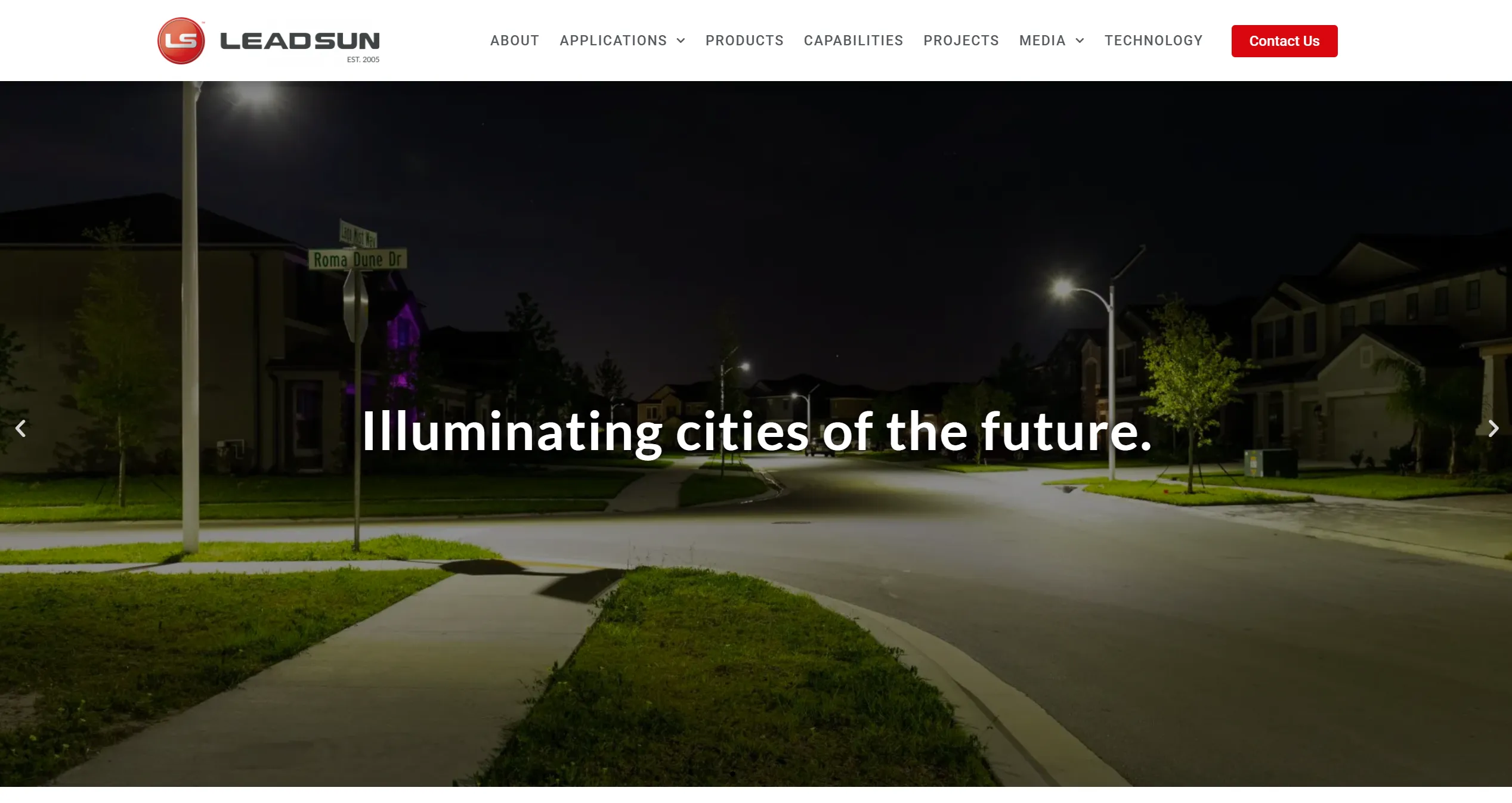
LEADSUN develops solar-powered public lighting systems for streets, parking lots, pathways, parks, communities, and commercial areas. Its global operations include teams and partners in China, Australia, the United States, Malaysia, the United Kingdom, India, and other markets.
The company’s product portfolio includes all-in-one and split configurations such as the AE3C, AE5, and AE6 series. It also provides smart control options for monitoring, dimming, and managing public lighting assets.
LEADSUN states that it develops and manufactures the complete solar-powered system rather than sourcing only the luminaire. Its project portfolio includes public roadway installations and customized systems that combine solar engines with locally specified poles or light heads. LEADSUN solar lighting products
For example, a published project in Rancho Cordova used 44 solar street lights, including several units connected through a remote wireless monitoring gateway.
Best suited for:
Public roads and residential streets
Parking lots and commercial areas
Parks, pathways and community spaces
Smart-controlled solar lighting
Turnkey projects requiring regional engineering support
What buyers should verify:
The specific LEADSUN entity supplying the project
Local service and spare-parts responsibility
Communication protocol and monitoring platform
Battery autonomy under the project’s winter conditions
Pole, fixture and solar-engine compatibility
Warranty terms for each system component
4.Fonroche Lighting
Country: France
https://www.fonrochesolarlighting.com/
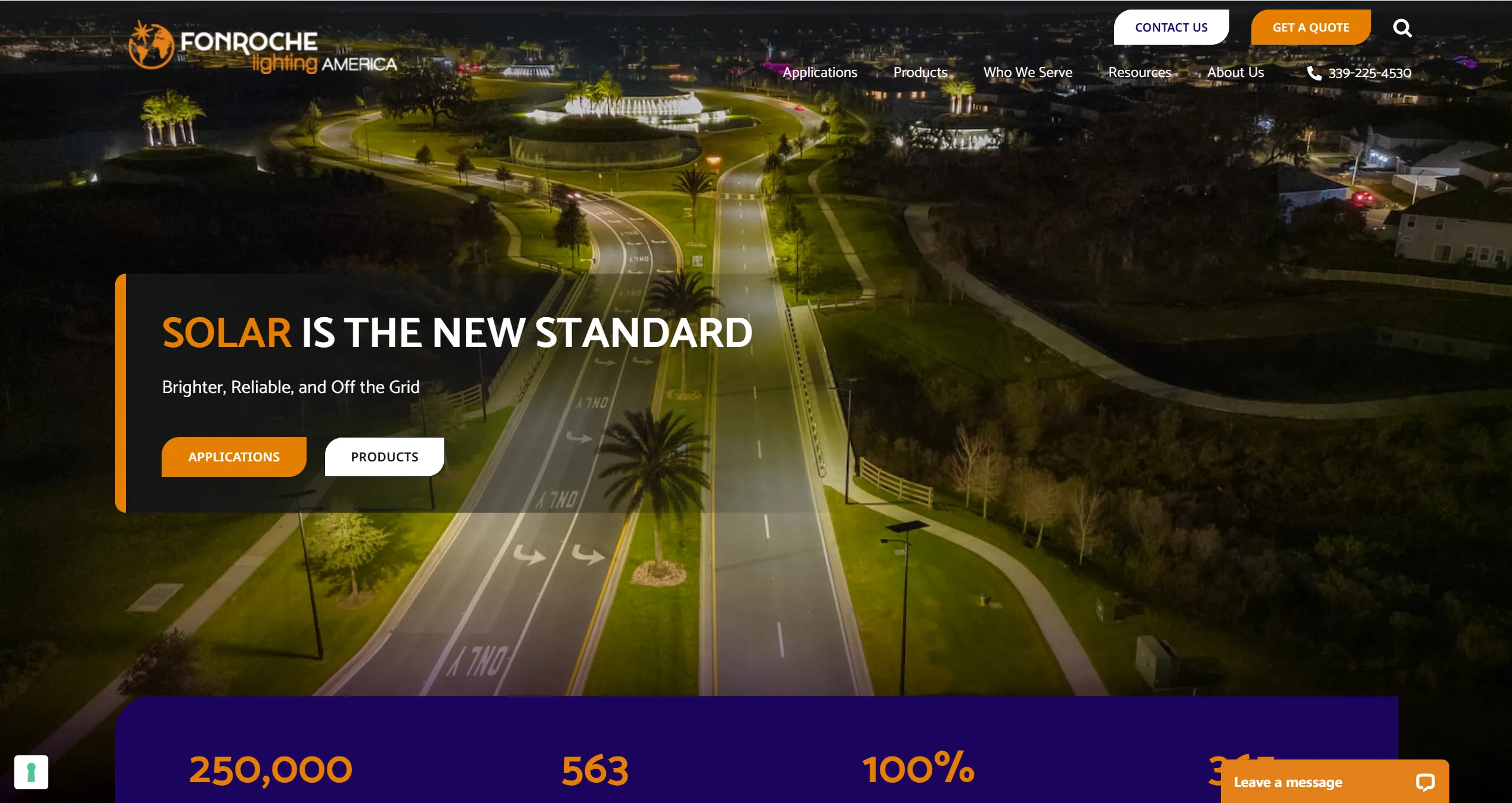
Fonroche Lighting is a French solar public lighting specialist focused on autonomous systems for roads, public spaces, industrial sites, urban developments, and large infrastructure projects.
Its product portfolio includes Smartlight, Helia, Sunset, and other functional or decorative solar lighting systems. The systems are built around Fonroche’s POWER365 energy storage and management technology.
Fonroche describes POWER365 as a programmable energy management system developed to maintain lighting throughout the year when the complete system has been correctly sized for the location. Fonroche POWER365 technology
The company also operates a solar streetlight testing facility where batteries and lighting systems are evaluated for temperature, corrosion, humidity, and other environmental conditions.
Best suited for:
Municipal roads and urban developments
Large autonomous lighting projects
Industrial and logistics areas
Locations requiring extended seasonal reliability
Public projects needing functional and decorative options
What buyers should verify:
The energy study used to support the proposed autonomy
Lighting level and uniformity calculations
Battery replacement and maintenance planning
Local service coverage
Pole and foundation requirements
Conditions attached to annual lighting-performance claims
A claim such as “365 nights of lighting” should always be evaluated against the actual project location, dimming profile, battery capacity, solar panel size, shading, and maintenance conditions.
5.SEPCO
Country: United States
https://www.sepco-solarlighting.com/
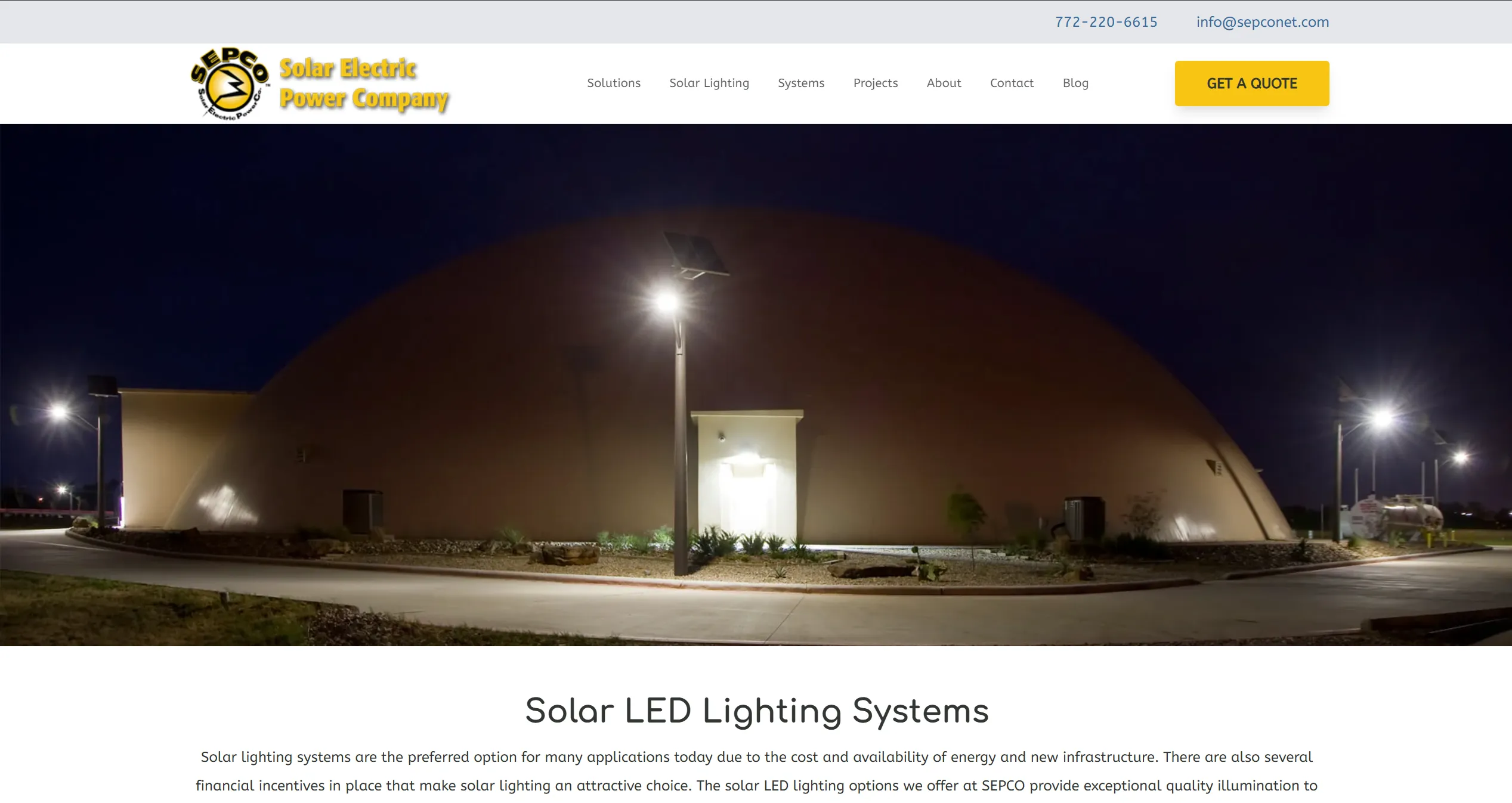
SEPCO, or Solar Electric Power Company, is a U.S.-based manufacturer of customized commercial solar lighting and remote power systems.
Unlike suppliers that mainly sell fixed catalog models, SEPCO emphasizes project-specific system engineering. Solar panel capacity, battery storage, fixture output, operating schedule, pole design, and winter solar conditions are evaluated as part of the complete configuration.
Its solar street lighting systems are used for roadways, residential streets, pathways, transportation facilities, public sites, and security-sensitive applications. Published projects include municipal roads, EPA facilities, coastal developments, and military installations. SEPCO solar street lighting projects
SEPCO systems can use GEL battery assemblies, while LiFePO₄ options are available for certain applications. The company also provides component-based warranty and maintenance information.
Best suited for:
U.S. municipal and transportation projects
Commercial and industrial sites
Customized roadway lighting
Federal or security-sensitive applications
Projects requiring photometric and structural documentation
What buyers should verify:
Battery technology proposed for the specific project
Complete component warranty schedule
AASHTO or local pole requirements
Photometric layout and lighting schedule
Battery replacement interval
Manufacturing origin requirements
Total installed cost compared with grid extension
6.Sresky
Country: China
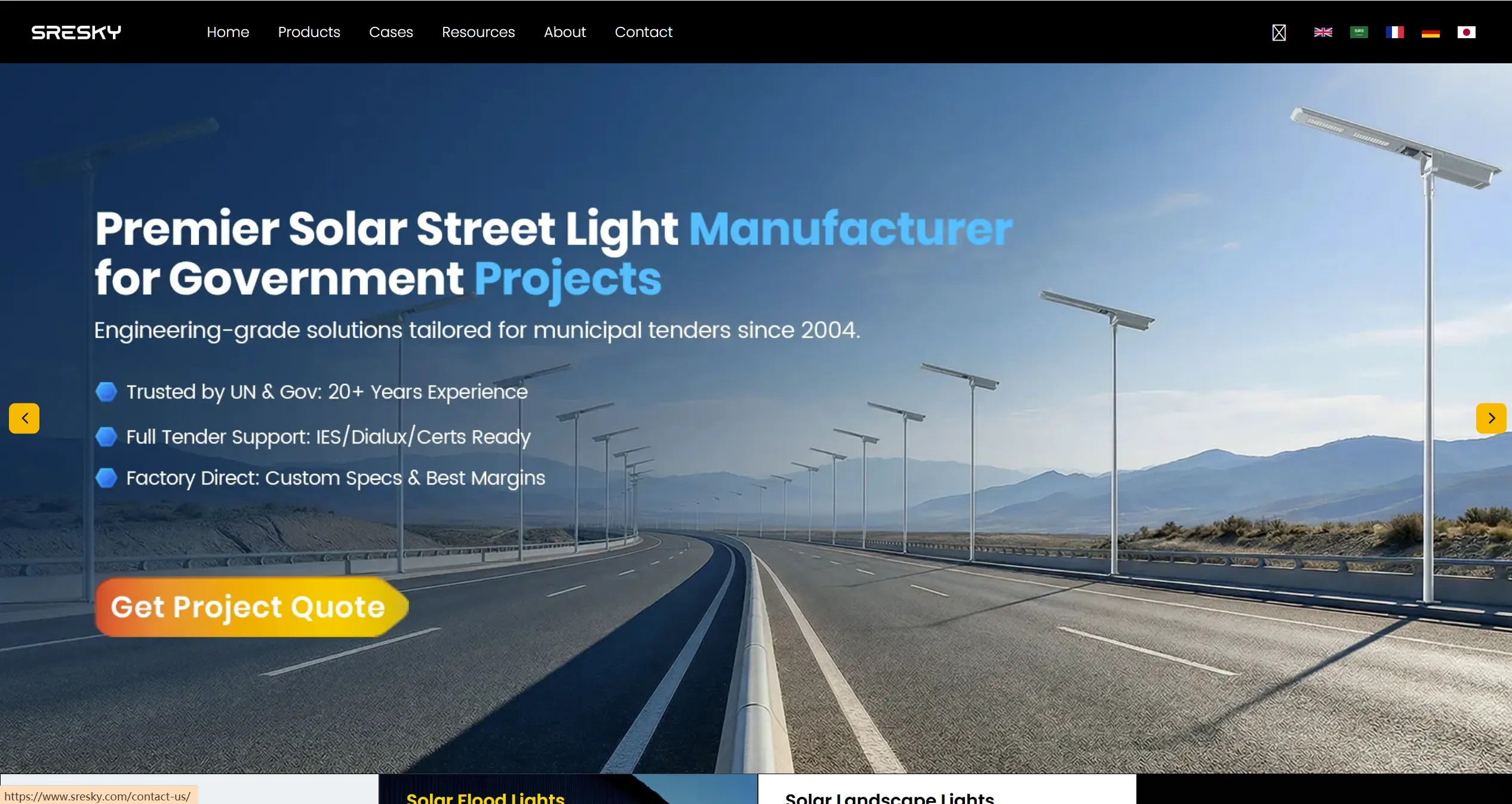
Sresky is a China-based outdoor solar lighting manufacturer established in 2004. Its product range includes solar street lights, landscape lights, floodlights, garden lights, and other integrated outdoor solar products.
The company’s solar street light portfolio includes Atlas, Basalt, Thermos, Raptor, and other all-in-one designs. These ranges cover different brightness levels, structural designs, display functions, rain sensing, automatic cleaning, and control strategies.
Sresky promotes proprietary ALS, TCS, and BMS technologies for energy management, temperature control, and battery protection. Its official website states that its sales network covers more than 70 countries and regions. Sresky solar street light portfolio
Best suited for:
Integrated solar street light projects
Distributors requiring multiple product styles
Parks, pathways and smaller public roads
Applications needing simplified installation
Markets with demand for feature-rich all-in-one products
What buyers should verify:
Actual system lumens rather than advertised lamp wattage
Solar panel power and usable battery energy in watt-hours
Performance of special functions under field conditions
Independent test reports for the exact product model
Spare-parts compatibility
Distributor protection and regional service policies
Dimming schedule used to calculate cloudy-day autonomy
7.SOLTECH
Country: United States
https://www.soltechlighting.com/
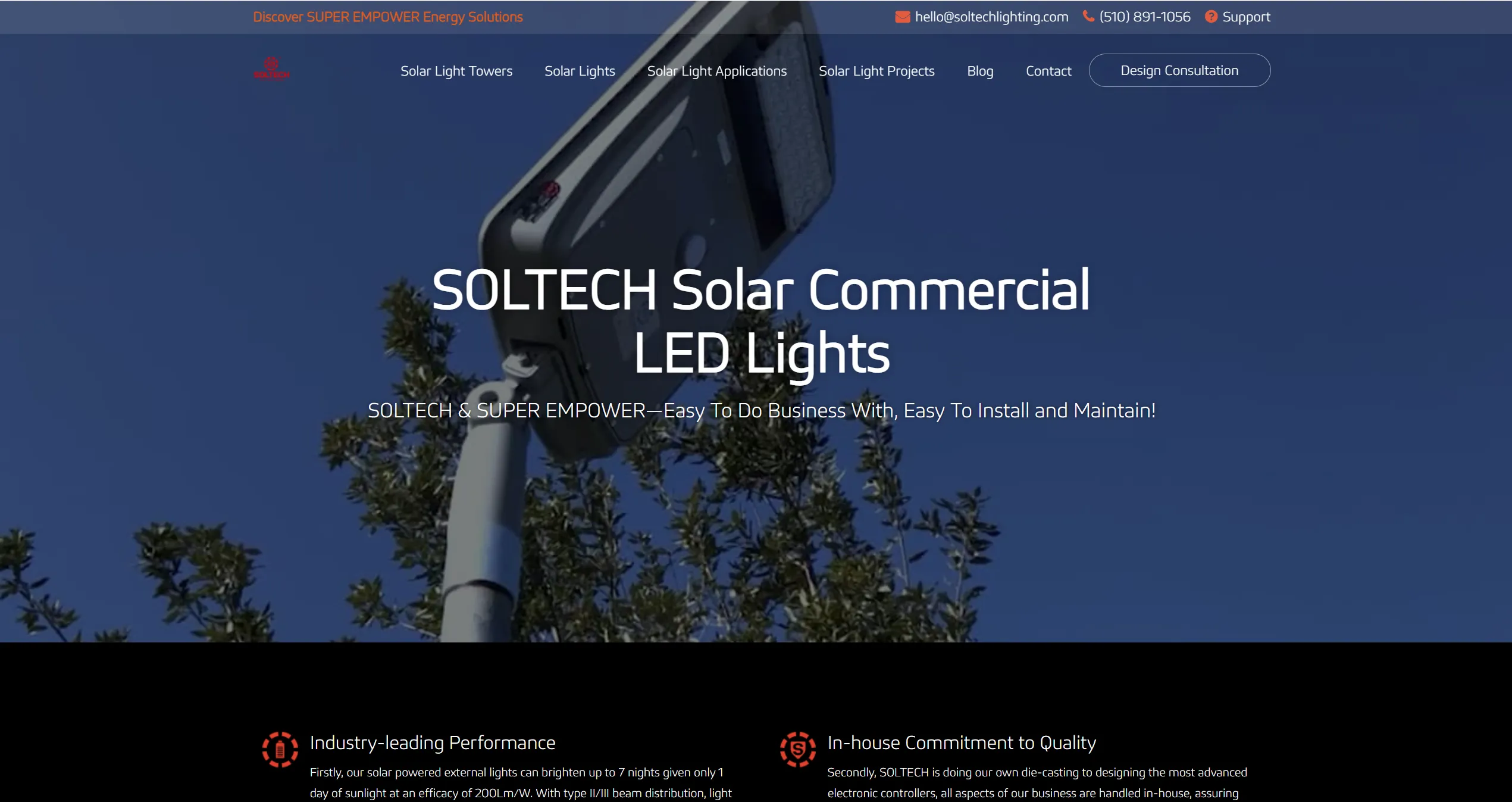
SOLTECH supplies commercial solar LED lighting for streets, parking lots, pathways, campuses, parks, military facilities, and other public or commercial areas.
Its commercial range includes SATELIS PRO, SUNLIKE PRO, CEGONIA PRO, ORINDA PRO, HYBRID, and other off-grid or hybrid solar lighting systems. Type II and Type III optical distributions are available across selected systems.
SOLTECH publishes an LED efficacy of up to 200 lm/W for parts of its portfolio and promotes multi-night operation when systems are correctly charged and configured. The SATELIS PRO range is specifically positioned for cold-weather applications and lists an operating temperature down to −40°C. SOLTECH commercial solar lighting products
The company also provides BAA-oriented product options for selected government, municipal, school, hospital, and military applications.
Best suited for:
North American commercial projects
Parking lots and campuses
Municipal pathways and streets
Cold-weather solar lighting
Projects with BAA-related procurement requirements
What buyers should verify:
Whether BAA compliance applies to the exact quoted model
Battery charging limitations at low temperatures
Photometric files for the specified optic
Real operating hours at each dimming level
Panel and battery sizing for winter conditions
Product warranty and regional service arrangements
8.SOKOYO
Country: China
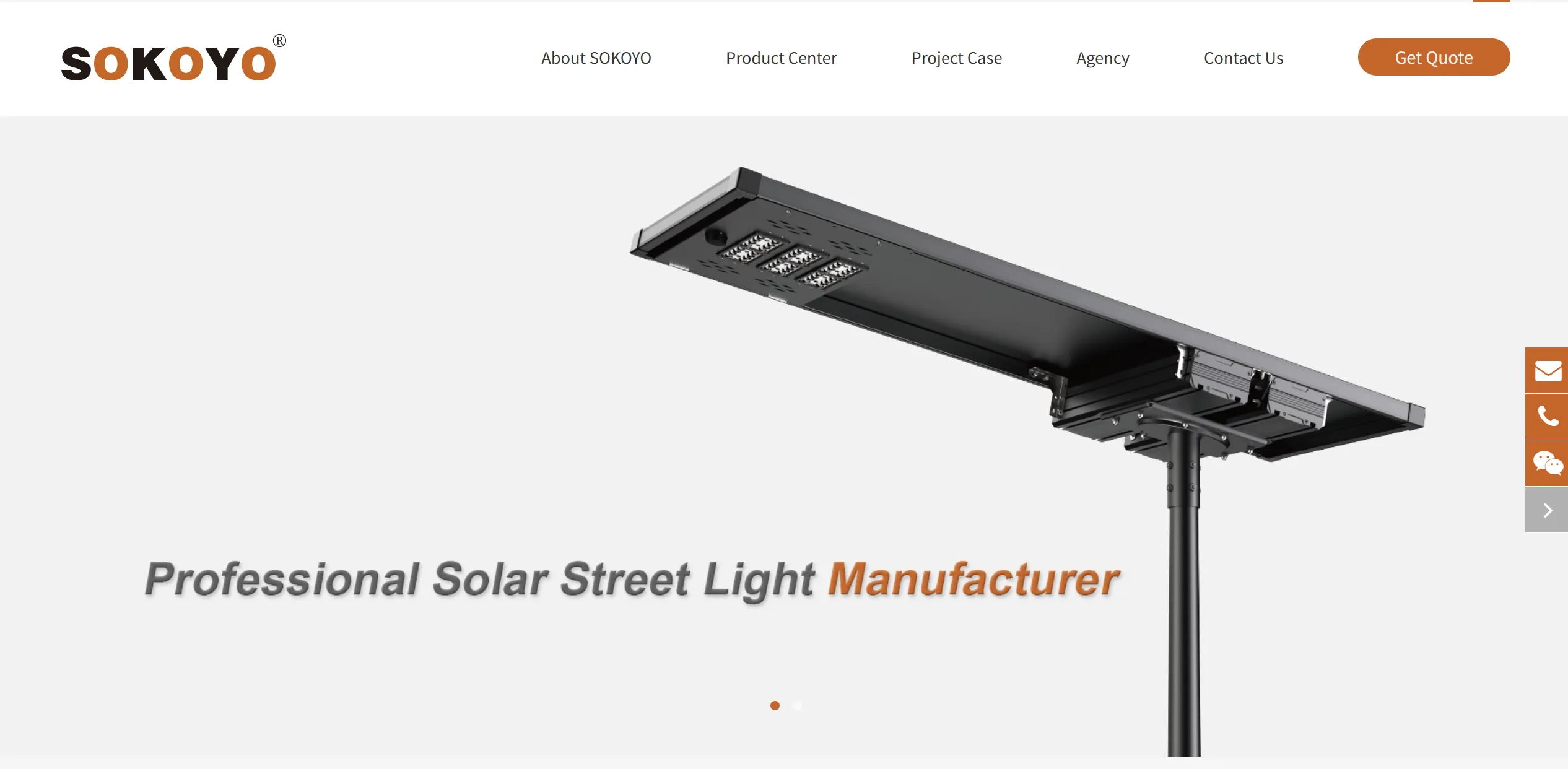
SOKOYO is a solar street light manufacturer based in Yangzhou, Jiangsu, China. The company was established in 2008 and focuses specifically on solar street lighting.
Its manufacturing coverage includes LED luminaires, light sources, solar panels, lithium battery systems, controllers, and light poles. This vertically integrated structure can be relevant to EPC companies and tender buyers that want one supplier to coordinate the complete system.
SOKOYO offers all-in-one, all-in-two, and split solar street lights for municipal roads, rural roads, highways, public spaces, and international infrastructure projects. The company also publishes ISO management certifications and product-related CE, RoHS, TÜV, CB, and other testing information. SOKOYO company and manufacturing information
Best suited for:
Government and municipal tenders
EPC road lighting projects
Split and integrated solar street lights
Buyers requiring poles and major system components
International projects needing China-based production
What buyers should verify:
Whether the certificate covers the quoted model
Battery cell supplier, usable capacity and cycle conditions
Controller protection and communication functions
Pole galvanization and wind-load calculations
Factory production scope for each component
Warranty handling outside China
Availability of installation supervision and replacement parts
9.Greenshine New Energy
Country: United States
https://www.streetlights-solar.com/
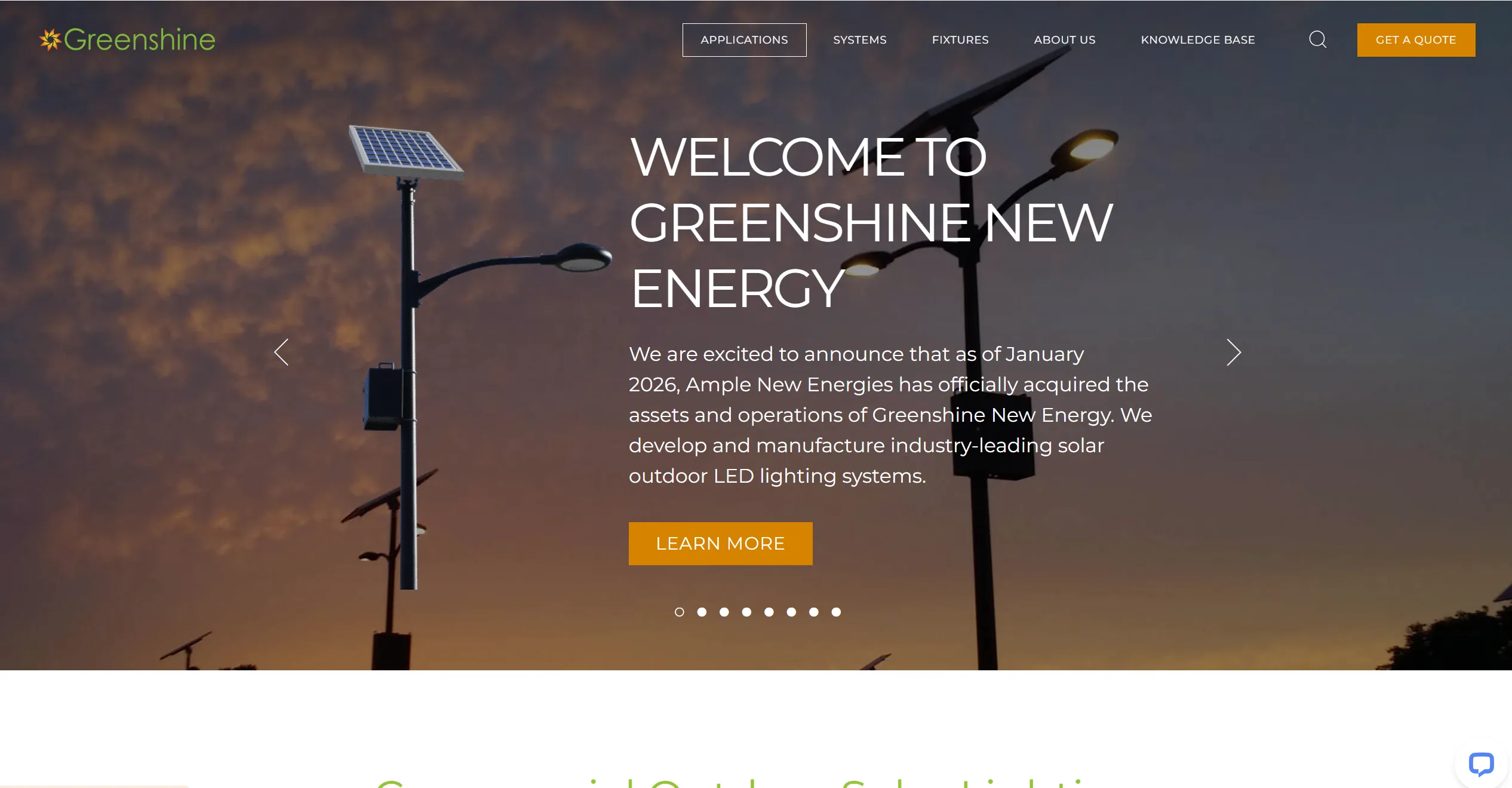
Greenshine New Energy supplies off-grid solar lighting for public streets, parking lots, pathways, parks, commercial properties, remote locations, security applications, and mobile lighting.
As of January 2026, Greenshine’s assets and operations were acquired by Ample New Energies. Greenshine continues as a registered lighting brand and trade name under the new ownership. Greenshine acquisition and company information
Its solar lighting portfolio includes Supera, Brighta, Lumina, and portable lighting systems. These configurations cover roadway lighting, medium-to-large outdoor areas, decorative applications, and temporary or relocatable lighting.
The current company positioning emphasizes site analysis, lighting design, procurement documentation, installation support, and after-sales service for municipal and commercial projects.
Best suited for:
U.S. municipal and commercial lighting
Streets, parking lots and pathways
Remote or grid-constrained sites
Portable solar lighting
Customized pole and fixture configurations
What buyers should verify:
Which legal entity issues the quotation and warranty
Whether previous Greenshine warranties remain unchanged
Current battery and controller specifications
Lighting design and structural documentation
Availability of replacement components after the acquisition
Installation and after-sales coverage in the project region
10.RoadSmart
Country: China
https://www.roadsmartsolar.com/
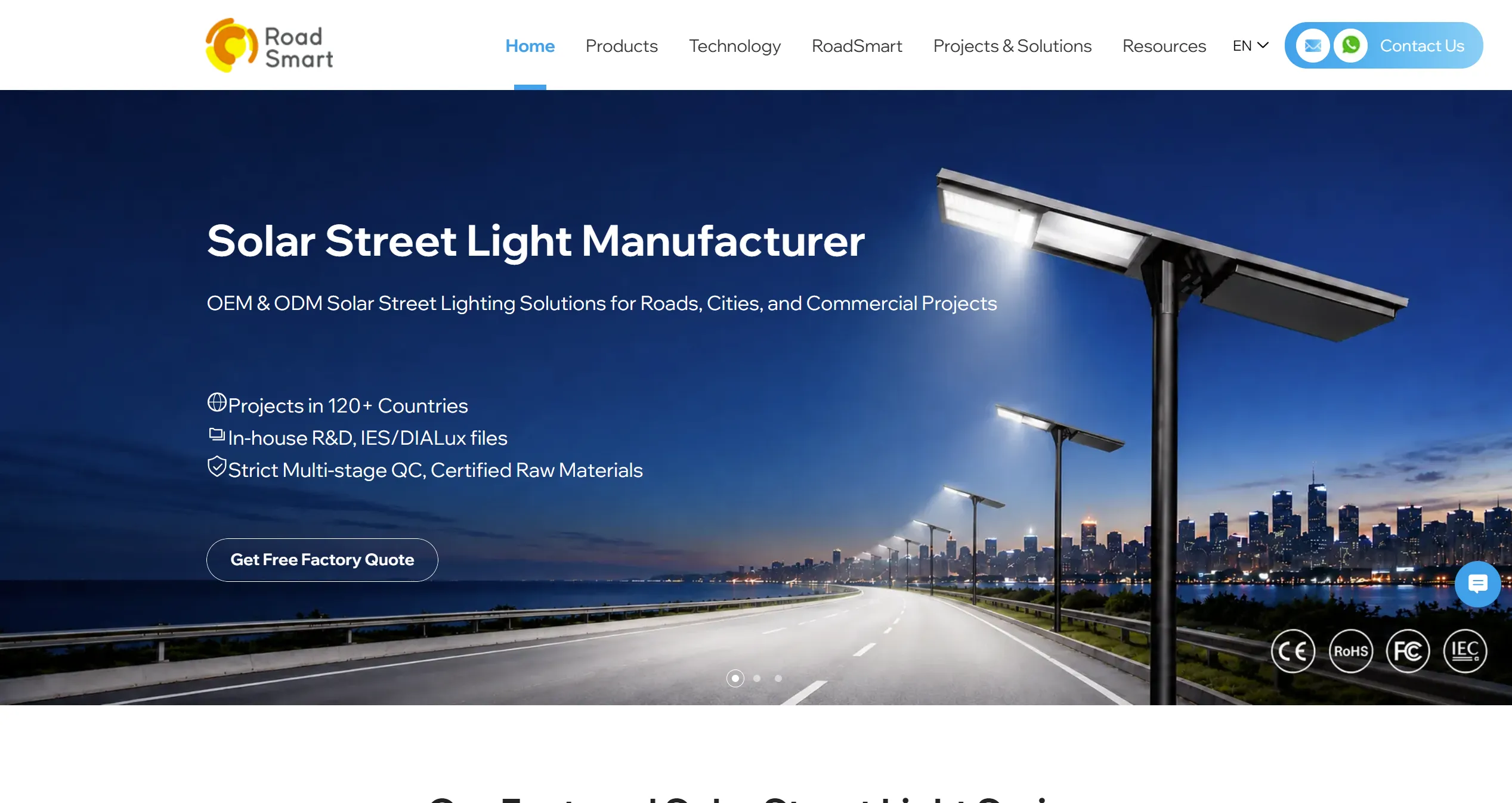
RoadSmart Solar, officially RoadSmart Co., Ltd., is a China-based solar street light manufacturer established in 2011. The company supplies all-in-one, all-in-two, split, solar pole, and project-specific solar lighting systems.
Its product portfolio includes the RSK and ST2 all-in-one series, FH, NH and Sailing all-in-two systems, SP split solar street lights, and HS and Y Series products for different road, public-space, commercial, and infrastructure applications.
RoadSmart provides OEM/ODM support for distributors and brand owners, as well as IES files, DIALux simulations, technical drawings, bill-of-material information, quality control documents, and pole-matching support for tenders and EPC projects.
According to its company information, RoadSmart operates a 12,000 m² manufacturing facility with eight automated production lines and supplies products to more than 120 countries. These figures should be verified through current factory audit and commercial documentation when required for a tender. RoadSmart company profile
Published RoadSmart projects include municipal roads, communities, industrial facilities, campuses, and other public areas across Africa, Southeast Asia, and additional international markets. RoadSmart project cases
Best suited for:
EPC and government tender projects
International solar street light distributors
OEM and private-label programs
Municipal roads, industrial zones and public areas
Buyers requiring all-in-one, all-in-two and split options
Projects requiring DIALux and tender documents
What buyers should verify:
Product certificate and test report model numbers
Battery cell, usable energy and cycle conditions
Exact autonomy under the proposed lighting schedule
Component-level warranty and RMA procedure
Reference projects using the same or similar model
Pole wind-load and corrosion requirements
Spare-parts plan for long-term maintenance
Which Solar Street Light Manufacturer Fits Your Project?
The following table provides an initial shortlist based on supplier positioning. It is not a substitute for a technical and commercial evaluation.
| Project Requirement | Manufacturers to Consider |
| Connected or hybrid smart-city lighting | Signify, Sunna Design, LEADSUN |
| Large autonomous municipal roads | Fonroche Lighting, Sunna Design, SEPCO |
| North American municipal and commercial projects | SEPCO, SOLTECH, Greenshine, Signify |
| China-based OEM/ODM and distributor supply | RoadSmart, SOKOYO, Sresky, LEADSUN |
| Cold-weather solar lighting | SOLTECH, Sunna Design, Fonroche Lighting |
| High-power split solar street lights | RoadSmart, SOKOYO, Fonroche Lighting, SEPCO |
| Integrated all-in-one systems | RoadSmart, Sresky, SOKOYO, LEADSUN, Signify |
| Portable or relocatable solar lighting | Greenshine, SEPCO |
| Tender documents and photometric support | RoadSmart, SEPCO, Sunna Design, Fonroche Lighting, LEADSUN |
Actual suitability depends on the proposed model, local service capability, project standards, and the completeness of the submitted engineering documents.
How to Evaluate a Solar Street Light Manufacturer
Start with Project Data
A responsible manufacturer cannot recommend a reliable system based only on the requested lamp wattage.
Before requesting a quotation, prepare:
Installation country and exact location
Road width and road classification
Pole height and spacing
Required average and minimum illuminance
Lighting uniformity requirement
Operating hours per night
Dimming schedule
Required cloudy or rainy-day autonomy
Local solar radiation
Lowest and highest temperatures
Wind speed and corrosion conditions
Expected order quantity
Required certifications and tender documents
Compare Complete System Specifications
The quotation should clearly identify:
Solar panel type and rated power in watts peak
Battery chemistry and usable energy in watt-hours
Battery depth of discharge and cycle conditions
LED system lumens and luminaire efficacy
Optical distribution and IES file
Controller type and MPPT efficiency
Motion-sensor or dimming logic
Ingress and impact protection
Pole material, galvanization and wind-load rating
Foundation and mounting requirements
A product labeled “100W” or “200W” does not provide enough information to evaluate lighting performance.
Review Engineering Documents
For municipal and EPC projects, request:
Product datasheet
IES photometric file
DIALux or AGi32 lighting layout
Solar energy calculation
Battery autonomy calculation
Installation drawing
Pole and foundation drawing
Wind-load calculation
Battery datasheet
Controller datasheet
Test reports
Certification documents
Quality control plan
Packing and shipping information
Warranty statement
Spare-parts recommendation
Verify Certifications
Do not evaluate a supplier only by the certification logos displayed on its website.
Check:
Name of the certificate holder
Manufacturing address
Product model
Test standard
Report or certificate number
Issuing laboratory
Issue and expiry dates
Whether the report covers the complete system or only one component
Compare Warranty by Component
A headline five-year warranty may not cover every part for five years.
Confirm separate coverage for:
Solar panel
Battery
Controller
LED module
Driver
Housing
Pole
Sensor
Communication gateway
Cables and accessories
Also confirm freight responsibility, replacement procedures, response time, labor coverage, and excluded operating conditions.
Common Solar Street Light Supplier Red Flags
Wattage Without System Data
The supplier promotes very high lamp wattage but does not provide system lumens, panel wattage, usable battery capacity, or an IES file.
One Configuration for Every Country
The same panel and battery configuration is recommended for tropical, desert, cold, and low-sunlight regions without recalculation.
Certificates That Do Not Match the Product
The certificate belongs to another company, factory, product category, or discontinued model.
No Photometric Design
The supplier recommends pole height and spacing without requesting road width, target illuminance, or optical distribution.
Unclear Battery Information
The quotation lists only battery amp-hours without voltage, usable watt-hours, cell information, depth of discharge, or temperature limits.
Vague Warranty Terms
The warranty states a number of years but does not define which components are covered or how replacements are handled.
No Relevant Project References
The supplier shows generic installation images but cannot provide a project location, product model, quantity, installation height, or similar operating environment.
For a more detailed factory audit framework, review 5 B2B Red Flags When Auditing a Solar Street Light Factory.
Conclusion
The top solar street light manufacturers in 2026 serve different project requirements. Some focus on connected public lighting, some specialize in high-power autonomous systems, and others provide flexible manufacturing for distributors, EPC contractors, and OEM programs.
A reliable selection process should begin with project conditions and technical requirements. Buyers should then compare complete system design, photometric performance, battery autonomy, environmental adaptability, certifications, warranty terms, project evidence, and after-sales support.
For buyers evaluating a China-based solar street light manufacturer for municipal roads, commercial areas, industrial zones, tenders, or OEM/ODM cooperation, RoadSmart can provide project-specific product selection, IES files, DIALux support, system configuration, and technical documentation.
Prepare the installation country, road width, pole height, spacing, lighting hours, rainy-day requirement, target illuminance, and estimated quantity before requesting a proposal. This information allows the engineering team to recommend a more realistic solar panel, battery, controller, luminaire, and pole configuration.
FAQ
Which is the best solar street light manufacturer in 2026?
There is no universal best manufacturer. The best supplier is the one whose products, engineering support, documentation, warranty, and service network match the project.
A municipal buyer may prioritize DIALux design, pole calculations, certifications, and long-term maintenance. A distributor may prioritize stable models, OEM branding, packaging, spare parts, and repeatable production. A North American public project may require local support, regional references, and procurement compliance.
How can I verify whether a supplier is a real manufacturer?
Request the company registration, factory address, production videos, factory audit report, quality control process, production equipment list, test equipment list, certification documents, and recent shipment records.
For large orders, arrange an on-site or third-party factory audit. Check whether the supplier manufactures the complete system, assembles selected components, or acts primarily as a trading company or system integrator.
What documents should an EPC contractor request?
An EPC contractor should normally request the datasheet, IES file, DIALux layout, solar energy calculation, battery autonomy calculation, drawings, pole wind-load data, test reports, certificates, bill of materials, quality plan, installation manual, warranty, and spare-parts list.
Additional documents may be required for government tenders or region-specific import compliance.
Is an all-in-one or split solar street light better?
All-in-one systems integrate the panel, battery, controller, and LED module into a compact structure. They are easier to install and suit pathways, communities, parks, campuses, and smaller roads.
Split systems allow larger panels and batteries and provide more flexibility in component position and maintenance. They are often more suitable for wide roads, highways, high poles, longer operating hours, and extended rainy-season autonomy.
All-in-two systems provide a middle option by separating the solar panel while integrating the battery and controller into the lamp body.
Which battery is best for solar street lights?
LiFePO₄ batteries are widely used because of their cycle life, safety, and compact design. However, battery suitability depends on operating temperature, charging conditions, depth of discharge, enclosure design, replacement strategy, and project cost.
Some engineered systems continue to use GEL or other battery types for specific climates and maintenance plans. Buyers should evaluate the complete battery system rather than selecting only by chemistry.
How many cloudy or rainy days should a solar street light support?
The required autonomy should be defined by the project rather than accepted as a generic supplier claim.
Many projects specify several nights of backup, but the correct requirement depends on the local rainy season, criticality of the road, dimming schedule, available solar radiation, and allowable maintenance risk. The supplier should show how the proposed panel and battery support the agreed operating profile.
Do solar street light manufacturers provide OEM and private-label services?
Many China-based solar street light manufacturers offer logo printing, housing color, product configuration, controller programming, CCT, optics, packaging, documentation, and structural customization.
Buyers should confirm the MOQ, tooling ownership, design ownership, sample process, certification responsibility, packaging standard, spare-parts support, and protection of distributor markets.
Should buyers choose the lowest-priced solar street light supplier?
The lowest quotation may use a smaller battery, lower solar panel capacity, reduced operating hours, aggressive dimming, lower-grade components, or limited warranty coverage.
Compare quotations using the same lighting output, operating schedule, rainy-day autonomy, pole configuration, certificates, warranty, and engineering scope. Otherwise, the prices do not represent equivalent systems.