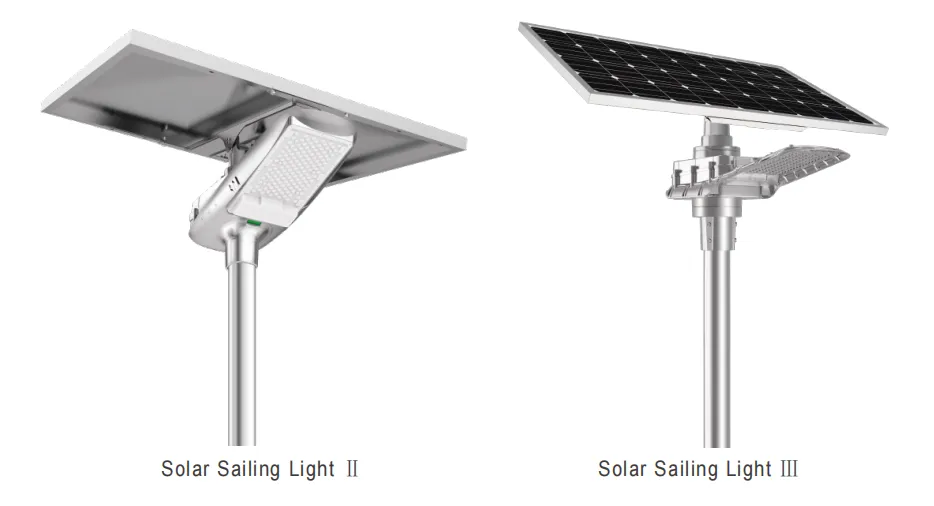
What are the Differences Between Split-type and All in One Solar Light, and are Their Application Scenarios Different?
May 22, 2026
Read:601
Introduction
All in one solar lights and split solar street lights are the two main product types of solar street lights. They are often compared with each other, and which type of product to choose is also a relatively difficult issue in procurement. In the view of many people, both rely on solar power generation, and they are only obviously different in appearance, while the rest should be more or less the same.
In fact, this is not the case. All in one solar lights and split solar street lights not only look different, but also have obvious differences in many aspects, ranging from structure, installation, and application scenarios to internal configuration, installation spacing, and other details. These differences can only be understood through in-depth knowledge. From the perspective of professional interpretation, this article will use easy-to-understand language to explain the differences between all in one solar lights and split solar street lights from the four most important aspects: definition, installation and construction, maintenance cost, and application scenarios. On this basis, it will teach you how to judge your own project situation and choose suitable products according to actual needs, helping you understand the differences and learn how to select the right type.
What are the Definitions of All in One Solar Lights and Split Solar Street Lights? What Structural Differences are There Between Them?
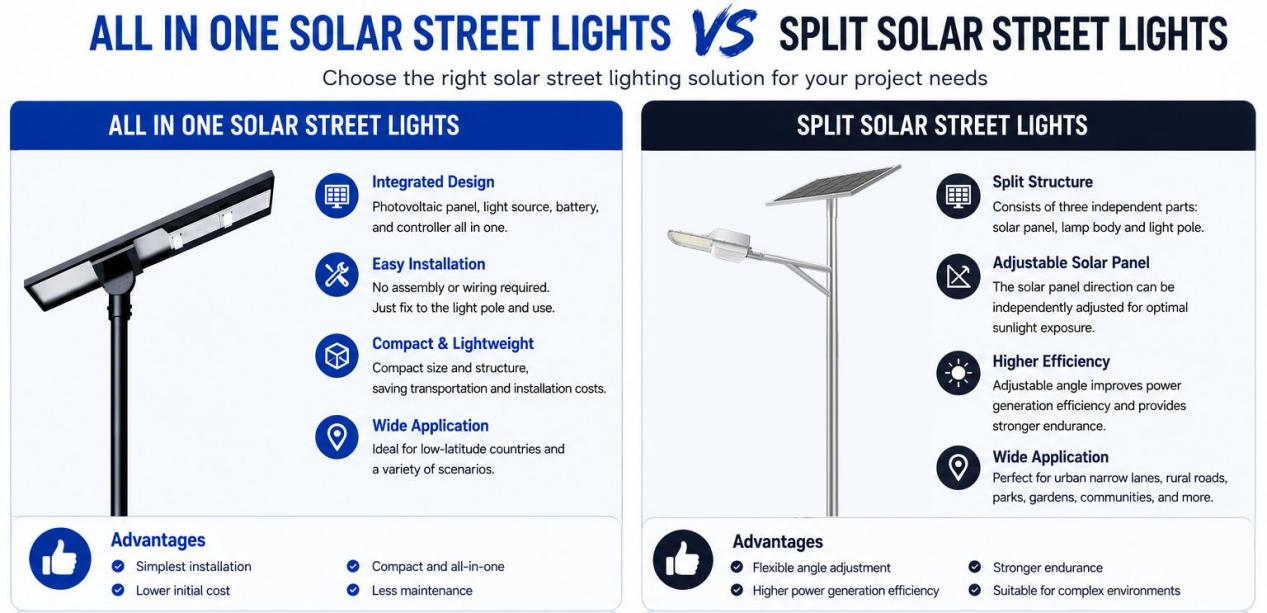
What is an All in One Solar Street Light?
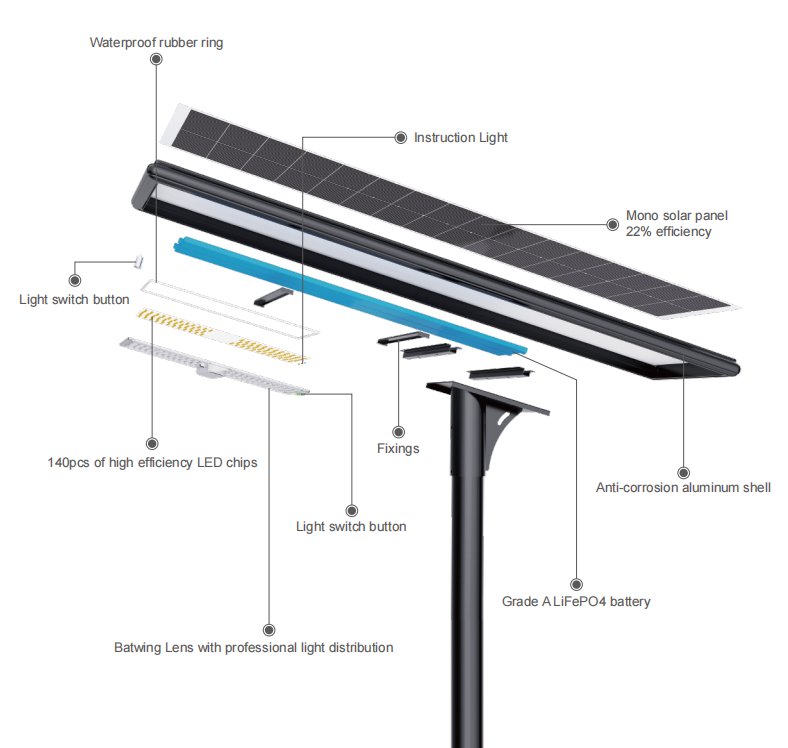
An all in one solar street light integrates the solar photovoltaic panel, lamp head, battery, and controller all into one lamp body, without the need for assembly, forming an independent lighting system. It does not need to be connected to municipal electricity and can achieve independent operation. It automatically stores energy during the day and generates power independently at night. Its appearance design is beautiful and neat, and its size is compact.
What is a Split Type Solar Street Light?
A split type solar street light, as the name suggests, separates the main components such as the solar photovoltaic panel, lamp head, battery, and controller, and they are assembled on site. Its core feature is that it can be freely matched according to needs. The solar photovoltaic panel can be adjusted to a suitable angle according to the orientation, and the battery and lamps can also be adjusted, making it flexible and convenient.
After understanding the difference between the definitions of the two, let us further understand the differences in the three main dimensions of installation and construction, maintenance cost, and application scenarios.
What Are the Differences in Installation and Construction Between AIO Solar Street Lights and Split Solar Street Lights?
As can be seen from the above, aio solar street lights and split solar street lights have different definitions and structures, which also determines the differences in their installation methods.
The integrated design of aio solar streets makes installation and construction very simple. No professional personnel are required, and there is no need for wiring or trench digging. You only need to unpack the product, fix the lamp onto the light pole, and after basic debugging, normal lighting can be achieved. The installation speed is fast, making it very suitable for projects with tight schedules and no need for additional wiring.
Relatively speaking, the installation and construction of split solar street lights are more complicated. Since each component is independently separated and packaged, professional construction personnel are required for on-site installation. There are many steps, and it takes a long time. Each component, accessory, and the site itself need professional installation and supporting configuration. The construction is more complex and the cost is higher. It is more suitable for projects that require high power, strong endurance, and flexible on-site installation.
What Is the Difference in Maintenance Cost Between All in One LED Solar Street Lights and Split Type Solar Street Lights?
In the early stage of use, there may not be much difference between all in one led solar street lights and split type solar street lights, but after long-term use, the difference will be very obvious.
Because all in one led solar street lights have a compact structure and almost all components are integrated together, they require almost no maintenance. It is only necessary to clean the solar photovoltaic panel regularly. However, if one of the components is damaged, it cannot be repaired separately. The whole lamp needs to be removed and replaced, and the cost of replacing a single component is higher.
Split type solar street lights are the opposite. Although there are relatively more components that need to be checked in the early stage, once a problem occurs in any part, it can be maintained separately and handled by module, without the need for overall replacement. In the long run, this can save maintenance costs.
Are There Differences in Application Scenarios Between All in One Integrated Solar Street Lights and Split Solar Street Lights?
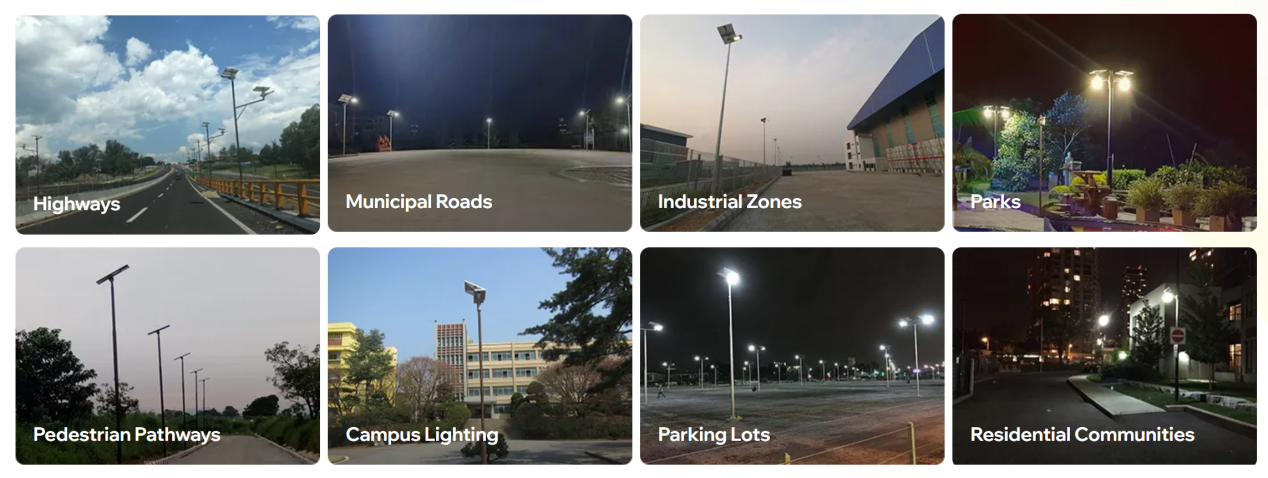
It can be said with certainty that there are very clear differences. Therefore, it is necessary to choose a suitable model according to the actual scenario of the project, and products should not be selected casually.
All in one integrated solar street lights are compact in size and have a neat and beautiful appearance. They are very suitable for park paths, courtyards, community walkways, scenic areas, and other scenarios. Because they are easy to install and can operate independently, they are also suitable for villages, mountainous areas, outdoor areas, and other regions without grid coverage.
Split solar street lights, because of their larger capacity, higher power generation efficiency, and stronger endurance, are more suitable for high-standard scenarios such as large roads, factory areas, and municipal projects. They can also independently adjust the orientation, making them suitable for scenarios with more complex lighting conditions.
How Should Your Project Choose Between LED Solar Street Light All in One and Split Type Solar Street Lights?
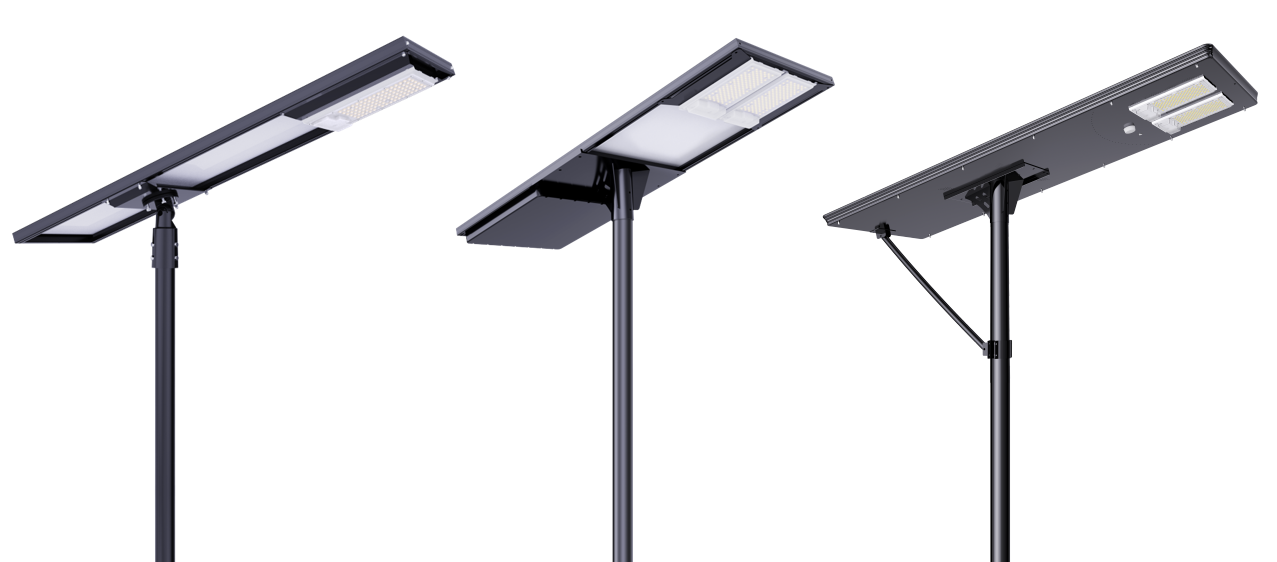
To choose a suitable type of solar street light for your project, you can focus on the following points:
First, look at the project schedule. If your project is urgent, the construction period is short, and there are few construction personnel, led solar street light all in one can be given priority. If there are no obvious requirements for the construction period and professional personnel can be arranged properly, then split type solar street lights are preferred.
Second, look at the application scenario of the project. If the application scenario is relatively small and the power requirement is not high, led solar street light all in one is more suitable. If the application scenario is large, the power requirement is high, and targeted configuration is also needed, split type solar street lights are more suitable.
Third, look at the budget and maintenance. If there is no professional maintenance team and you want to save construction costs, choose led solar street light all in one, which are worry-free in the early stage. If there is a professional maintenance team and long-term cost performance is pursued, choose split type solar street lights, which save money in the later stage.
It should be specially noted that RoadSmart’s led solar street light all in one technology is very mature. The product power covers 60–120W and can cover some rural main roads and small parks. If the budget is limited, it can be given priority.
Conclusion
After understanding the definitions, installation and construction, maintenance costs, and application scenarios of all in one solar street lights and split type solar street lights, I believe you now have a certain understanding of these two products. It should be understood that when choosing between these two products, it is not about choosing the best one, but choosing the suitable one. Do not blindly follow the trend. Instead, you should comprehensively evaluate your own project needs, application scenarios, budget, and other conditions, determine priorities, and then select the most suitable all in one solar street light or split type solar street light lighting solution for your project.