What Are the Most Important Factors When Choosing Solar Street Lights?
May 26, 2026
Read:474
Summary
As an important global basic lighting facility, the importance of solar street lights is self-evident. With the growing market demand, how to choose suitable solar energy street lights has become a major challenge. Many people are asking: what is the first reference factor when choosing solar powered street lamps?
Based on this, this article will start from the most critical reference factor from the perspective of a professional recommender, telling purchasers how to choose suitable solar powered led street lights, so that they can have fewer concerns and more professionalism.
After reading this guide, you will know exactly which type of solar street light fits your rural road, parking lot, highway, or industrial project – without overpaying or under-specifying.
What Is the First Factor in Choosing Solar Street Lights?
Before you choose, answer these 7 questions:
- What is the road type? (Rural, urban main road, highway, parking lot, park?)
- What is the local climate? (Rainy days per year, extreme temps, coastal?)
- What is the road width and pole height?
- What is the desired spacing between lights?
- How many hours of lighting per night?
- How many rainy/cloudy days of backup needed?
- Is there professional maintenance available?
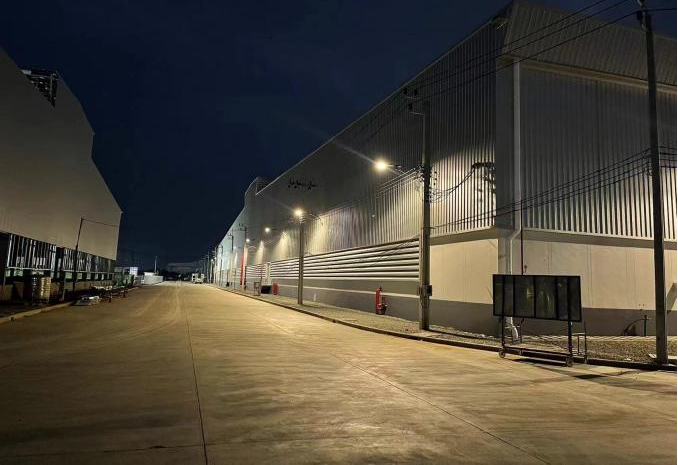
Undoubtedly, it is scenario matching. To expand on this, it refers to the specific and actual scenario required by the project application. Although solar street lights are a lighting solution with a wide range of applications, not every place or scenario is applied in the same way if more stable, energy-saving, and low-maintenance lighting is desired. Therefore, before recommending solar street light products, it is necessary to clarify the project’s usage environment.
Different scenarios have very different requirements for solar street lights. For example, whether they are used on rural roads, urban main roads, parking lots, parks, schools, industrial areas, or highways; what the local climate environment is like; what the road width is; how high the light pole needs to be; the spacing between each solar street light; how long the lights need to stay on at night; and how long the endurance capacity needs to be on rainy days. These are all key points that must be clearly considered before choosing solar led street lights, and they must not be treated carelessly.
Next, we will focus on understanding the main reference factors for solar street lights under different application scenarios.
Considerations for Solar Energy Street Lights in Different Application Scenarios
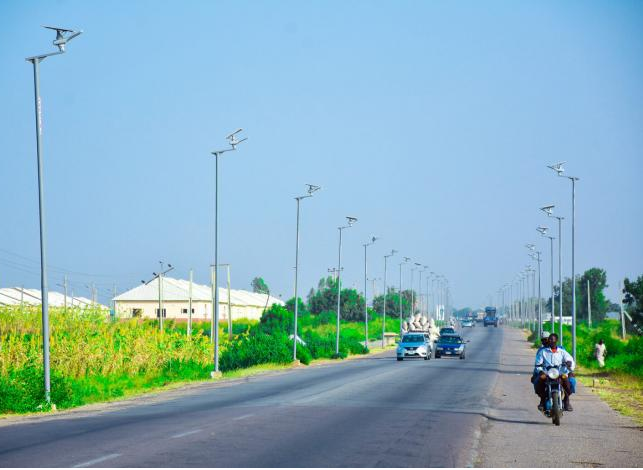
Solar energy street lights cover almost all scenarios. In this article, we will mainly analyze the following relatively common scenarios and recommend different types of solar street lights:
1. Rural Roads
Rural areas do not have a stable power grid, and the vehicle flow and pedestrian flow are also relatively small. In addition, the lanes are narrower, so there is not such a high demand for lighting brightness. Meeting basic lighting needs is enough, and cost performance and simple installation are more valued. Therefore, all in one solar street lights are a suitable choice.
2. Urban Main Roads
There is more traffic flow, and driving safety is very important. There are higher requirements for the brightness, illumination range, lighting uniformity, and safety of solar powered street lamps. Professional construction and commissioning personnel are needed to design a light distribution plan and avoid unclear vision caused by uneven lighting. Solar powered led street light products with higher power and larger battery capacity are required, so split type solar street lights are recommended as a more suitable match.
3. Parking Lots
The focus is on lighting area and light uniformity. Therefore, the illumination angle and installation spacing of solar street lights are very important. Both all in one solar street lights and split type solar street lights can be used, depending on the specific lighting brightness requirements.
4. Industrial Areas, Parks, or Schools
These are basically large-area scenarios. While achieving safe and stable lighting, centralized maintenance and management are also required. The endurance and intelligent control functions of solar powered led street lights are highly valued, so it is necessary to clearly check the core configuration of the solar energy street lights, especially the configuration of the battery and controller. Battery chemistry, usable energy and temperature limits affect system reliability. See the solar street light battery comparison for the main differences.
5. Highways or Wide Road Projects
These belong to application scenarios with high requirements for solar energy street lights. Ordinary solar street lights are difficult to adapt to them, and matching and customization are needed according to specific requirements. Brightness and endurance are only basic considerations. Wind resistance, dust prevention, corrosion resistance, and long-term operational reliability must also be considered. What is needed is a stricter engineering lighting solution.
RoadSmart’s 3 Golden Rules for Solar Street Light Selection:
Scenario first, configuration second – Don’t start with price.
Environment first, price second – Harsh climates demand higher specs.
Long-term stability first, single parameter second – A high-lumen light that fails in 2 years is worthless.
Conclusion
When recommending solar led street lights, the correct logic should be: look at the scenario first, then determine the configuration; look at the environment first, then compare prices; look at long-term stability first, then look at individual parameters. In this way, the selected solar powered led street lights can meet the actual needs.
As a China solar street light manufacturer that drives product innovation through technology, RoadSmart has products that can meet almost all of the above application scenario needs, includingall in one solar street light, integrated solar street lights, split-type solar street lights, solar garden lights, pole-type solar street lights, and more. With different series and different specifications, RoadSmart can also provide OEM or ODM solutions according to the specific needs of the project. If your project has related needs, please feel free to contact RoadSmart at any time.
Frequently Asked Questions (FAQs)
Q1: Can solar streetlights be used on highways? Is the brightness sufficient?
A: Yes. Using 180-260W All-in-One or high-power All-in-Two products, the luminous flux can reach 18,000-31,000 lm. With professional optical lenses, it fully meets highway lighting standards. RoadSmart has numerous highway project cases.
Q2: Is an integrated system necessary for rural roads?
A: Not necessarily, but an integrated system is the most economical and efficient choice. It is easy to install (no trenching required), operates independently, has a 5-7 day battery life even in cloudy or rainy weather, and its cost is controllable. If there is a need for future expansion, an All-in-Two system can also be considered.
Q3: Should parking lots use integrated or separate systems?
A: Both are acceptable. If installation speed and cost are important, choose an integrated system; if the parking lot area is large, requires more uniform light distribution, or has an adjustable panel angle, choose a separate system. RoadSmart can provide DIALux simulations based on your site requirements.
Q4: What should be considered when choosing lights in coastal areas?
A: IP65 protection rating + anti-corrosion coating is a must.
Q5: Does RoadSmart offer free product selection consultation?
A: Yes. Contact us to receive free DIALux simulation, product parameter suggestions, and project case references.