10 Traps to Avoid When Buying Commercial Solar Street Lights Online (2026 Checklist)
May 29, 2026
Read:529
There are many ways to purchase solar street lights, but if we are talking about the most convenient way with the widest range of product types, it is definitely online. Open any webpage, type in “solar street light”, and many different types of products will appear for selection, including all in one solar street lights, split solar street lights, and various products classified by specifications such as 60W, 100W, and so on. However, they cannot be selected casually. Solar street lights still need to be chosen according to specific requirements.
According to industry surveys, over 60% of online solar light buyers have received products with inflated wattage claims or undersized batteries. Don‘t be one of them.
This article focuses on commercial solar street lights. Based on practical experience, it summarises 10 traps that should be avoided when purchasing online, hoping to provide some help when you choose and buy solar street lights online.
After reading this guide, you will know exactly what to check before clicking “buy” – from battery type to hidden costs – and how to avoid expensive mistakes.
10 Red Flags to Avoid Buying for Commercial Solar Street Lights Online
Trap 1: Taking low price as the first choice
This is the most common trap when purchasing commercial solar street lights. After all, a low price is the most attractive. For one unit, the difference may not be so obvious, but when making bulk purchases, the price gap can become particularly large, making it difficult not to be tempted. But please remember that commercial solar street lights are different from ordinary solar street lamps. The environment in which they are used requires the configuration to meet certain standards. If the price is very low, you need to be alert, because the configuration may have been reduced, which can easily lead to product quality problems later.
The point to note is: do not look only at the price. You must clearly understand the configuration behind the commercial solar street light.
Quantitative Warning: Be highly cautious if the price is more than 30% lower than the market average. A normal FOB price for a 120W integrated street light is around 220-450 (currency unspecified). Prices below 220-450 (currency unspecified) or below 150 (currency unspecified) are generally problematic.
Avoidance Tip: Request a detailed BOM (Bill of Materials) and test reports from the supplier.
Trap 2: Choosing lights without mentioning the application scenario
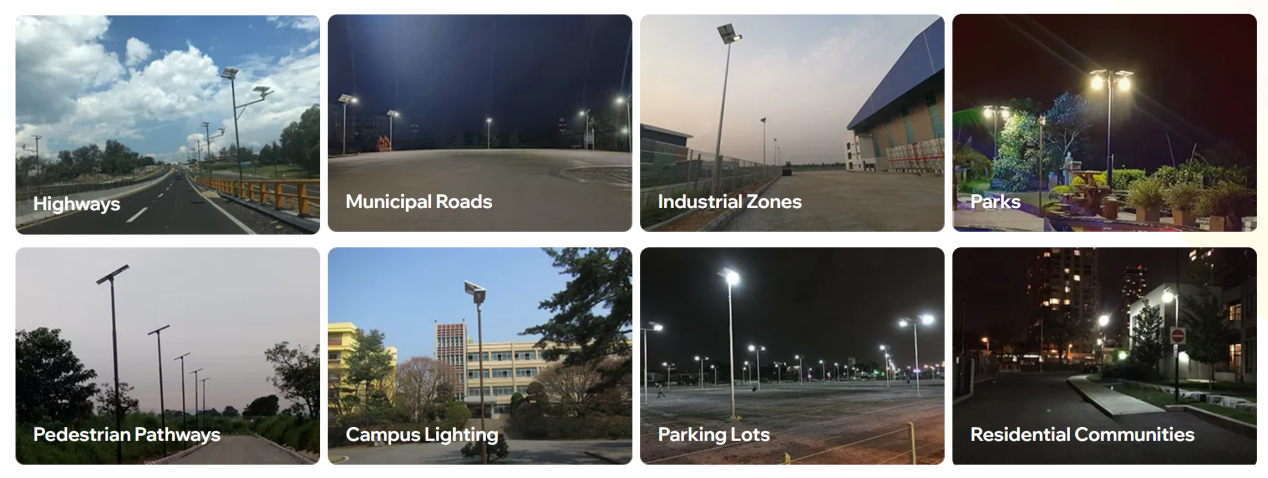
When browsing different commercial solar powered street lights online, most of the content placed at the front is about parameters and configurations, while the specific application scenarios are often placed later. This makes them easy to ignore. If you only look at the specific parameters, it becomes difficult to choose the right solar street lamp product. Different application scenarios have completely different requirements for led solar street lights. Therefore, one point to remember is: determine the actual conditions of the project site, and do not choose blindly.
Quantitative Warning: If the product page lacks any scenario description, such as “Suitable for rural roads” or “Suitable for parking lots,” it indicates the supplier is not concerned with matching requirements.
Avoidance Tip: Proactively inform the supplier of your specific scenario, including road width, pole height, and sunlight conditions, to see if they can provide a reasonable configuration.
Trap 3: Taking power as the main consideration
Since many commercial solar powered street lights display products according to different power ratings, directly marked as 100W, 120W, 200W, and so on, people may think this is a direct reflection of brightness. In fact, this is not the case. Power only refers to electricity consumption, not brightness or the actual lighting effect. The brightness of a solar led street light should be judged by actual lumens, luminous efficacy, light distribution, and other effects. It is not true that the higher the power, the better the lighting effect. You also need to look at lighting uniformity and the suitable range for the specific scenario.
Quantitative Warning: If a product only lists “100W” without providing the lumen output (lm) or luminous efficacy (lm/W), it’s likely a misrepresentation. High-quality products will simultaneously indicate: 100W, 16,000 lm, and 160 lm/W.
Tips to avoid pitfalls: Ask, “What is the actual luminous flux in lumens? What is the LED luminous efficacy in lm/W?”
Trap 4: Ignoring battery type and capacity
As one of the core components of a solar powered street lighting, the battery determines the endurance capacity of the whole street light. Therefore, when purchasing online, you need to check what type of battery is configured in the commercial solar street light, and what the specific capacity is. If only vague words such as “large capacity” and “ultra-long endurance” are written, they have little reference value. This means the battery parameters are not transparent, making it difficult to judge whether the battery can support the related functions. One point that needs to be specially noted here is that commercial solar street lights should focus on whether lithium iron phosphate batteries are used.
Quantification guidelines: Be wary if the product only states “large-capacity lithium battery” without specifying Wh or Ah, or the battery type (LiFePO4 or ternary lithium). Commercial-grade batteries should at least use LiFePO4, and the capacity should be calculated based on power and range.
Tips to avoid pitfalls: Request specific battery type, capacity (Wh), and cycle life (≥2000 cycles).
Trap 5: Choosing a solar photovoltaic panel that is too small
The solar photovoltaic panel is an important power-generation component that receives solar energy during the day. If the solar photovoltaic panel is too small, it means the area receiving sunlight is small, which will cause slow daytime charging or even failure to fully charge, making it unable to support stable power supply and lighting at night. Therefore, when choosing commercial solar powered street lights, local sunlight conditions and lighting duration must be fully considered. The panel should not be too small or too large, and should be configured according to specific requirements.
Quantification guidelines: The photovoltaic panel power should be 1.5-2 times the LED power. For example, for a 120W LED, the photovoltaic panel should be between 180-240W. Usable area estimation: High-efficiency monocrystalline silicon panels are approximately 200W/m².
Tips to avoid pitfalls: Request the open-circuit voltage and short-circuit current parameters of the photovoltaic panel to confirm compatibility with the controller.
Trap 6: Ignoring the controller
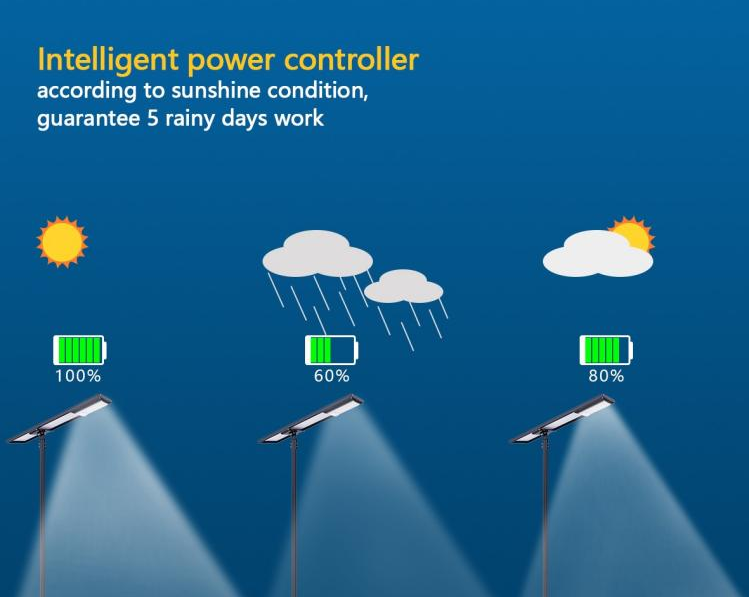
This is an invisible structural detail, but it is the brain that controls the solar street light system. It is responsible for charging and discharging, lamp switching, and brightness adjustment, and can directly affect the stability of the whole system. Therefore, when purchasing commercial solar powered street lights online, a high-quality controller should be selected. It is also necessary to check whether the controller supports reasonable protection functions and dimming strategies. This can ensure basic lighting, reduce pressure on the battery, and extend the service life of the street light.
Quantification guidelines: If the product does not specify the controller type (MPPT or PWM), it is likely an inefficient PWM controller. MPPT charging efficiency is 20-30% higher than PWM.
Tips to Avoid Pitfalls: Confirm the controller supports overcharge, over-discharge, and over-temperature protection, as well as multi-time-period dimming.
Trap 7: Not paying attention to shell quality
The internal configuration is important, and the shell structure is equally important. It is the key structure that protects the core configuration. Therefore, when purchasing commercial solar street lights online, attention should be paid to the requirements of the specific use environment for the shell, the explanation of waterproof material grade, waterproof structural design, as well as corrosion resistance, high-temperature resistance, and other capabilities for dealing with various extreme weather conditions.
Key Quantitative Guidelines: Be wary if the IP rating is not specified (at least IP65, IP66/IP67 recommended for commercial use), or if the housing material is not described (die-cast aluminum is better than plastic).
Tips to Avoid Pitfalls: Request an IP test report and confirm whether it has an anti-corrosion coating for coastal environments.
Trap 8: Not checking certifications and test reports
This is also a point that is very easy to overlook, because purchasers often only look at the product itself and forget the solar street light supplier behind it. When purchasing commercial solar powered street lights online, it is recommended to confirm with the supplier whether they can provide specifications, photoelectric parameters, IP protection tests, CE, RoHS, battery test reports, installation instructions, and warranty documents. If they cannot provide these, then careful consideration is needed.
Key Quantitative Guidelines: Reputable suppliers should be able to provide CE, RoHS, IP test reports, battery UN38.3 certification, IES documentation, etc. If they refuse on the grounds of “trade secrets,” skip this step.
Tips to Avoid Pitfalls: Request a sample specification sheet and screenshots of third-party test reports.
Trap 9: Not asking about after-sales service
Any product needs after-sales service, and commercial solar powered street lights especially need it. This involves whether a corresponding responsible person can be found for later service. It needs to be made clear whether the solar street led light has installation guidance, how many years of warranty are provided after installation, what parts are covered by the warranty, what to do if a fault occurs, and so on. All these details need to be clarified one by one.
Key Quantitative Guidelines: At least a 3-year warranty on the entire lamp (batteries can be agreed upon separately). Confirm whether there is local after-sales service or a response time commitment.
Tips to Avoid Pitfalls: Clearly define the warranty scope (which components), warranty duration, and response process in the contract.
Trap 10: Not looking at lifecycle cost
This echoes the first trap of only looking at low price. When purchasing commercial solar street lights online, you cannot only look at the purchase price. If the purchase price is low but the product soon requires constant maintenance, repair, and replacement, then in the long run it will consume both time and labour. You still need to look at the cost of the whole lifecycle, including product purchase price, transportation and installation costs, maintenance and replacement costs, fault rework costs, long-term use costs, and so on. These all need to be taken into consideration. Commercial solar street lights place more emphasis on the cost of the entire lifecycle.
Quantitative benchmark: A 10-year TCO (Total Cost of Ownership) should include: purchase price + installation cost + electricity cost (0 for solar power) + maintenance/replacement cost. Cheap lights may break down in 3 years, making them more expensive in the long run.
Tips to avoid pitfalls: Ask the supplier to provide a comparison of 5-year and 10-year TCO estimates.
Checklist Before Purchasing
Check Item | Key Confirmation Content |
Power | Whether it is the real LED power |
Brightness | What the actual lumens and luminous efficacy are |
Solar panel | Whether the power is sufficient and whether it matches local sunlight conditions |
Battery | Whether the type, capacity, and cycle life are clear |
Controller | Whether it has protection functions and dimming modes |
Protection rating | Whether there is an IP rating and related testing |
Application scenario | Whether it matches road width, pole height, and installation spacing |
Rainy and cloudy days | Whether it supports lighting during consecutive rainy and cloudy days |
Certification documents | Whether there are specifications, test reports, and certifications |
After-sales service | Whether warranty, spare parts, and technical support are clear |
Conclusion
Because the specific product cannot be seen when purchasing online, it is easy to be misled by the surface promotional numbers. Therefore, when buying commercial solar street lights online, you need to look at the product comprehensively from all aspects. Do not only look at a single parameter, number, or price. You need to look at the real performance supported behind the numbers, as well as the configuration of the entire system. If you cannot distinguish these by yourself, you can choose RoadSmart as a reference to provide practical purchasing experience and solar street led light lighting solutions.
But in the end, one sentence should always be remembered when purchasing: buying online is not the problem; failing to verify is the real problem.
Frequently Asked Questions (FAQs)
Q1: I see many low-priced solar streetlights on Alibaba. Are they really usable?
A: Some may be usable, but the risks are high. Low prices usually mean: lead-acid batteries (2-year lifespan), inefficient PWM controllers, falsely advertised power, and no certification. They might be acceptable for temporary lighting, but not recommended for commercial projects.
Q2: How can I determine if an online supplier is a legitimate factory?
A: Check four points: ① Do they have a live factory video or can arrange a video factory visit? ② Do they have "Powerful Seller" certification on platforms like Alibaba? ③ Can they provide OEM/ODM case studies? ④ Do they have complete company qualifications and tax registration? RoadSmart supports video factory visits.
Q3: What documents should I request from the supplier to place an order with confidence?
A: At least: Product specification sheet (including detailed parameters), IES file (light distribution curve), CE/RoHS certificate, battery test report, company business license/export qualification. Large projects also require a third-party inspection report.
Q4: What should I do if the parameters do not match the received goods?
A: First, stipulate the acceptance standards in the contract (e.g., "actual luminous flux not less than 95% of the nominal value"). After receiving the goods, a simple verification can be done using an illuminance meter and power meter. If it does not meet the requirements, request a return or compensation based on the contract and test evidence. It is recommended to trade through platforms such as Alibaba, which have dispute resolution mechanisms.
Q5: What is RoadSmart's online procurement process? Can you provide samples?
A: RoadSmart supports sample orders (minimum 1 unit), providing detailed specifications and third-party test reports. Video factory visits or on-site inspections can be arranged. For bulk orders, a formal contract will be signed, clearly defining warranty and acceptance terms. Contact the sales team for details.
Q6: If I cannot go to China for a factory inspection, how can I ensure quality?
A: You can request: ① a real-time video factory inspection; ② inspection by a third-party inspection agency (such as SGS, TUV); ③ place a sample order first, and proceed with bulk orders only after the sample passes testing. RoadSmart can cooperate with any form of remote factory inspection.