Do Solar Lights Work in Winter? Charging and Cold Weather Explained
Sep 28, 2026
Read:203
Source: Yin Zhenkun
Yes, solar lights can work in winter, provided they receive enough daylight and operate within their specified temperature limits. However, shorter days, longer nights, shading, and snow can reduce the energy available for lighting. Battery charging restrictions also matter, particularly in freezing conditions.
If you are asking whether solar powered lights work in the winter, distinguish between a light switching on briefly and delivering the brightness and operating hours you need. A decorative garden light and a road-lighting system have very different requirements.
The most useful checks are straightforward: how much energy the panel collects, how much the battery can safely store and deliver, and how much the light consumes overnight.
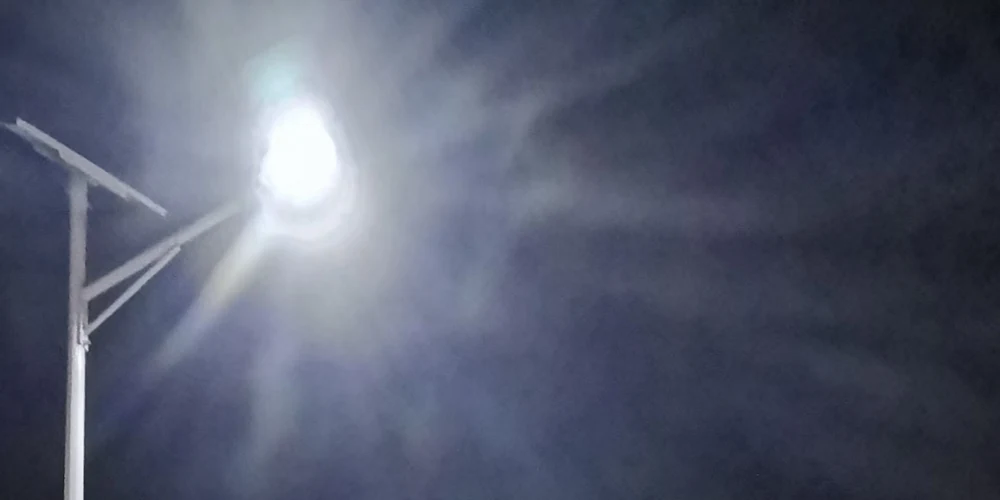
Solar street lights continuing to operate after dark.
What Changes for Solar Lights in Winter?
Winter affects several parts of a solar lighting system at once. Identifying the limiting factor helps you decide whether to change the installation, adjust its operating mode, or select a different configuration.
| Winter condition | Possible effect | What to check |
|---|---|---|
| Shorter days | Less time to collect solar energy | Local winter solar resource |
| Lower sun angle | Longer shadows and different panel exposure | Buildings, trees, and panel orientation |
| Longer nights | More hours of lighting demand | Timer settings and brightness schedule |
| Cloud cover | Lower solar energy input | Charging conditions and stored reserve |
| Low temperatures | Battery charging or discharge limitations | Separate charging and operating specifications |
| Snow or debris | Partial or extensive panel obstruction | Panel condition and safe maintenance access |
Shorter days and longer nights
A solar light may have enough energy for a summer evening but struggle with a much longer winter night. The system has less opportunity to recharge while being asked to operate for more hours.
For illustration, a light drawing an average of 10 watts for 12 hours uses 120 watt-hours. The same average draw over eight hours uses 80 watt-hours. These are simplified load calculations, excluding controller losses or battery heating.
Winter performance therefore depends on the whole energy balance, not simply on fitting a larger battery.
Lower sunlight and seasonal shading
A panel that receives direct sunlight in summer may sit behind a roofline or tree shadow in winter. Inspect exposure during the season when the problem occurs.
The Department of Energy explains that seasonal solar availability changes with day length and the angle of incoming sunlight. A good summer location is not automatically a good winter location. DOE Solar Radiation Basics
Cold weather affects the battery differently from the panel
Cold air does not automatically stop a solar panel from generating electricity. Battery behavior is a separate issue.
Check the permitted charging temperature as well as the operating temperature. A product may be able to power its LEDs below freezing while restricting battery charging at that temperature.
“Suitable for outdoor use” and “suitable for charging in freezing conditions” are not interchangeable specifications.
Do Solar Lights Charge on Cloudy Days?
Solar lights can charge on cloudy days, but the energy collected may be insufficient to replace what they use overnight. The result depends on cloud density, panel exposure, system size, and the lighting schedule.
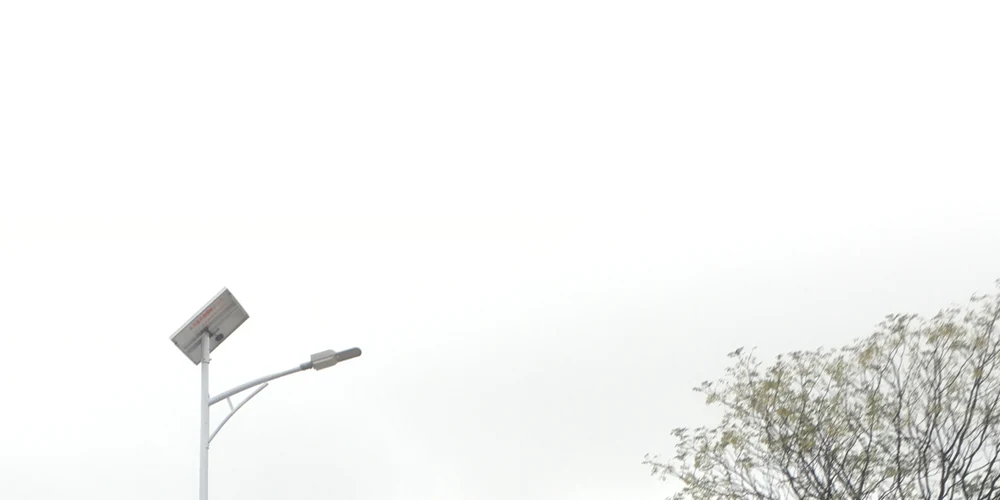
A YY Series solar street light under cloud cover, where diffuse daylight still supports charging.
After several overcast days, a light may still turn on but operate for less time. This does not, by itself, prove that the battery has failed.
The Department of Energy identifies clouds, shadows, snow, dirt, and other environmental conditions as factors affecting solar production. DOE Solar Energy and Storage Basics
Do solar lights need sun or just daylight?
Solar panels can use diffuse daylight as well as direct sunlight. However, receiving some daylight does not mean receiving enough energy for the intended lighting duty.
A panel under an open cloudy sky and one beneath a dense canopy may both be exposed to daylight, but their charging conditions differ substantially.
When comparing solar lights for cloudy days, ask about the panel capacity, usable battery reserve, and operating schedule. Avoid treating “charges without direct sunlight” as a promise of unchanged performance in deep shade.
Also clarify what a backup-duration claim means. Several nights at a reduced brightness level are different from several nights at full output.
How to Charge Solar Lights in Winter
Improving winter charging begins with panel exposure and the product’s permitted operating conditions.
Check the winter sun path
Inspect the installation at several points during the day. Note shadows from fences, buildings, trees, and nearby equipment.
Portable solar garden lights can sometimes be moved to a more exposed location. Fixed road lights require a site assessment rather than casual repositioning.
Where the design permits adjustment, panel direction and tilt should reflect the location and seasonal conditions. There is no single angle that is correct for every country or installation.
Keep the panel unobstructed
Remove accessible leaves and loose dirt using the manufacturer’s recommended method. Arrange suitable maintenance for elevated equipment.
Snow coverage can reduce generation, but removal should not damage the panel or mounting system. Avoid scraping with sharp tools, pouring hot water onto frozen surfaces, or climbing poles to reach a panel.
For fixed installations, include safe maintenance access in the original project plan.
Confirm the operating and charging settings
Check whether the light is in its intended automatic mode. Nearby artificial lighting may interfere with dusk detection on some products, while an unsuitable schedule can consume stored energy too quickly.
If the system provides dimming or motion-based control, select a mode appropriate to the application. Reducing decorative garden-light output is different from changing illumination on a road or pedestrian route.
Do not bypass temperature protection or connect an improvised charger to force charging. Follow the instructions for the battery and controller supplied with the light.
Solar Lights Not Working in Winter: What to Check
A shorter runtime, failure to switch on, and visible moisture are different symptoms. Record what happens before replacing components.
| Symptom | Checks to make first |
|---|---|
| Light starts normally but goes off early | Recent sunlight, runtime settings, battery condition |
| Light remains off after cloudy weather | Panel obstruction, charging status, temperature restrictions |
| Light works after a bright day but not after several dull days | Whether daily charging meets nightly demand |
| Only one light performs poorly | Local shading, dirt, settings, or an individual component issue |
| Moisture appears inside the housing | Seals, drainage design, and supplier inspection guidance |
If performance improves after suitable charging conditions return, investigate the energy balance. If one unit remains faulty while comparable units recover, an individual component issue deserves closer attention.
Why do solar lights fog up?
Fogging involves moisture condensing on a cooler surface. Condensation outside a lens is different from moisture trapped inside the enclosure.
Persistent internal fogging or pooled water warrants inspection. Photograph the condition and contact the supplier before opening a sealed unit or adding extra sealant, which may interfere with the original design.
Weather resistance should be evaluated alongside temperature limits. A water-resistance rating alone does not establish cold-weather battery performance.
Can You Leave Solar Lights Out in the Winter?
You can leave solar lights outside when the complete product is rated for the expected conditions and its installation remains suitable. Check the manufacturer’s limits rather than relying on the word “outdoor.”
For small decorative lights, seasonal storage may be appropriate if the instructions recommend it or local conditions exceed the product rating. Follow the specified battery storage procedure; removing or fully charging every battery is not a universal rule.
Fixed street and area lights should be selected for their installation environment from the outset. Their winter plan should address charging temperatures, snow exposure, structural conditions, maintenance, and the required lighting schedule.
The key distinction is between surviving outside and providing the intended service. A housing may remain intact while the system lacks enough daily energy to illuminate throughout the night.
Choosing Outdoor Solar Lights That Work in Winter
The best outdoor solar lights for winter are those matched to the location and lighting task. A winter label, large lumen figure, or battery-capacity claim is insufficient on its own.
Match the system to the lighting duty
Identify what the light must accomplish:
- Decorative garden lighting for part of the evening.
- Pathway lighting during expected pedestrian use.
- Motion-activated security lighting.
- Scheduled road or parking-area illumination.
Each duty produces a different energy requirement. Specify the brightness schedule and operating hours before comparing panel and battery sizes.
For project lighting, request an assessment based on local winter conditions rather than annual average sunshine alone.
Check battery protection and charging limits
Ask for separate charging and discharge temperature ranges, the protection strategy, and any heating arrangement.
RoadSmart’s intelligent temperature-control technology includes internal battery-temperature detection and heating-film or additional heating arrangements for suitable configurations. These features are intended to protect the battery in low-temperature applications.
Their availability and control settings must be confirmed for the selected product. Battery heating also consumes energy, so its demand belongs in the winter energy calculation.
Temperature monitoring, low-temperature charging protection, and active heating perform different functions. A controller that stops unsafe charging does not necessarily warm the battery.
Evaluate charging control and power management
RoadSmart’s technical materials also describe multi-peak MPPT control for tracking available panel power under partial shading and IPC 5.0 intelligent power control for managing discharge power in response to recent conditions.
These functions address different parts of the system: collecting available energy and allocating stored energy. Neither creates energy when the panel is heavily obstructed or daylight is insufficient.
For winter solar lights, ask what brightness changes the selected mode permits. Maintaining some illumination for longer is different from maintaining the original full output throughout every night.
Project Example: YY-80 Solar Lighting for a Rural Road
A RoadSmart project record documents YY-80 solar street lights on a rural road in China. The supplied photograph shows pole-mounted fixtures extending along a residential street, with houses, entrances, and parked vehicles beside the illuminated roadway.
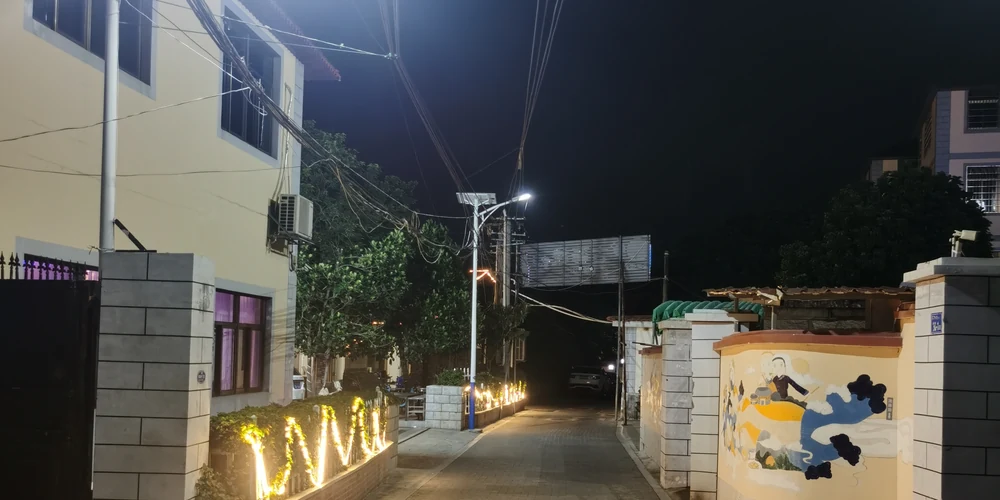
YY-80 rural-road installation in China. The project record specifies 5 m mounting height and 20 m spacing.
The recorded project configuration is:
| Item | Project specification |
|---|---|
| Model | YY-80 |
| Solar panel | 60 W |
| Battery capacity | 192 Wh |
| Luminous flux | 3,400 lm |
| Color temperature | 6,000 K |
| Mounting height | 5 m |
| Installation spacing | 20 m |
| Application | Township and rural roads |
The accompanying township-road requirements emphasize resistance to moisture, corrosion, and dust. These concerns are relevant to exposed outdoor installations, including wet seasonal conditions.
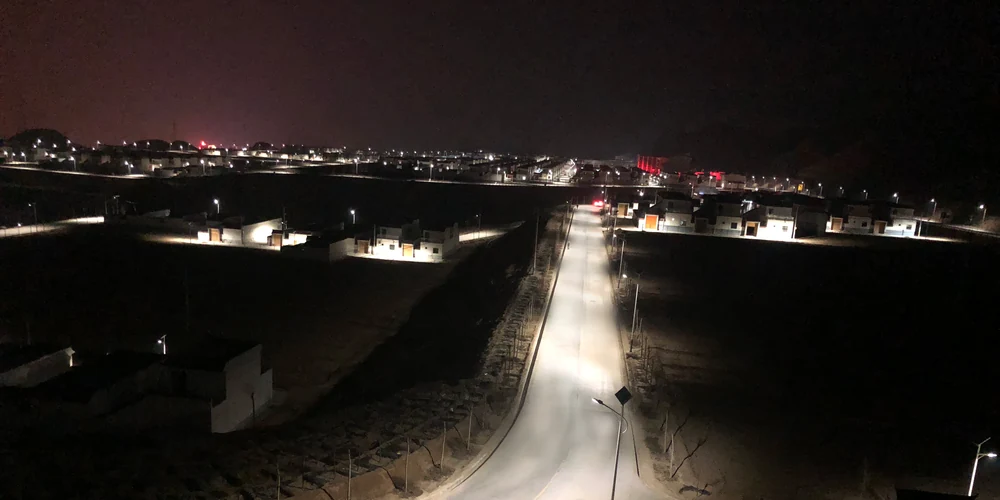
Pole-mounted solar lights spaced along the rural roadway.
For similar applications, the RoadSmart YY Series split solar street light provides a product reference, with a working-temperature range of −20°C to 60°C and a charging requirement above 0°C.
That distinction is important when planning a cold-climate project. Do not assume that the documented installation includes battery heating or that the standard configuration can charge below freezing. Confirm the cold-weather configuration and winter energy budget for the proposed site.
Frequently Asked Questions
Do solar garden lights work in winter?
They can, provided they receive sufficient daylight and remain within their temperature limits. Small decorative lights may run for fewer hours when winter charging is limited. Check their location before assuming that the batteries need replacement.
Do solar powered security lights work in winter?
They can, but runtime depends on charging conditions and activation frequency. A frequently triggered motion light can consume considerably more energy than one operating only occasionally. Include the expected use pattern when comparing products.
Are waterproof outdoor solar lights suitable for freezing weather?
Not automatically. Water resistance, charging temperature, discharge temperature, and structural durability are separate considerations. Check each specification for the complete system.
How long should solar lights stay on during winter?
There is no universal duration. Runtime depends on stored energy, brightness settings, night length, and recent charging. For project lighting, request a defined operating schedule and the conditions supporting the quoted backup duration.
What should I provide when requesting a winter lighting configuration?
Provide the location, expected minimum temperatures, site dimensions, shading photographs, required lighting hours, and brightness schedule. For road projects, include pole height and spacing. These details allow RoadSmart to assess a suitable solar lighting configuration, including whether additional battery-temperature management is needed.