Do LED Lights Attract Bugs? Colors and Outdoor Lighting Tips
Sep 29, 2026
Read:120
Source: Yin Zhenkun
Yes, LED lights can attract bugs. The amount of insect activity around a light depends on its spectrum, brightness, placement, and the insects living nearby. For gardens and patios, a practical starting point is warm lighting, suitable brightness, and fixtures positioned away from doors and seating areas.
LEDs also give you more control over how an outdoor space is illuminated. Different light colors, optics, dimming settings, and operating schedules make it easier to provide useful light while reducing unnecessary illumination.
Here is how those choices affect insects—and how to apply them to garden lighting.
Why Are Bugs Attracted to LED Lights?
Artificial light changes the nighttime environment insects use to move around. Its wavelength and position help explain why flying insects gather around outdoor fixtures.
Light can disrupt insect flight
A 2024 study of insect flight around artificial lights found that insects tilted their backs toward nearby light sources. This response helps them maintain orientation under natural skies, but an artificial lamp can send them into circling, stalling, or inverted flight.
That behavior explains the familiar sight of insects repeatedly flying around a garden lamp. Once close to the light, their attempts to orient themselves can keep them nearby.
Different wavelengths attract different insects
Many insects respond strongly to ultraviolet and shorter visible wavelengths. This makes the spectrum of a light source relevant to its appeal.
White LEDs combine different wavelengths to produce their visible color. Warm-white and cool-white lights have different spectral characteristics, while colored LEDs concentrate their output in particular parts of the spectrum.
For outdoor lighting, consider color together with brightness and beam direction. These determine both the character of the light and how much of the surrounding space it reaches.
Do LED Bulbs Attract Fewer Bugs Than Other Lights?
Research provides a useful reason to consider LEDs when replacing older outdoor lamps.
In a field comparison of domestic lighting technologies, researchers found that the tested LED lamps attracted fewer insects than tungsten-filament and compact fluorescent lamps. The warm-white and cool-white LEDs in that experiment performed similarly, with no statistically significant difference between them.
The practical lesson is to select the complete lighting setup: the source, its output, and its placement. Replacing an old lamp with an efficient LED is an opportunity to improve all three.
For example, a patio previously lit by an exposed lamp may benefit from a lower-output LED positioned to illuminate the table and walking route. This provides useful visibility with less light spilling into the surrounding garden.
What Color Light Attracts Fewer Bugs?
For gardens and outdoor seating areas, warm-white lighting offers a comfortable appearance, while amber and yellow lighting are options where reducing short-wavelength output is a priority.
Color is best considered alongside the task. A path needs clear visibility; a dining area benefits from a relaxed atmosphere; an entrance needs enough light to identify steps and handles.
Does blue light attract bugs?
Blue light can attract flying insects. Blue decorative strips or spotlights placed beside doors and outdoor tables may concentrate insect activity close to people.
For a garden used regularly in the evening, reserve blue lighting for limited accents and use more comfortable functional lighting along paths and seating areas.
Does red light attract bugs?
Some insects respond less strongly to red light than to shorter wavelengths. Red lighting also changes the appearance of plants, surfaces, and objects.
It suits selected decorative effects, while warm-white lighting provides a more familiar view of a garden and the people using it.
Does green light attract bugs?
Green light attracts certain insects, so it is better selected for a decorative purpose than as an insect-management measure.
For practical garden lighting, focus on useful coverage and controlled operating hours rather than switching an entire space to green.
Do yellow lights keep bugs away?
Yellow “bug lights” work by being less attractive to some insects. Their role is to reduce attraction around the light, rather than repel insects from the garden.
Use them where their color suits the setting, particularly when accurate color appearance is less important than simple visibility.
| Light color | Insect-related considerations | Outdoor lighting use |
|---|---|---|
| Blue or violet | Short wavelengths can strongly attract many insects | Keep decorative use limited near doors and seating |
| Cool white | Often has a stronger blue component than warm white | Match output and coverage carefully to the task |
| Warm white, 2700K–3000K | A practical option when limiting short-wavelength light is a priority | Gardens, patios, residential paths, and relaxation areas |
| Amber or yellow | Can be less attractive to some insects than sources rich in blue light | Selected outdoor areas where color rendering is less important |
| Red | Some insects respond less strongly to longer wavelengths | Accent lighting or specialized uses |
| Green | Attraction varies with insect species | Decorative applications chosen for appearance |
What Bugs Do LED Lights Attract?
Outdoor LED lights may draw moths, flies, midges, and some beetles. The mix changes with the season and the surrounding habitat.
A lamp beside dense planting or water may have different insect activity from the same fixture beside a paved entrance. When adjusting lighting, look at both the fixture and its immediate surroundings.
Do LED lights attract spiders?
Spiders often appear near lights because insects provide a convenient food source.
As explained in Cornell’s guidance on spiders, some web-building spiders select locations near lights or reflective surfaces where prey gathers.
To reduce webs around an entrance, review the position of nearby lights, reduce unnecessary overnight illumination, and include fixtures and sheltered corners in routine cleaning.
Do LED lights attract silverfish?
Silverfish are nocturnal and tend to avoid light. Virginia Tech’s guide to silverfish and firebrats describes their preference for sheltered conditions.
If silverfish appear near an indoor LED strip, inspect nearby gaps, moisture, and stored materials. Addressing those conditions is more useful than changing the strip’s color.
How to Reduce Bugs Around Outdoor LED Lights
The most useful changes often involve several small adjustments: light color, output, direction, location, and timing.
The five principles for responsible outdoor lighting provide a helpful framework: illuminate useful areas, target the light, keep levels appropriate, control operating times, and favor warmer colors.
Choose comfortable light for the setting
For patios and garden paths, 2700K–3000K warm-white lighting creates a welcoming atmosphere. Where insect sensitivity is a particular concern, compare the spectral information of candidate fixtures and consider amber options.
Choose the light around the activity: walking, sitting, dining, or identifying an entrance.
Match brightness to the area
A small seating area and a broad vehicle entrance need different lighting.
Use enough output to reveal edges, steps, and obstacles without flooding the entire garden. Where fixtures are dimmable, adjust them after dark so you can assess the result from the positions people actually use.
Direct light toward paths and activity areas
Optics, shielding, and aiming help place light where it is useful.
For a walkway, assess visibility along the route. Near planting, avoid directing unnecessary light deep into shrubs or tree canopies. Decorative fixtures can be balanced with restrained output and shorter operating periods.
Keep prominent light sources away from open doors
A bright fixture directly beside an open doorway places insect activity close to an entry point.
Where the layout allows, illuminate the approach from a position farther from the opening. Apply the same thinking to dining tables and lounge chairs: light the activity area without placing the brightest source immediately beside people.
Use timers, dimming, or motion control
Lighting schedules should follow how the space is used.
A garden may need full evening illumination, followed by a lower level along access routes. A rarely used side path may suit motion-controlled lighting. These settings reduce unnecessary operating time while keeping important routes usable.
Do Solar Lights Attract Bugs?
Solar lights can attract insects because they produce visible light just like other outdoor fixtures. Their advantage is the flexibility to provide illumination without extending a mains lighting circuit to every location.
For gardens, combine that installation flexibility with warm light, appropriate output, and a considered layout. Position solar panels where they receive useful daylight, then evaluate how the lamps serve paths, entrances, and seating areas after dark.
Garden Lighting in Practice: A RoadSmart Project in Nigeria
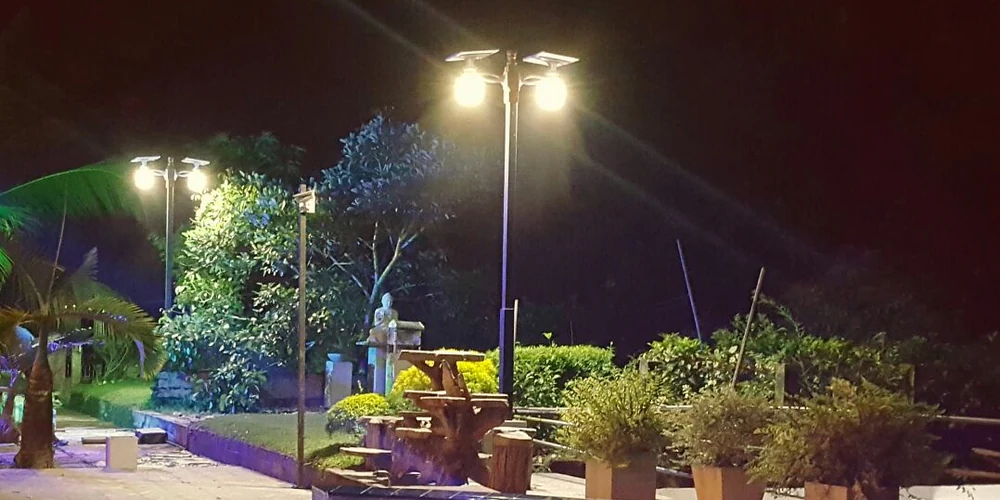
A garden project in Nigeria used RoadSmart Solar Moon Lights beside landscaped paths and planting. The rounded luminaires form part of the garden’s appearance during the day and provide illumination for evening use.
The project configuration included:
| Item | Configuration |
|---|---|
| Model | SC-ML-R40 |
| Light output | 1800 lm |
| Color temperature | 3000K |
| Solar panel | 40W |
| Battery capacity | 144Wh |
| Installation height | 3 m |
| Fixture spacing | 10 m |
The 3000K light supports a warm, welcoming atmosphere around greenery and pedestrian areas. The installation height and spacing provide a concrete reference for planning garden lighting, with the final layout determined by path width, planting, and the areas people use.
Solar operation also reduces reliance on mains cabling between distributed lighting points—useful in landscaped spaces where routes pass through established planting.
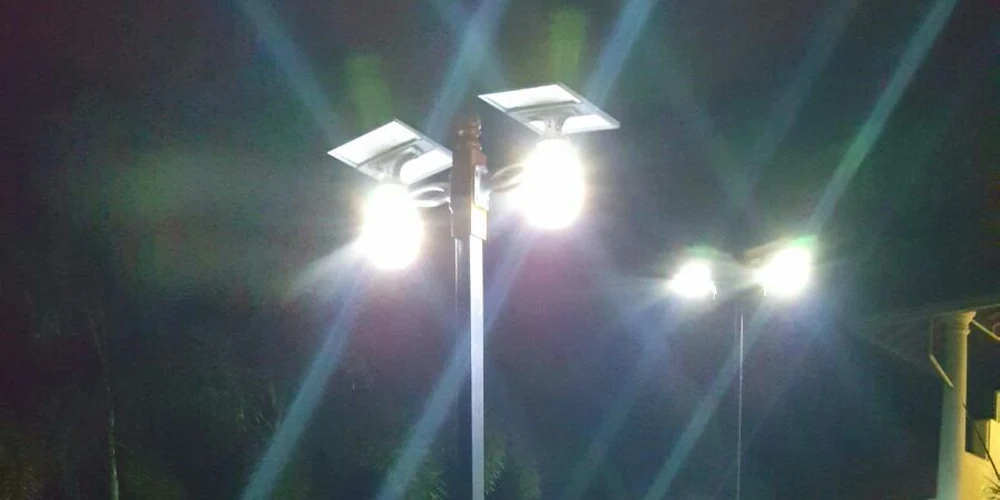
The RoadSmart Moon Series solar garden lights pair decorative lighting with a lithium iron phosphate battery, charge-and-discharge management, and a corrosion-resistant aluminum housing. These features support repeated daily energy storage and outdoor use. The adjustable solar panel helps installers orient the panel for local sunlight conditions.
For a garden design, consider four elements together:
- Atmosphere: use warm light that complements seating areas and landscaping.
- Energy storage: size the battery and lighting schedule around local solar conditions.
- Durability: select suitable housings, pole finishes, and fixings for outdoor exposure.
- Light placement: keep unnecessary illumination away from doors and quiet planted areas.
For insect-conscious lighting, pair a warm appearance with restrained output and appropriate operating hours. This keeps the focus on comfortable garden use while reducing unnecessary nighttime light.
Choosing LED Lights That Attract Fewer Bugs
When comparing outdoor fixtures, ask questions that connect the specifications to your space.
- What light color is available?
Identify the actual color temperature or colored-light option. For a relaxed garden atmosphere, warm-white settings are a useful starting point. - Where will the light travel?
Review the beam pattern, fixture height, and nearby surfaces. A well-positioned lamp can serve a path without illuminating the entire property. - Can the output and schedule be adjusted?
Dimming and timing options help tailor illumination to evening activity and quieter overnight periods. - How will the fixture handle the environment?
For permanent garden installations, consider moisture exposure, corrosion resistance, accessible maintenance, and battery replacement arrangements. - How will it look from a seated position?
View the proposed fixture from tables, benches, and neighboring windows. Comfort depends on what people see directly as well as what the light illuminates.
Frequently Asked Questions
Do LED strip lights attract bugs indoors?
They can draw flying insects that enter through open doors or windows. Keep screens in good condition and avoid placing bright strips immediately beside frequently opened windows. For crawling pests, inspect moisture and hiding places around the installation.
Are warm-white LEDs better for garden lighting?
Warm-white LEDs provide a comfortable appearance for patios, paths, and landscaped areas. Choose output, optics, and operating hours alongside color temperature to create a balanced installation.
What color light does not attract bugs?
Amber and yellow are common choices when lower insect attraction is a priority. Their longer-wavelength output is less attractive to some insects than blue-rich lighting. Choose the color that also provides suitable visibility for the space.
How can I reduce bugs around a patio light?
Start with a suitable warm or amber light, lower excessive brightness, and move prominent light sources away from the seating area where practical. Use a timer so the patio remains illuminated during use rather than throughout the night.
Which solar garden light should I choose?
Start with the path layout, desired atmosphere, available sunlight, and evening operating hours. For decorative garden and pedestrian applications, the RoadSmart Moon Series offers a starting point for matching the fixture configuration to the site.