Lux vs Lumens: What’s the Difference for Outdoor Lighting?
Sep 30, 2026
Read:156
Source: Yin Zhenkun
Lumens measure the total visible light a source emits. Lux measures the light arriving on a surface per square meter. Use lumens to compare fixture output and lux to evaluate illumination on a path, entrance, road, or working area.
The connection is straightforward: one lux equals one lumen per square meter. Applying that relationship to an outdoor installation requires knowing how much light reaches the area you want to illuminate.
For someone buying outdoor lights, this distinction answers an important question: why can two fixtures with similar lumen ratings produce very different results after installation?
This guide explains lux vs lumens, how candela and watts fit into the comparison, and how to use these measurements when selecting solar street lights.
Lux vs Lumens: The Key Difference
A lumen rating describes the light leaving a source. A lux reading describes illumination at a particular receiving surface.
Imagine pouring the same amount of water over a small tray and a much larger tray. The total amount stays the same, but the amount received per unit area changes. Light distribution works in a similar way: concentrating light on a smaller area produces a higher average illuminance than spreading the same arriving light over a larger area.
| Measurement | Lumens | Lux |
|---|---|---|
| Symbol | lm | lx |
| Quantity measured | Luminous flux | Illuminance |
| Main question | How much visible light does the fixture produce? | How much light reaches this surface? |
| Typical use | Comparing fixture output | Evaluating an installed lighting layout |
| Information needed | Output at the specified operating conditions | Measurement position, surface orientation, and operating conditions |
| Outdoor example | A luminaire rated at 8,000 lm | The measured illuminance at a point on a walkway |
What are lumens?
Lumens describe total visible-light output, weighted for human visual sensitivity.
When comparing LED fixtures, look for the lumen output of the complete luminaire. This accounts for the assembled light, including its optics, rather than simply adding together the nominal output of individual LED chips.
Also check the operating setting. A dimmed fixture produces less light than it does at full output, so comparisons should use equivalent conditions.
What is lux?
Lux describes the luminous flux arriving per unit area. The NIST definition of lux expresses it as one lumen per square meter.
A lux meter measures illuminance where its sensor is placed. Readings can change across the same installation: directly beneath a fixture, between poles, and near the edge of a path.
That makes lux useful for evaluating whether the areas people actually use receive the intended illumination.
Lux vs Lumens vs Candela
Candela adds information about direction. It describes luminous intensity—the amount of luminous flux per unit solid angle in a particular direction.
As NIST explains in its introduction to the candela, directional intensity is different from the total light output described by lumens.
| Unit | What it describes | Practical value |
|---|---|---|
| Lumens, lm | Total visible-light output | Compare the output of complete fixtures |
| Candela, cd | Luminous intensity in a particular direction | Understand how strongly the fixture sends light in that direction |
| Lux, lx | Light arriving per square meter of surface | Assess illumination where it is needed |
A narrow-beam light can concentrate its output and produce high intensity toward a small target. A wider distribution can spread light across a larger area.
For outdoor projects, the appropriate distribution depends on the job. A long, narrow access route needs a different pattern from a broad yard. The candela distribution helps a lighting designer calculate how a fixture will illuminate those surfaces.
Where do watts fit?
Watts measure electrical power. They help evaluate energy demand, while lumens describe light output—the distinction is also summarised in the DOE overview of LED lighting basics.
Two LED fixtures using the same power can have different lumen outputs because their efficiencies differ. On a solar lighting specification, a watt figure may also refer to the solar panel rather than the LED load.
Check what each number describes:
- LED input power, W: the electrical demand of the light.
- Solar panel rating, W: panel output under specified test conditions.
- Battery capacity, Wh: stored energy.
- Luminaire output, lm: visible light produced at the stated setting.
Keeping these quantities separate makes product comparisons much clearer.
Lux-to-Lumens Conversion: Formula and Examples
The basic relationship is:
Average illuminance, lx = luminous flux reaching the area, lm ÷ area, m²
Rearranging it gives:
Luminous flux reaching the area, lm = average illuminance, lx × area, m²
The important phrase is “reaching the area.” A fixture’s total output includes light that may fall outside the chosen calculation boundary.
Example: the same arriving light over different areas
Suppose 1,200 lumens reach a surface. The average illuminance depends on the area over which that light is distributed.
| Light reaching the surface | Surface area | Average illuminance |
|---|---|---|
| 1,200 lm | 12 m² | 100 lx |
| 1,200 lm | 40 m² | 30 lx |
| 1,200 lm | 120 m² | 10 lx |
These are illustrative calculations. They show the relationship between arriving light and area; they are not recommended illumination levels.
The average also leaves the distribution within the area unresolved. Some points may be brighter and others darker.
Example: estimating the light needed on a surface
Assume a design exercise calls for an average of 15 lux over 80 m².
15 lx × 80 m² = 1,200 lm reaching that area
The fixture selection must then account for its distribution, position, and the proportion of output reaching the target. A lighting calculation using photometric data provides that connection.
For longer-term design, the calculation should also include appropriate maintenance assumptions, such as light depreciation and dirt accumulation.
How many lumens is 5,000 lux?
The answer depends on area.
If 5,000 lux is the average over 1 m², the arriving flux is 5,000 lumens. If that average applies to 0.2 m², the arriving flux is 1,000 lumens.
A single 5,000-lux reading at the center of a beam does not establish the average across the surrounding surface. To determine total arriving flux, you need information about the illumination across that area.
Lux and footcandles
Lux and footcandles both measure illuminance, using different area units.
The NIST conversion tables give the relationship:
1 footcandle ≈ 10.764 lux
For example, 2 footcandles is approximately 21.5 lux. Always check the units when comparing lighting reports from different suppliers.
Why More Lumens May Not Mean Better Outdoor Lighting
A useful outdoor installation delivers light to the right locations with a suitable distribution. Several design choices influence that result.
Beam distribution determines where light goes
A fixture may direct much of its output onto the target area or send a substantial portion beyond it.
For a farm access route, useful light follows the route and its edges. For an entrance, the layout may need to reveal both the ground and vertical objects such as a gate.
Compare the distribution to the task before increasing the lumen rating.
Mounting height and spacing change coverage
Changing mounting height changes the relationship between the fixture and the receiving surface. Spacing determines how neighboring distributions combine and whether dim areas appear between poles.
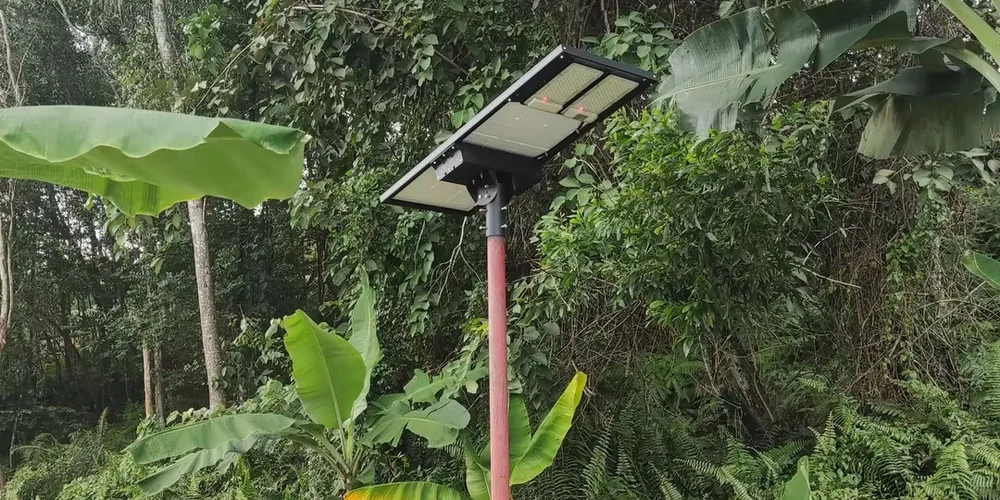
These variables should be assessed together with the optics and output. For installation planning, RoadSmart’s solar street light installation guide covers the broader site and mounting considerations.
Uniformity matters alongside average lux
An area with a bright patch beneath each fixture and dark gaps between them can have an acceptable-looking average while remaining uncomfortable to use.
A lighting report should show the calculation grid and relevant minimum, average, and uniformity results. This reveals how illumination changes across the space.
Also consider the viewing direction. A light aimed toward approaching users may create glare even when the ground receives substantial illumination.
Color temperature describes appearance
A 3000K light has a warmer appearance than a 6000K light. Kelvin describes that color appearance; it is not a replacement for lumens or lux.
Choose color temperature for the setting, then evaluate output and distribution separately. Nighttime photographs can help show the atmosphere, while measured or calculated illuminance is more useful for comparing lighting performance.
Choosing Bright Solar Street Lights: What to Check
When comparing bright solar street lights, begin with the area and activity rather than the largest number on a specification sheet.
Define the lighting task
Identify whether the project involves pedestrian movement, vehicle access, an entrance, or a working area.
Record the dimensions, possible mounting positions, obstructions, and operating hours. Establish the applicable lighting criteria for the site before selecting fixtures.
Request the information needed for a lighting calculation
Useful supplier information includes:
- Complete luminaire output at the proposed setting.
- An IES or LDT photometric file for the selected optics.
- Proposed mounting height, spacing, and aiming.
- A layout showing illumination across the target area.
- The dimming schedule and corresponding output levels.
An IES or LDT file describes the light distribution used in lighting software. It turns a general lumen figure into a site-specific calculation.
Check how output is supported through the night
Solar lighting combines a daytime energy supply with nighttime demand.
Panel capacity, local sunlight, battery capacity, and the operating schedule all influence how the system supports the proposed lighting profile. Where dimming is used, review illumination at the relevant settings as well as at full output.
This connects brightness selection to the complete solar system.
A Farm Lighting Application in Malaysia
A RoadSmart farm project in Malaysia used Solar Star Light II, model ST2-100, in a setting with substantial surrounding vegetation.
The installation photograph shows a pole-mounted fixture with its panel assembly above the planted area. This illustrates why site planning includes both the area to be illuminated and the solar panel’s exposure to daylight.
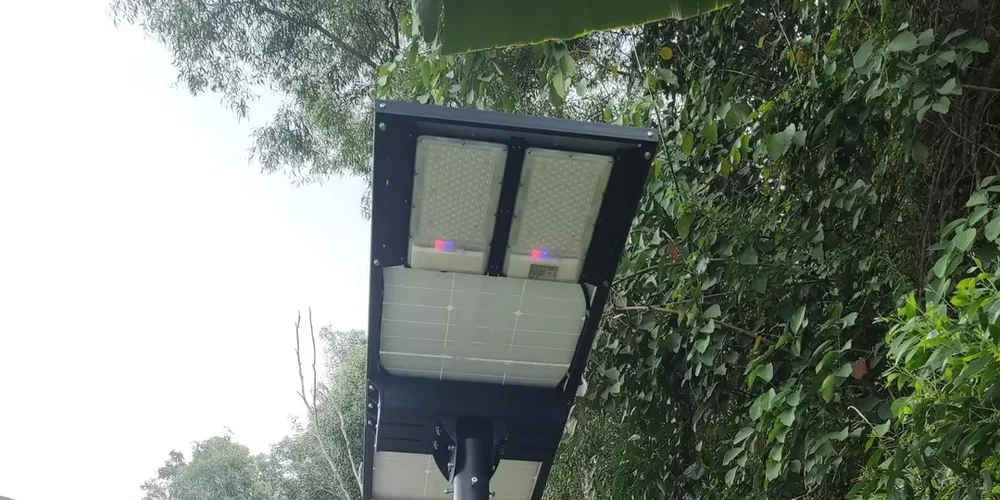
Solar Star Light II installation at a farm in Malaysia.
The project configuration was:
| Item | Project specification |
|---|---|
| Model | ST2-100 |
| Specified luminous flux | 15,000 lm |
| Color temperature | 3000K |
| Solar panel rating | 110W |
| Battery capacity | 640Wh |
| Installation height | 3 m |
| Pole spacing | 10 m |
Each specification answers a different planning question.
The 15,000-lumen figure describes specified light output. The 3 m installation height and 10 m spacing describe the project’s physical arrangement. Together with the selected optics, these are inputs for evaluating illumination across the target area.
The 110W panel and 640Wh battery address energy collection and storage, while 3000K describes the warm-white appearance of the light.
For a similar application, the RoadSmart Solar Star Light II provides a product starting point. The next step is to match the configuration and layout to the new site’s dimensions, vegetation, sunlight, and nighttime activity.
This approach keeps the selection tied to both useful illumination and the energy needed to support it.
Frequently Asked Questions
Is lux or lumens more important for outdoor lighting?
Use both at different stages. Lumens help compare fixture output; lux helps evaluate illumination across the installed area. For a purchasing decision, review the lumen rating together with a lighting layout and its calculated results.
How do you measure lux and lumens?
Measure illuminance with a suitable lux meter at defined positions and orientations. Total luminaire output is typically established through laboratory photometric testing, using equipment such as an integrating sphere or goniophotometer.
For site checks, record the fixture settings, measurement locations, and other light sources present.
Does doubling the distance reduce lux to one quarter?
That relationship applies to a point-source approximation when luminous intensity in the relevant direction and the receiving surface’s orientation remain unchanged.
Outdoor layouts also involve different angles, distributions, and contributions from neighboring fixtures. Use photometric calculations to evaluate changes in pole height or position.
Can a phone app measure outdoor lux?
A phone app can help with rough comparisons on the same device. For commissioning or checking a specified lighting target, use a suitable calibrated illuminance meter and a consistent measurement method.
How many lumens do I need for outdoor lighting?
Start with the target area, the required illumination, and the mounting arrangement. Then select output and optics through a lighting calculation. A narrow walkway and a broad working yard can need very different layouts even when their total areas are similar.
What should I send when requesting a solar lighting proposal?
Provide the site location, dimensions, photographs, available pole positions, intended activities, and nightly operating hours. Include any required lighting criteria.
With those details, RoadSmart can discuss a suitable solar lighting configuration and the information needed to assess its performance on your site.