Solar Street Light vs Grid-Connected LED Street Light: Which Solution Fits Your Project?
Sep 15, 2026
Read:33
Source: Yin Zhenkun
Choosing between solar and grid-connected street lighting is not simply a comparison between solar technology and LED technology. Modern solar street lights normally use LED fixtures too. The real decision is whether the LED fixture should operate as an independent solar-powered system or connect to the public electricity grid.
For municipalities, EPC contractors, developers, and project buyers, the right choice depends on the condition of the electrical infrastructure, local solar resources, road lighting requirements, construction constraints, operating responsibility, and long-term maintenance plan. A solution that works well for a remote road may not be the best option for a dense urban intersection with existing underground power infrastructure.
Quick answer: Off-grid solar street lighting is usually better suited to remote roads, new developments, parks, campuses, industrial sites, and locations where trenching or grid extension is difficult. Grid-connected LED lighting is often more practical where reliable electrical infrastructure already exists, continuous full-output lighting is required, or the site has limited solar exposure. Neither system is universally better; the decision should be based on the complete project environment.
Solar Street Light vs LED Street Light: What Is Actually Being Compared?
The phrase solar street light vs LED street light can be misleading because it compares a power-supply system with a light-source technology. An LED describes how illumination is produced, while solar and grid-connected describe how the fixture receives electricity.
An off-grid solar street light combines an LED fixture with a photovoltaic panel, rechargeable battery, controller, pole, and mounting structure. During the day, the solar panel generates electricity and stores it in the battery. At night, the controller uses that stored energy to operate the LED fixture according to a programmed lighting schedule.
A grid-connected LED street light receives electricity through the local utility network. Depending on the project, the system may also require underground or overhead cables, distribution cabinets, protective devices, transformers, metering equipment, and centralized control infrastructure.
Both solutions can use efficient optics, dimming schedules, monitoring systems, and LED light sources. The project decision should therefore compare two complete systems: off-grid solar LED lighting versus grid-connected LED lighting.
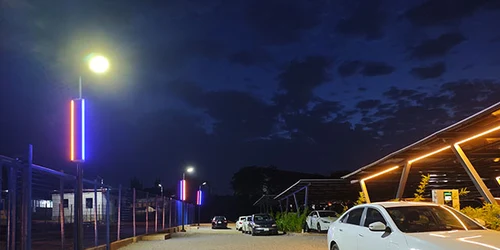
Solar and Grid-Connected LED Lighting at a Glance
| Decision factor | Off-grid solar street light | Grid-connected LED street light |
|---|---|---|
| Power source | Solar panel and battery | Utility electricity grid |
| Electrical connection | Independent at each lighting point | Connected through cables and distribution equipment |
| Trenching and cabling | Usually not required between poles | Often required for new installations |
| Dependence on local grid | No | Yes |
| Dependence on solar conditions | Yes | No direct dependence |
| Energy storage | Battery required | Normally unnecessary |
| Main planning inputs | Solar resource, autonomy days, battery capacity and shading | Grid availability, cable routes, connection capacity and electrical design |
| Operating electricity bill | No utility electricity consumption | Ongoing utility electricity use |
| Typical maintenance focus | Panel, battery, controller and fixture | Fixture, driver, cables and distribution equipment |
| Expansion flexibility | Individual poles can often be added independently | Expansion may require extending the electrical network |
| Strong-fit projects | Remote roads, new sites, parks, campuses and off-grid areas | Existing urban grids, tunnels, heavily shaded sites and continuously demanding roads |
This comparison is directional rather than a substitute for engineering design. Lighting performance must still be verified against the project’s applicable road, parking, pedestrian, or public-space requirements. ANSI/IES RP-8, for example, covers the design of roadway and parking-facility lighting rather than prescribing one universal solution for every site. The Illuminating Engineering Society identifies visibility, uniformity, environmental impact and maintainability as interconnected design considerations.
When Does an Off-Grid Solar Street Light Make More Sense?
The electrical grid is unavailable or expensive to extend
Solar lighting is particularly valuable when the proposed road or outdoor area has no practical grid connection. Rural roads, village access routes, remote facilities, construction areas, industrial perimeters, and undeveloped land may require long cable runs, transformers, utility approvals, or significant civil work before grid lighting can operate.
In these conditions, evaluating only the fixture purchase price gives an incomplete result. The project team should also consider trench excavation, cable installation, reinstatement of road surfaces, electrical cabinets, grid-connection fees, traffic management, and approval time. An independent solar light can remove several of these work packages because each pole generates and stores its own electricity.
However, “no trenching” does not mean “no civil engineering.” Solar street lights still require site investigation, foundation design, pole installation, structural checks, orientation planning, and commissioning.
The site must be deployed in phases
Independent solar lighting can be useful for projects that will expand gradually. A developer may need to illuminate the first completed road, parking section, or industrial area before the entire electrical network is available. Because individual solar lighting points do not need to wait for a continuous cable network, the system can often follow the construction sequence more easily.
This flexibility also applies to campuses, resorts, parks, and large commercial properties where only selected pathways or perimeter sections need lighting. Additional units may be installed later, provided that every new location has adequate solar exposure and suitable foundation conditions.
Trenching would disrupt an operating site
Installing underground electrical infrastructure can be difficult around existing roads, landscaped areas, warehouses, parking facilities, or operational factories. Excavation may interfere with traffic, underground utilities, drainage systems, landscaping, or normal business activity.
An off-grid solar street lighting solution can reduce these disruptions because power cables do not have to connect every pole. The advantage should still be evaluated against local soil conditions, pole-foundation requirements, equipment access, and any restrictions imposed by the site owner.
Grid outages are a significant local concern
Because each solar street light operates independently, a utility outage does not automatically switch off the whole lighting network. This can be valuable for access roads, perimeter areas, industrial sites, and communities with unreliable electricity supply.
The tradeoff is that solar autonomy depends on system sizing. Battery capacity, solar-panel output, daily lighting demand, temperature, shading, and consecutive cloudy or rainy days must be evaluated together. A poorly sized solar system can lose lighting time even though it is technically independent of the grid.
RoadSmart’s complete guide to solar street lights explains how panels, batteries, controllers, optics, lighting hours, and local weather conditions interact in an off-grid system.
When Is Grid-Connected LED Lighting More Suitable?
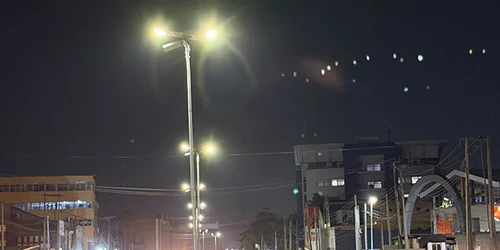
Reliable grid infrastructure is already in place
Where a functioning electrical network, cable ducts, distribution system, and utility connection already exist, replacing or upgrading the luminaires with modern LED fixtures may be more straightforward than installing a separate solar power system at every pole.
This is particularly relevant to established urban roads, city centers, commercial districts, and infrastructure-renovation projects. The existing network changes the economic comparison because many of the grid system’s civil and electrical costs have already been incurred.
Grid-connected LED lighting can also use intelligent dimming and network controls. It should not be assumed that a grid-powered fixture must operate at full output throughout the night. The U.S. Department of Energy notes that LED roadway lighting can support time-based and adaptive dimming when the control system is designed appropriately. DOE roadway lighting research also emphasizes optical control and delivering light where it is required.
The site has heavy shading or limited solar access
Solar street lights need sufficient sunlight to restore the energy used each night. Trees, tall buildings, mountain terrain, persistent shading, narrow urban streets, dust, snow, and unsuitable panel orientation can reduce daily solar generation.
A grid-connected system may be more dependable where shading cannot be eliminated or where the available panel area cannot support the required lighting load. Solar feasibility should be checked using location-specific solar data rather than a general regional assumption.
The lighting requirement is consistently high
Busy arterial roads, major intersections, tunnels, transport hubs, and high-traffic areas may require demanding lighting levels, strict uniformity, or continuous operating profiles. Solar can still be technically possible in some of these projects, but higher nightly energy demand requires larger panels, batteries, and structural provisions.
If sufficient solar collection and storage cannot be accommodated economically or physically, grid-connected lighting may be the more practical choice. The decision should be confirmed using a photometric design and an energy balance, not by comparing fixture wattage alone.
Centralized electrical management is already established
Some municipalities and utilities operate centralized street-lighting networks with established maintenance teams, control platforms, metering systems, and replacement procedures. A grid-connected LED upgrade may integrate more easily into this existing operating model.
Solar lighting can also support remote monitoring, but the communication method, fault reporting, platform compatibility, and maintenance responsibilities should be specified before procurement.
Installation Is More Than Comparing Pole Costs
The installation comparison changes significantly between a greenfield project and a retrofit project.
For a new grid-connected system, the scope may include trenching, conduit, cables, distribution cabinets, transformers, utility coordination, road reinstatement, electrical testing, and fixture installation. Solar lighting removes the continuous power cable between poles but adds photovoltaic panels, batteries, controllers, solar-orientation requirements, and project-specific energy calculations.
For a retrofit project with usable electrical infrastructure, grid-connected LED lighting may need little new civil work. Replacing functional grid lighting with solar equipment solely to eliminate electricity consumption may not provide the best overall project value.
The project team should compare complete installed scopes instead of requesting a lamp-only quotation from one supplier and a full-system quotation from another.
How Reliability Differs Between the Two Systems
Reliability depends on different risk chains.
An off-grid solar system depends on solar-panel generation, battery condition, controller operation, LED performance, programmed dimming, and local weather. If one pole develops a fault, the problem is usually localized to that unit. Solar independence can therefore limit network-wide failures, but every pole contains its own energy-generation and storage components.
A grid-connected system depends on the fixture, LED driver, cable network, protective equipment, distribution system, and utility supply. Individual fixture failures may remain localized, while cable, cabinet, or grid faults can affect multiple lighting points. Grid power generally offers predictable energy availability when the network is stable.
Neither architecture eliminates maintenance. Solar projects require panel inspection, cleaning where necessary, battery-health checks, controller diagnostics, structural inspection, and eventual battery replacement. Grid-connected projects require fixture, driver, cable, connection, cabinet, and protective-device maintenance.
How to Compare Long-Term Project Cost
| Cost category | Solar lighting questions | Grid-connected lighting questions |
|---|---|---|
| Equipment | Are the panel, battery, controller, pole and fixture included? | Are the fixture, pole, driver and control equipment included? |
| Civil work | What foundations, access work and surface repairs are required? | What trenching, conduit and road reinstatement are required? |
| Electrical infrastructure | Is any external connection needed? | Are cables, cabinets, transformers and utility connections included? |
| Energy | What nightly load and dimming profile must the battery support? | What are the local tariff, operating hours and control schedule? |
| Maintenance | What inspection and replacement cycle is planned? | Who maintains fixtures, cables and distribution equipment? |
| Replacement | When should batteries and electronic components be budgeted? | When should drivers, fixtures and network components be budgeted? |
| Project risk | What happens during extended poor weather? | What happens during grid or cable failure? |
A useful cost comparison should cover the same evaluation period and service requirement for both systems. It should not rely on a fixed claim that one option always saves a particular percentage.
The calculation should also include local labor rates, electricity tariffs, transport costs, project access, expected service period, financing assumptions, and disposal requirements. This keeps the page separate from a dedicated cost guide: the purpose here is to define which cost categories affect the selection, not to promise a universal payback period.
Project Selection Decision Matrix
| Project condition | Usually favors solar | Usually favors grid-connected LED | Requires detailed comparison |
|---|---|---|---|
| No nearby electrical grid | ✓ | ||
| Long cable extension required | ✓ | ||
| Existing usable street-light network | ✓ | ||
| Remote road or village access route | ✓ | ||
| Dense urban road with existing ducts | ✓ | ||
| Heavy shade throughout the day | ✓ | ||
| New park, campus or industrial site | ✓ | ||
| Road surface cannot be easily excavated | ✓ | ||
| Continuous high-output operation | ✓ | ||
| Frequent utility outages | ✓ | ||
| Several consecutive cloudy days | ✓ | ||
| Centralized municipal control required | ✓ | ||
| Phased construction or future expansion | ✓ |
This matrix is a preliminary filter. The final design still needs to meet applicable lighting, structural, electrical, environmental, and procurement requirements.
A Practical Five-Step Selection Process
Define the required lighting result
Start with the road type, width, traffic conditions, pedestrian use, conflict areas, target lighting standard, operating hours, pole height, spacing, and required uniformity. Both solar and grid-connected designs must deliver an acceptable lighting result.
A lower-energy system is not automatically a better system if its optics, spacing, glare control, or uniformity do not meet the project requirements.
Audit the site infrastructure
Confirm the distance to the nearest practical grid connection, condition of existing cables, permitted trench routes, underground utilities, surface-restoration requirements, and utility approval process. At the same time, evaluate solar exposure, shading, panel orientation, wind conditions, foundation space, and maintenance access.
Model the energy requirement
For solar lighting, calculate nightly energy consumption, expected solar generation, system losses, battery depth of discharge, temperature effects, and required autonomy days. For grid-connected lighting, calculate annual electricity consumption using the actual lighting schedule and planned dimming profile.
Compare full lifecycle responsibilities
Identify who will inspect, clean, repair, monitor, and replace each component. The lowest initial quotation may create a more difficult maintenance system if spare parts, access, diagnostics, or local technical support are not planned.
Verify the proposed layout
Use photometric files and lighting-design software to check fixture output, beam distribution, pole spacing, average illumination, uniformity, and relevant project requirements. RoadSmart supports project buyers with DIALux design, IES/LDT files, BOQ preparation, technical documentation, and configuration recommendations through its solar street light project support.
Can a Project Use Both Solar and Grid-Connected Lighting?
Yes. A hybrid site strategy can be more practical than forcing one architecture across the entire project.
For example, an urban development may retain grid-connected LED lights on main roads and intersections while using solar lighting on perimeter roads, pathways, parking extensions, landscaped areas, or sections where trenching is difficult. An industrial project may use grid lighting around high-demand production entrances and independent solar lights along remote boundaries.
The two systems should still follow a coordinated lighting plan. Fixture appearance, color temperature, optical distribution, control schedules, maintenance access, and monitoring responsibilities should be considered across the full site.
Why Project Data Matters More Than a Wattage Label
Street-light selection cannot be completed by matching one solar wattage with one grid-fixture wattage. Two fixtures with similar wattage can produce different road results because of optical efficiency, beam distribution, mounting height, spacing, dimming, and system losses.
Solar design adds another layer: the panel and battery must support the selected fixture under local operating conditions. Choosing a large nominal lamp without verifying the energy balance can shorten lighting duration or reduce performance during poor weather.
A useful supplier proposal should therefore connect the product configuration to the project’s road dimensions, lighting schedule, solar resource, consecutive cloudy days, installation structure, and maintenance expectations.
How RoadSmart Supports Early Project Selection
RoadSmart provides off-grid solar lighting solutions for roads, highways, industrial zones, campuses, parks, parking areas, communities, and other outdoor applications. Its current product range includes all-in-one, all-in-two and split solar street lights, allowing the system structure to be matched to different installation and energy-storage requirements.
For project evaluation, RoadSmart can support buyers with DIALux lighting design, IES/LDT photometric files, model and configuration recommendations, technical documentation, BOQ assistance, and OEM/ODM services. These inputs help EPC contractors, distributors, and municipal buyers evaluate whether an off-grid solar system is technically appropriate before moving to a detailed quotation.
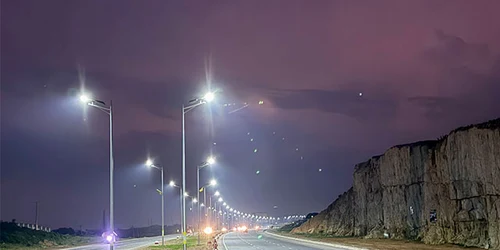
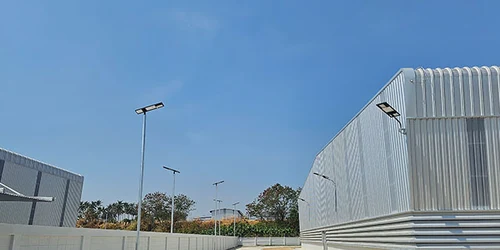
RoadSmart’s published project portfolio includes an ST2-160 highway project in Nigeria, an RSK-series urban road project in Central Africa, and an ST2-60 industrial park project in Thailand. These examples demonstrate different application environments but should not be treated as universal configurations for new projects.
Frequently Asked Questions
Is a solar street light different from an LED street light?
A solar street light normally uses an LED fixture, so the two terms are not direct opposites. “Solar” describes the energy source and system architecture, while “LED” describes the light source. A meaningful comparison is between an off-grid solar-powered LED street light and a grid-connected LED street light.
Which is better, solar street lights or traditional street lights?
Neither is better for every project. Solar street lights are often more practical where grid access is unavailable, cable installation is expensive, or independent operation is valuable. Grid-connected LED lighting may be better where reliable infrastructure already exists, the site has heavy shade, or the lighting load cannot be supported by a practical solar and battery configuration.
Do solar street lights work during cloudy or rainy weather?
They can continue operating when properly sized for the local climate and required backup period. Performance depends on the available solar resource, panel capacity, battery capacity, lighting schedule, temperature, shading, and consecutive cloudy days. Buyers should request an energy calculation instead of relying on a general claim about rainy-day operation.
Are grid-connected LED street lights always more reliable?
Grid lighting has predictable energy availability where the utility network is stable, but it remains dependent on cables, distribution equipment, and grid supply. Solar lighting avoids network dependence but relies on local energy generation and battery storage. Reliability should be evaluated according to the failure risks and maintenance resources of the actual site.
Does solar street lighting require less maintenance?
Solar lighting removes some grid-related components, but it introduces panels, batteries, and controllers. Maintenance may include panel cleaning, battery-health checks, controller diagnostics, fixture inspection, and eventual battery replacement. Grid lighting requires inspection of fixtures, drivers, cables, connections, cabinets, and protection equipment. The workload depends on system quality, environment, design, and maintenance planning.
What information is needed to compare the two solutions?
The project team should provide the location, road dimensions, application type, target lighting requirement, pole height, operating hours, traffic pattern, consecutive cloudy days, shading conditions, grid availability, cable distance, installation constraints, project quantity, and maintenance expectations. These inputs allow a supplier or lighting designer to compare technically suitable systems.
Request a Project Lighting Comparison
If you are deciding between off-grid solar street lighting and a grid-connected LED system, send RoadSmart your project location, road width, pole height, operating hours, grid conditions, consecutive cloudy days, and required lighting standard.
RoadSmart can help prepare a preliminary solar configuration, DIALux lighting layout, relevant photometric files, and a project-specific recommendation for technical and procurement review.