Solar Street Light Motion Sensor vs Timer Mode: Which Is Better?
Oct 30, 2026
Read:14
Source: Yin Zhenkun
A street light that stays at full brightness throughout the night offers predictable illumination, but it also places a steady demand on the battery. Motion sensing can reduce that demand during quiet periods, although frequent traffic may keep the light operating at higher output for much longer than expected.
For municipal roads, industrial parks, and parking areas, choosing between motion sensor and timer mode is therefore a practical design decision. Traffic patterns, required lighting levels, and the available solar energy all influence how the system should operate after dark.
This article compares the main control options, their effect on nighttime energy consumption, and the details project buyers should check before selecting a lighting configuration.
Quick Answer
Timer control works well where lighting requirements follow predictable hours. Motion-responsive dimming can reduce energy use on roads or sites with intermittent activity, while combined controls offer more flexibility. Neither is automatically better: the selected mode must provide the required illumination and be supported by the luminaire, controller, and battery system.
How Do Motion Sensors and Timer Controls Work?
A lighting control system regulates when a street light operates and how its output changes during the night. In a solar installation, the controller may use daylight detection, a programmed schedule, or signals from a motion sensor.
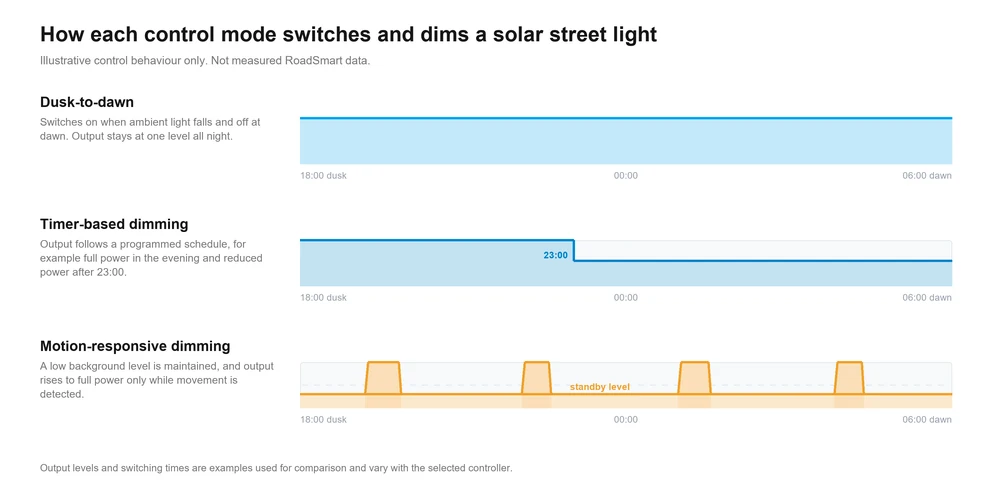
Timer control follows predetermined settings. A road may require higher output during the evening commute, followed by lower illumination during quieter hours. The brightness changes at the scheduled time whether or not traffic is present.
Motion-activated street lights respond to movement within a sensor's detection area. When activity is detected, the controller raises the light output according to its programmed settings. After a defined hold time, the fixture returns to its standby level. Some configurations maintain background lighting continuously; others may operate differently.
PIR and microwave sensors are both used for outdoor lighting, but their detection characteristics are not identical. Mounting height, surrounding obstacles, expected movement, and the manufacturer's sensor specifications all matter when selecting a system.
Dusk-to-dawn lighting is often mentioned alongside these functions, although it serves a different purpose. It switches the luminaire on when daylight falls and off when daylight returns. Timer-based dimming or motion detection can operate within that nighttime period.
A supplier's description of a fixture as “automatic” or “intelligent” is therefore not enough to identify its actual operating behavior. The programmed lighting profile needs to be checked separately.
Motion Sensor vs Timer: How Do Street Light Dimming Modes Compare?
Street light dimming can follow a fixed schedule, respond to activity, or use both methods. The differences become important when traffic varies between the early evening and the hours before dawn.
| Lighting mode | How it works | Main advantage | Main limitation |
|---|---|---|---|
| Constant all-night lighting | Maintains a selected output throughout the night | Continuous, predictable illumination | Sustained energy demand |
| Timer-based dimming | Changes output at programmed times | Predictable energy use and lighting schedule | Cannot respond directly to unexpected activity |
| Motion-responsive dimming | Increases output when movement is detected | Lower energy demand is possible during quiet periods | Depends on detection and frequency of movement |
| Combined timer and motion control | Uses scheduled settings with motion-triggered changes | Responds to both regular and unexpected activity | Requires compatible controls and appropriate settings |
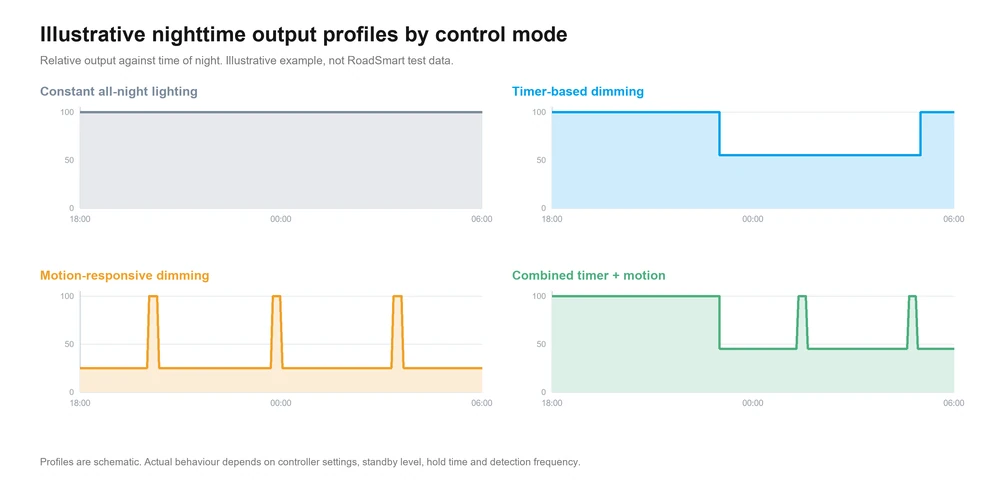
All-night operation does not necessarily mean full-power operation. A luminaire may remain on at a specified background level throughout the night, with brighter settings during periods of greater activity.
Motion sensing also does not have to mean that the road becomes dark between detections. For an industrial access road or parking area, background illumination may be needed so that drivers and pedestrians can see the route before entering the sensor's coverage area.
Combined controls can be useful where traffic follows a broad daily pattern but individual movements remain unpredictable. For example, scheduled dimming may reduce output late at night, while a sensor temporarily raises brightness when activity is detected.
The available functions vary between controllers. Before choosing a more complex profile, the project team needs to confirm that the equipment supports it and that the resulting illumination meets the site's requirements.
Which Lighting Mode Uses Less Battery Energy?
A solar street light's overnight energy demand depends on the electrical power it draws and how long it remains at each output setting.
Constant lighting produces a relatively predictable demand. Timer-based dimming allows consumption to be calculated from the programmed periods. With motion-responsive lighting, the result also depends on how often the sensor is triggered and how long the fixture stays at its higher setting.
Consider three simplified profiles for a luminaire capable of operating at 100 W and 30 W over a 12-hour night.
| Operating profile | Nighttime LED energy demand |
|---|---|
| 100 W for 12 hours | 1,200 Wh |
| 100 W for 4 hours, followed by 30 W for 8 hours | 640 Wh |
| 100 W for a combined 6 hours and 30 W for the remaining 6 hours | 780 Wh |
These calculations use assumed electrical power levels to illustrate energy demand. They are not RoadSmart test results and exclude additional system losses and controller consumption.
Why Motion Detection Does Not Always Save More Energy
In a lightly used parking area, a motion-controlled luminaire may spend much of the night at its lower standby setting. The energy saving can be substantial compared with operating continuously at a higher power.
The situation changes on a busy road. If vehicles repeatedly enter the detection area, the luminaire may remain at increased output for much of the night. Depending on the settings, a timer-based profile could then consume less energy.
Battery autonomy must also account for the usable battery capacity, solar charging conditions, electrical losses, and any required reserve for poor weather. Reducing the lighting load helps, but it cannot make up for a solar array that consistently produces too little energy.
For project comparisons, suppliers should calculate the expected consumption using the same lighting requirements and realistic operating assumptions. A percentage saving quoted without the underlying schedule and power settings has limited value.
Which Lighting Control Mode Works Best for Different Roads?
Municipal roads, industrial access routes, and parking areas do not have identical nighttime lighting requirements. Traffic volume, pedestrian activity, road classification, and local lighting rules determine whether continuous illumination or reduced output is appropriate.
Adaptive street lighting can adjust output as conditions change, but any reduction must remain consistent with the project's required lighting performance.
| Application | Control strategy to evaluate | Main consideration |
|---|---|---|
| Municipal main roads | Continuous lighting or permitted scheduled dimming | Required road illumination and consistent visibility |
| Industrial park roads | Timer-based or combined control | Shift changes, vehicle access, and background lighting |
| Parking areas | Timer, motion-responsive, or combined control | Occupancy, entrances, pedestrian movement, and security |
| Rural access roads | Motion-responsive or combined control where allowed | Low traffic, detection coverage, and nighttime autonomy |
| Campus pathways | Scheduled or motion-responsive dimming | Pedestrian movement and safe background illumination |
These are starting points for design review, not fixed rules for every installation. A low-traffic road, for instance, may still require continuous lighting because of its layout, hazards, or contractual requirements.
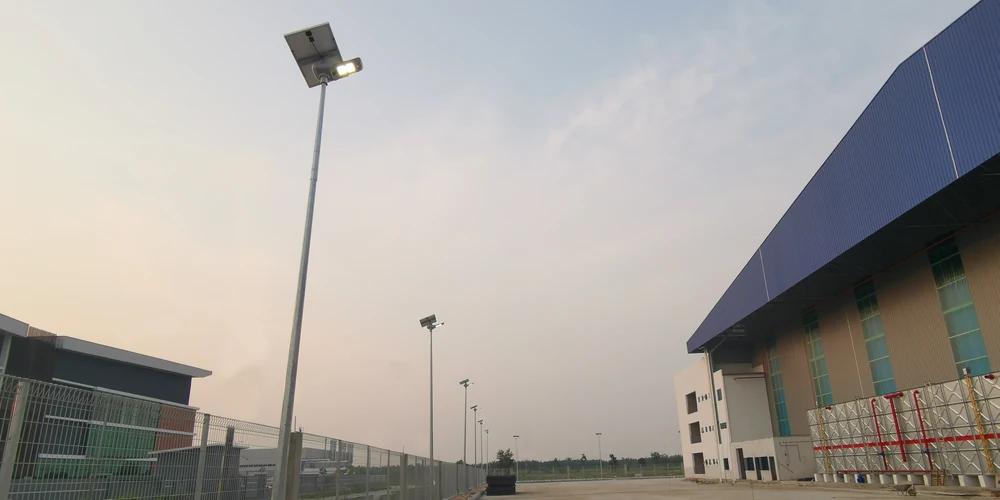
RoadSmart Malaysia Industrial Park: Solar Flyhorse Light FH120
RoadSmart supplied Solar Flyhorse Light FH120 units for an industrial park roadway in Malaysia. The project serves a working industrial environment where roadway visibility, reliable lighting control, and weather resistance are important considerations.
| Project detail | Configuration |
|---|---|
| Product | Solar Flyhorse Light FH120 |
| Location | Malaysia |
| Application | Industrial park roadway |
| Luminous flux | 7,500 lm |
| Color temperature | 6,000 K |
| Solar panel | 120 W |
| LiFePO4 battery | 460 Wh |
| Mounting height | 7 m |
| Pole spacing | 20 m |
The 7 m mounting height and 20 m pole spacing describe the installed roadway layout. The 460 Wh battery capacity is equally relevant when evaluating how the lighting schedule should be supported through the night.
In an industrial park, working hours and vehicle activity can vary between different access roads. A road used regularly during shift changes may benefit from a predictable timed schedule. Where movement is less regular, a compatible motion-responsive setting may offer another way to manage output while maintaining the required visibility.
The appropriate control profile must be assessed alongside actual site activity, lighting requirements, and available stored energy. The FH120 project's specifications provide a useful reference for that assessment without treating the lighting mode as separate from the rest of the installation.
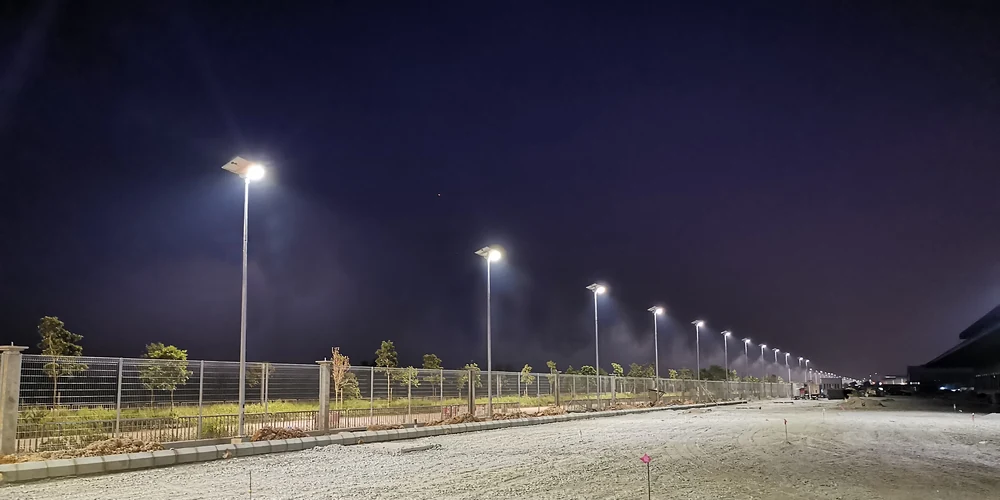
The RoadSmart Solar Flyhorse Light series features bat-wing roadway optics, intelligent power management, and an adjustable solar-panel design. Configurable working modes are available within the series, with motion sensing offered for applicable configurations.
For industrial road projects, these product features need to be considered together with the required lighting hours and site conditions. The aim is a reliable operating schedule that the selected solar and battery system can support.
What Should Buyers Check in Smart Lighting Controls?
A proposal that lists “intelligent dimming” or “motion sensor control” may still leave important questions unanswered. Distributors, EPC contractors, and project owners need to know exactly how the lights will behave after installation.
Before approving the lighting control settings, ask the supplier to document the operating profile and confirm that the proposed controller supports it.
| Item | What to confirm |
|---|---|
| Operating schedule | On/off times and programmed changes in output |
| Standby brightness | Output maintained when no movement is detected |
| Motion boost | Output used after a detection event |
| Sensor detection range | Coverage at the proposed installation height |
| Hold time | Duration of increased output after detection |
| Controller compatibility | Availability of the requested functions on the selected model |
| Battery autonomy | Expected operating duration under the project's energy assumptions |
| Lighting requirements | Compliance of the proposed settings with applicable illumination criteria |
| Commissioning records | Ability to verify the final settings after installation |
Different areas of the same project may need different profiles. A main entrance with regular vehicle traffic should not automatically use the same settings as a lightly used service road.
The RoadSmart RSG-Pro Series uses Intelligent Power Control 5.0 and offers L, M, T, and U lighting modes. These provide options for managing nighttime output, including dimming and activity-responsive functions on supported configurations.
The selected model and its actual control options should be confirmed before specifying a particular motion-detection or timed-dimming arrangement.
RoadSmart can work with distributors and project teams to assess road dimensions, pole layout, operating hours, and local solar conditions when selecting an appropriate lighting configuration.
FAQ: Motion Sensors and Timer-Based Street Lighting
Can motion sensor street lights stay on all night?
Yes, if the controller supports continuous background illumination. The light can remain at a programmed level and increase output when movement is detected. Not every motion-sensing model uses the same operating sequence, so the settings should be checked.
Is dusk-to-dawn lighting the same as timer mode?
No. Dusk-to-dawn control determines when the light switches on and off according to ambient daylight. Timer mode sets operating periods or brightness changes within that schedule. The two functions can work together.
Do motion-activated street lights always save more energy?
No. Savings depend on standby power, detection frequency, hold time, and the power used at each output setting. On a busy road, frequent triggers can significantly reduce the expected saving.
Can a lighting control system combine timer and motion detection?
Yes, provided the controller supports both functions. A combined profile can follow programmed brightness periods while allowing movement to trigger temporary increases in output.
What happens when a motion sensor stops detecting movement?
In a typical dimming configuration, the luminaire returns to its programmed standby level after the hold time expires. The exact behavior depends on the product settings and should be verified during commissioning.
Conclusion: Match the Control Mode to the Road
Timer control is easier to plan where lighting requirements are predictable. Motion-responsive dimming offers more flexibility where activity varies, but its energy benefit depends on how frequently the lights are triggered.
For roadway projects, the choice should be based on required illumination, actual operating conditions, controller functions, and the energy available from the solar system.
RoadSmart provides solar street lighting products and configuration support for municipal roads, industrial parks, parking areas, and other outdoor projects.
Planning a solar street lighting project?
Share your site layout, lighting hours, and operating requirements with the RoadSmart team to discuss a suitable configuration.
References
- U.S. Department of Energy — Exterior Lighting Control Guidance
betterbuildingssolutioncenter.energy.gov - Federal Highway Administration — Design Criteria for Adaptive Roadway Lighting
fhwa.dot.gov - DarkSky International — Five Principles for Responsible Outdoor Lighting
darksky.org