How to Check a Solar Street Light Photometric Report
Oct 26, 2026
Read:10
Source: Yin Zhenkun
A solar street light with high lumen output does not necessarily provide even illumination across a road. Two luminaires with similar wattage can produce different lighting results because their optical distribution, mounting height, and pole spacing are different.
For municipal projects, industrial roads, and commercial developments, a solar street light photometric report helps engineers and procurement teams determine whether the proposed lighting system meets the project's requirements.
Rather than comparing brightness claims alone, buyers need to understand how to review the photometric data, interpret the road lighting calculations, and check whether the report matches the actual installation.
Quick Answer
To check a solar street light photometric report, first confirm the luminaire model and optical configuration. Review the luminous intensity distribution, illuminance or luminance results, and lighting uniformity. Then verify that the simulation uses the correct mounting height, pole spacing, road geometry, and operating conditions before comparing the results against the applicable project requirements.
What Should a Solar Street Light Photometric Report Include?
A photometric report describes how a luminaire produces and distributes light. It provides the technical information needed to evaluate the fixture beyond its stated wattage or total luminous output.
For roadway projects, three types of documents are particularly useful.
| Document | Main purpose | What to verify |
|---|---|---|
| Photometric test report | Measures the luminaire's optical and electrical characteristics | Luminous flux, input power, light distribution, and test conditions |
| IES or LDT file | Provides electronic light-distribution data | Exact luminaire model and optical configuration |
| Lighting simulation report | Calculates lighting performance for the proposed installation | Road dimensions, mounting arrangement, illuminance, uniformity, and relevant glare results |
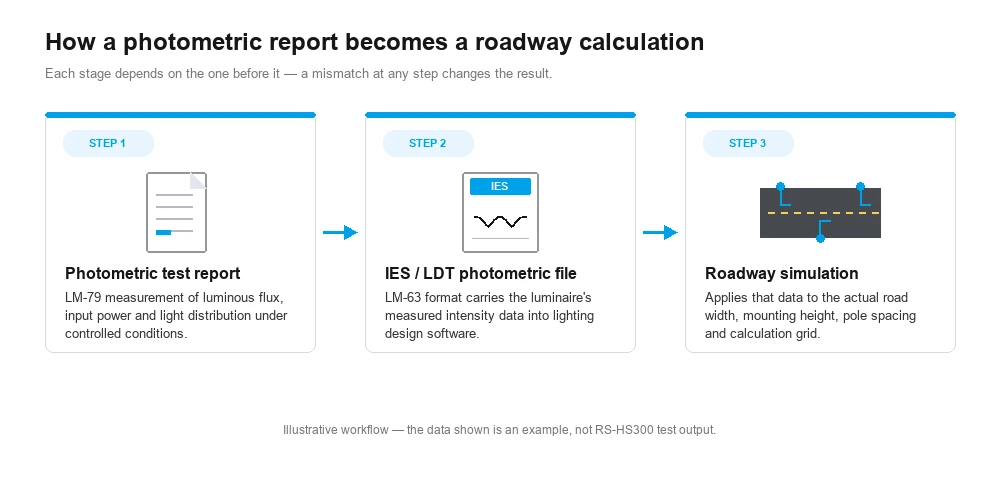
A laboratory photometric test and a roadway lighting simulation serve different purposes.
The test characterizes the luminaire under controlled conditions. The IES or LDT file makes its light-distribution data available to lighting design software. A calculation report then applies that data to the actual road geometry.
For example, a luminaire may provide suitable illumination at a particular mounting height and pole spacing but produce a less uniform result when the distance between poles increases.
ANSI/IES LM-79-24 establishes measurement procedures for solid-state lighting products, while ANSI/IES LM-63 specifies a format for transferring photometric data. Roadway lighting performance must still be evaluated against the design criteria applicable to the project.
How to Read the Key Photometric Results
The most important values in a photometric report describe different aspects of lighting performance. A higher number is not always better, and several measurements need to be considered together.
| Measurement | Unit | What it means | What the reviewer should check |
|---|---|---|---|
| Luminous flux | lm | Total light emitted by the complete luminaire | Confirm luminaire-level output rather than LED-chip output |
| Luminous intensity | cd | Light directed toward a particular angle | Check the distribution curve and relevant directions |
| Illuminance | lx | Light reaching a surface | Check the road area and calculation grid |
| Average illuminance | lx | Average light level over the defined surface | Compare with the project requirement |
| Minimum illuminance | lx | Lowest value within the calculation grid | Identify poorly illuminated areas |
| Uniformity | Ratio | Consistency of lighting across the defined area | Check the formula and applicable limit |
| Input power | W | Electrical power used under the specified test condition | Verify consistency with the selected model |
Why Lumens Alone Cannot Determine Road Lighting Quality
Lumens measure total visible light output. Lux measures the amount of light reaching a surface.
A higher-lumen street light may not illuminate a roadway more effectively if its beam distribution directs too much light outside the intended area or produces excessive brightness near the pole.
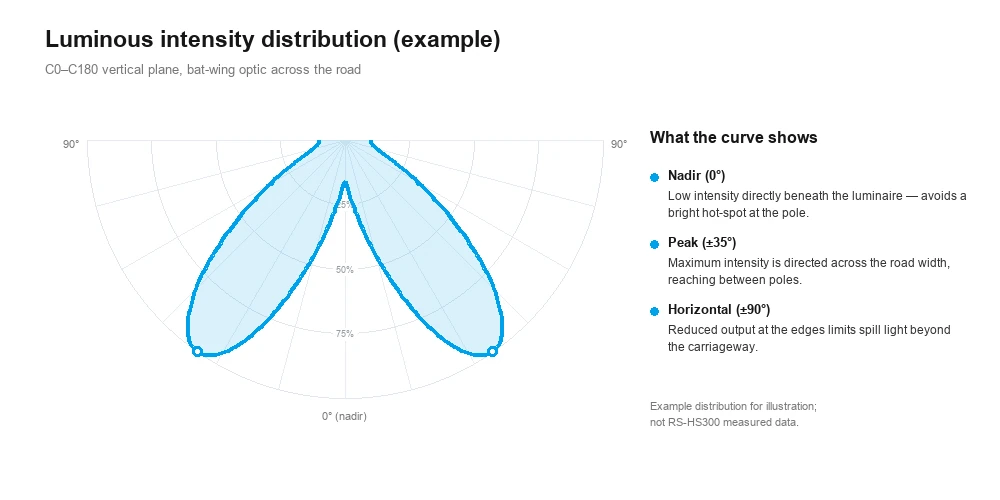
For roadway lighting, the optical system should distribute light across the road width and along the spacing between adjacent poles.
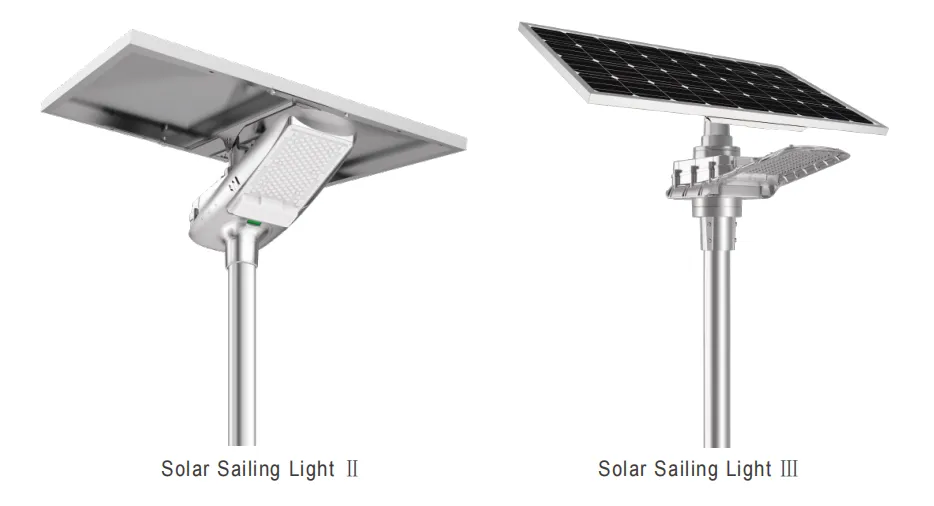
RoadSmart's HS Series solar street lights use bat-wing optics with polarized light distribution. This optical design is intended to spread illumination across road surfaces rather than concentrate it directly beneath the fixture.
When reviewing the corresponding photometric data, engineers should examine how the luminous intensity distribution supports the proposed road width, mounting height, and pole spacing.
How Should You Interpret Lighting Uniformity?
Uniformity indicates how consistently a road or calculation area is illuminated.
For illuminance-based assessments, one common expression is:
U₀ = E_min / E_avg
Here, E_min is the minimum illuminance and E_avg is the average illuminance over the specified calculation grid.
For example, an average illuminance of 15 lx and a minimum of 6 lx give a minimum-to-average uniformity of 0.40.
This illustrates how the ratio is calculated. Whether such a result is acceptable depends on the applicable road category and lighting requirements.
Some reports use different ratio definitions, while roadway projects may also specify luminance-based uniformity. The reviewer should therefore confirm both the calculation method and the required criteria.
How to Verify the IES File and Lighting Simulation
A lighting calculation is only as reliable as the data used to create it.
Before reviewing the colors or isolines on a DIALux report, confirm that the photometric file represents the luminaire being supplied.
The model number, optical configuration, luminous flux, and power setting should correspond to the quotation and technical specification. An IES file from another luminaire should not be used merely because the fixtures have similar wattage.
Next, review the installation parameters.
A typical roadway calculation should identify the road width, mounting height, pole spacing, pole arrangement, luminaire tilt, and overhang. These dimensions determine how the emitted light reaches the road surface.
The calculation grid, maintenance factor, and operating assumptions also require attention. A report based on initial full-output performance may differ from one assessing maintained illumination under the actual operating schedule.
Once these inputs are confirmed, evaluate the calculated results against the relevant lighting criteria.
Depending on the project, these may include maintained average illuminance, minimum illuminance, luminance, overall or longitudinal uniformity, and glare-related requirements.
The ANSI/IES RP-8-22 roadway lighting recommended practice provides technical guidance for roadway and parking-facility lighting. Projects should use the requirements applicable to their jurisdiction and contractual specification.
Check the Actual Lighting Schedule
Solar street lighting introduces an additional consideration because many systems adjust LED output during the night.
A lighting calculation performed at full power does not necessarily describe the illumination delivered during a reduced-power operating period.
The photometric review should therefore identify which power setting is used in the calculation and whether that setting corresponds to the project's required lighting schedule.
For roadway projects with specified lighting levels during particular periods, the proposed dimming program must be considered alongside the calculated photometric performance.
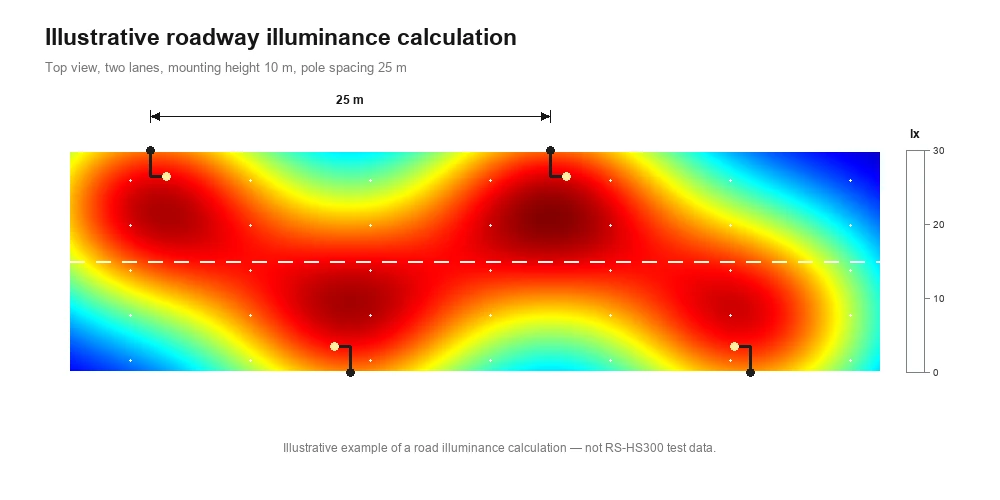
What Are the Most Common Photometric Report Errors?
A photometric report may contain technically valid measurements but still be unsuitable for a particular project if its configuration or calculation assumptions are inconsistent with the proposed installation.
The following issues deserve particular attention.
| Common issue | Why it matters | Recommended check |
|---|---|---|
| IES file from another model | The light distribution may differ | Match the exact luminaire and optic |
| Comparing LED-chip lumens with luminaire lumens | Results may overstate useful fixture output | Confirm complete-luminaire measurements |
| Incorrect mounting height or spacing | Calculated road performance may change | Compare with engineering drawings |
| Reviewing average lux alone | Dark areas may remain unidentified | Check minimum values and uniformity |
| Incorrect maintenance factor | Maintained-lighting predictions may be misleading | Confirm the specified factor |
| Full-power simulation for a dimmed installation | The calculation may not reflect the operating schedule | Verify controller settings and required lighting periods |
A review should focus on whether the data represents the project as designed, rather than whether the report contains an impressive peak illuminance or a visually attractive color map.
RoadSmart Hebei Urban Road Project: Reviewing the RS-HS300 Lighting Configuration
A RoadSmart urban road installation in Hebei, China, provides a practical example of how product specifications and actual installation conditions should be considered together during a photometric review.
The project uses the RS-HS300 solar street light from RoadSmart's HS Series for urban main-road lighting.
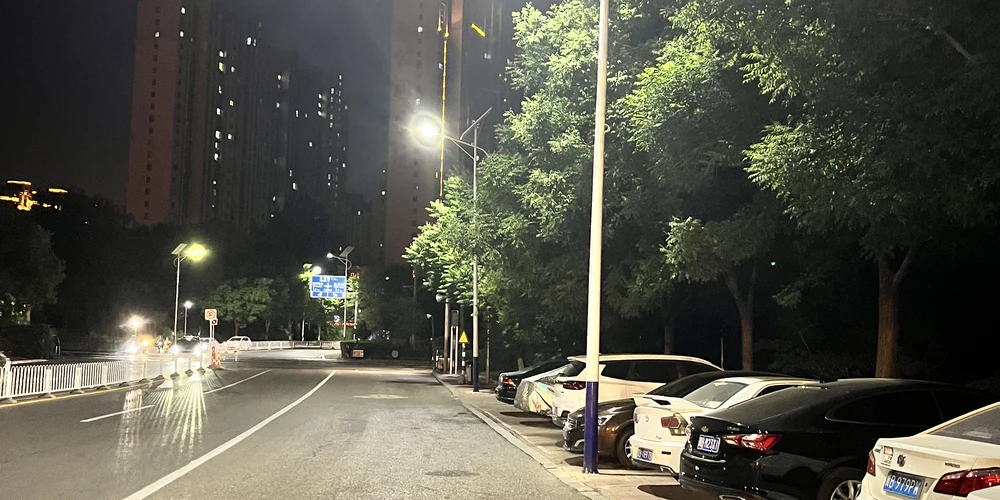
The project configuration includes:
| Project specification | Recorded value |
|---|---|
| Product model | RS-HS300 |
| Application | Urban main road |
| Location | Hebei, China |
| Luminous flux | 16,000 lm |
| Color temperature | 6,000 K |
| Solar panel | 300 W / 18 V |
| Battery capacity | 1,536 Wh |
| Mounting height | 10 m |
| Pole spacing | 25 m |
The RS-HS300 combines a 100 W LED luminaire with RoadSmart's bat-wing optical distribution, designed to support broad roadway illumination.
In a project with 10 m mounting height and 25 m pole spacing, the photometric review should examine how the light reaches the road surface between adjacent poles, not only the area directly below each luminaire.
The 16,000 lm luminous flux establishes the product's stated total light output, but the actual illuminance distribution depends on its optical characteristics and the geometry of the installation.
For a road with this configuration, the review should focus on three connected questions.
- Does the photometric file match RS-HS300? The selected IES or LDT data should represent the actual luminaire and bat-wing optical configuration. The light output and operating condition should also correspond to the proposed product.
- Does the lighting simulation represent the installed layout? The calculation should use the 10 m mounting height and 25 m pole spacing, together with the actual road width, luminaire orientation, and pole arrangement.
- Does the calculated distribution satisfy the road's lighting requirements? Average lighting levels, minimum values, uniformity, and any applicable glare criteria should be evaluated using the relevant road classification and project specification.
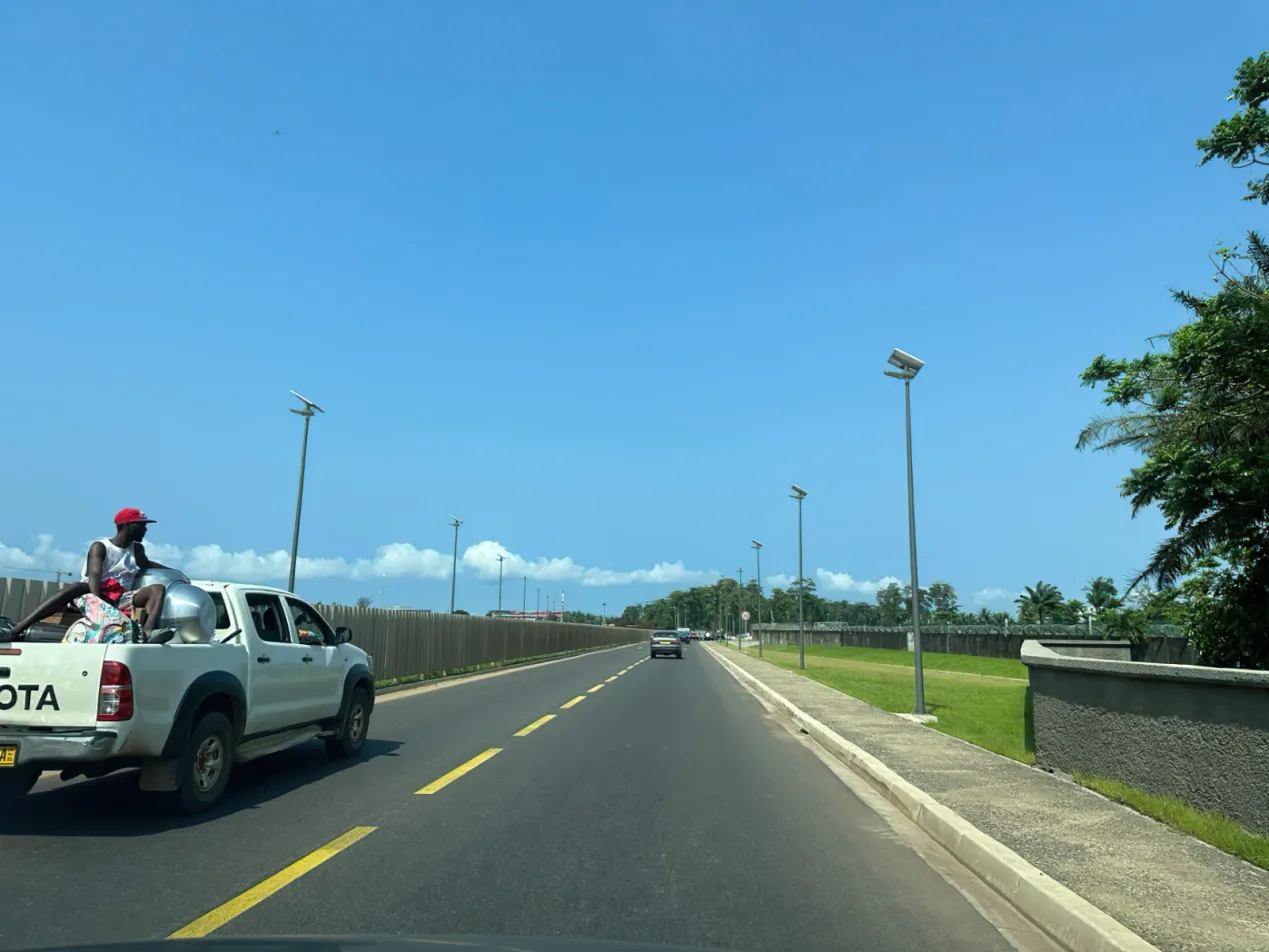
The installation photographs show the lighting arrangement and nighttime road coverage, while the photometric calculation provides the quantitative basis for checking the design.
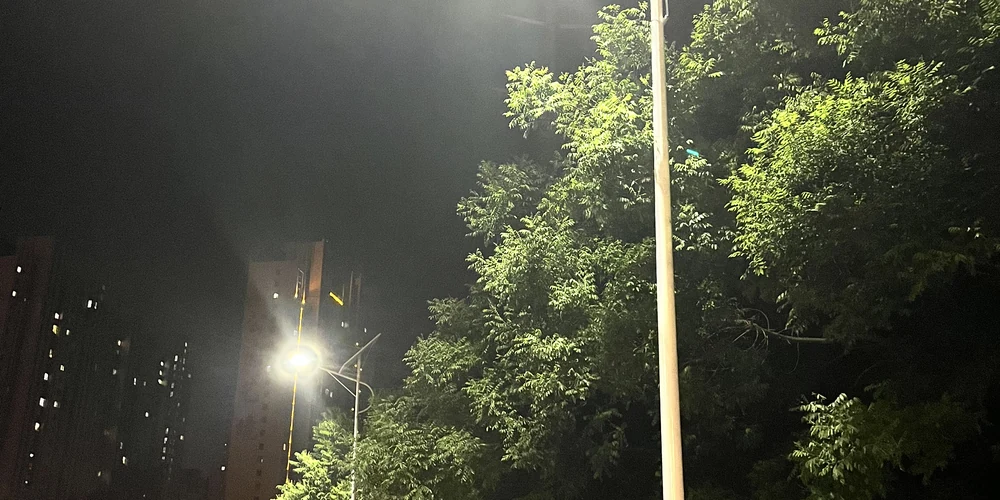
For this type of project, RoadSmart's HS Series optical design and the installation layout should be evaluated as one lighting system. The purpose of photometric review is to connect the selected luminaire, actual pole arrangement, and required road visibility rather than assess each product specification in isolation.
The project also illustrates why road lighting and solar-system operation need to be considered together. The luminaire's intelligent control settings should be coordinated with the required illumination periods, while weather resistance and any specified remote-monitoring functions are evaluated through their appropriate product and system documentation.
Solar Street Light Photometric Report Checklist
Before approving a lighting proposal, the reviewer should establish whether the product information, photometric file, and roadway calculation describe the same installation.
| Review item | What to verify |
|---|---|
| Luminaire model | Exact product model and optical configuration |
| Photometric test data | Measured luminous flux, power, and applicable test conditions |
| IES/LDT file | Correct file for the proposed model and optic |
| Light distribution | Appropriate coverage for the road width and pole arrangement |
| Mounting height | Consistent with the installation drawings |
| Pole spacing | Matches the proposed road layout |
| Calculation grid | Correct surface, dimensions, and calculation points |
| Maintenance factor | Consistent with the project design basis |
| Lighting results | Required illuminance or luminance and uniformity are achieved |
| Glare-related criteria | Evaluated where applicable |
| Operating schedule | Matches the required lighting levels and dimming periods |
If a report contains inconsistencies, the relevant inputs should be clarified before using the calculation to support procurement or installation decisions.
For roadway projects, RoadSmart can review road dimensions, proposed pole height and spacing, lighting requirements, and operating schedules to help recommend suitable solar street light configurations.
This approach supports project buyers who need to compare equipment options based on engineering conditions rather than wattage or lumen output alone.
FAQ: Solar Street Light Photometric Reports
Is an IES file the same as a photometric test report?
No. An IES file contains electronic photometric distribution data used in lighting calculations. A photometric test report includes measured optical and electrical information under specified testing conditions.
Can luminous flux alone determine whether a road will be adequately illuminated?
No. Luminous flux measures total emitted light, while road illumination depends on the luminaire's optical distribution, mounting height, spacing, and road geometry.
What is the difference between a photometric report and a DIALux report?
A photometric test report describes measured luminaire performance. A DIALux report uses photometric data and installation inputs to calculate the expected illumination of a particular project.
Why is uniformity important in urban road lighting?
Uniformity helps assess how consistently the road is illuminated. A roadway with acceptable average illumination may still have poorly lit areas if the distribution between poles is uneven.
What should buyers provide when requesting a roadway lighting assessment?
Project location, road width, proposed mounting height, pole spacing, road classification, lighting requirements, and operating schedule are useful starting points. Existing drawings and required technical standards can help define the assessment.
Conclusion: Review the Lighting Design, Not Just the Product Rating
A solar street light photometric report should help project teams determine whether a proposed luminaire can deliver the required illumination under the actual installation conditions.
Reliable review starts with matching the photometric data to the selected model, checking optical distribution and calculation inputs, and comparing the resulting road lighting performance against the applicable design requirements.
RoadSmart's RS-HS300 urban road application demonstrates how luminaire specifications, pole layout, and optical design come together in a real project.
For upcoming municipal roads, industrial developments, and infrastructure lighting projects, RoadSmart offers solar street lighting products and engineering configuration support based on specific site requirements.
Planning a solar street lighting project?
Share your road dimensions, proposed mounting layout, required lighting criteria, and operating schedule with RoadSmart to discuss a suitable lighting configuration.
References
- Illuminating Engineering Society — ANSI/IES LM-79-24: Optical and Electrical Measurements of Solid-State Lighting Products
Measurement procedures for the optical and electrical performance of solid-state lighting products.
https://store.ies.org/product/optical-and-electrical-measurements-of-solid-state-lighting-products/ - Illuminating Engineering Society — ANSI/IES RP-8-22: Recommended Practice: Lighting Roadway and Parking Facilities
Technical guidance for evaluating roadway and parking-facility lighting.
https://www.ies.org/wp-content/uploads/2023/04/RP-8-22-comprimido_compressed.pdf - Illuminating Engineering Society — ANSI/IES LM-63: Standard File Format for the Electronic Transfer of Photometric Data
Standardized format for exchanging luminaire photometric data used in lighting calculations.
https://www.ies.org/standards/lighting-library/