Can Solar Street Lights Work in Shaded Areas? A Site Assessment Guide
Oct 22, 2026
Read:18
Source: Yin Zhenkun
Solar street lights are often installed along roads where trees, warehouses, or nearby buildings block sunlight for part of the day. A location may be ideal for illuminating the road, yet poorly positioned for collecting solar energy.
For industrial parks, municipal roads, and commercial projects, this raises a practical question: can solar street lights work in shaded areas without compromising nighttime illumination?
The answer depends on how much sunlight reaches the panel, when shading occurs, and whether the system can collect enough energy for its required lighting schedule. Some shaded locations can support solar street lighting with appropriate planning. Others may require a different panel arrangement or power solution.
Quick Answer: Yes, solar street lights can operate in partially shaded areas if their panels collect sufficient energy for nighttime lighting. Brief or intermittent shade may be manageable, while prolonged obstruction can create charging deficits. Site suitability depends on the shade pattern, panel positioning, lighting requirements, and battery reserve.
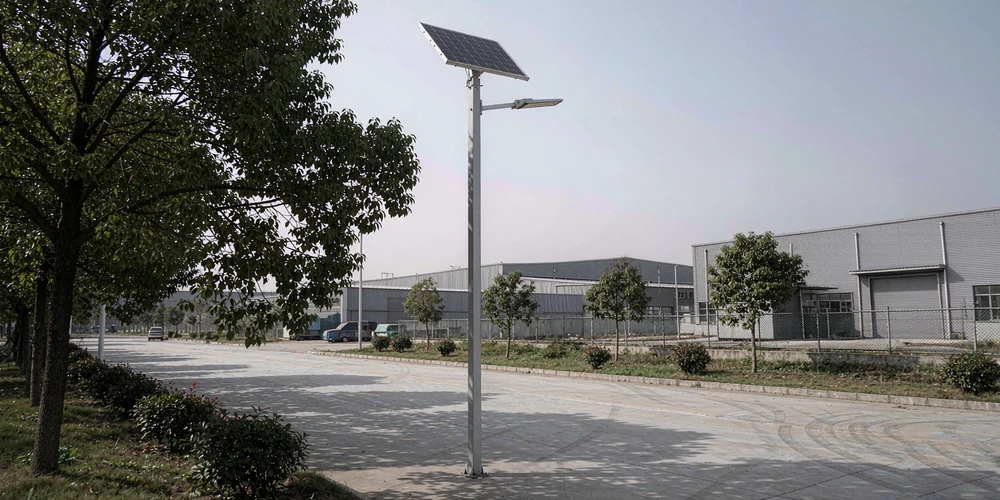
Illustrative scenario: Roadside trees partially shade a solar street light panel near industrial buildings.
Can Solar Street Lights Charge in the Shade?
Solar panels can generate electricity under diffuse daylight or partial shade, but their output is generally lower than under comparable direct sunlight. Whether this affects nighttime lighting depends on the amount of energy the system collects over the entire day.
In a solar panel street light system, photovoltaic electricity charges the battery during daylight hours. When surrounding trees or buildings reduce the panel's exposure, less energy may be available to replace what the light consumes overnight. A brief shadow may have little practical impact on a system with sufficient energy reserve, while repeated charging shortfalls can eventually affect its lighting schedule.
Shading losses are not always proportional to the area covered. Research by the National Renewable Energy Laboratory (NREL) examines how partial shading affects photovoltaic output through electrical mismatch. The magnitude of the loss depends on the panel and system configuration, not simply the visible size of the shadow.
The U.S. Department of Energy also identifies shade as a factor that must be considered when estimating actual photovoltaic energy yield.
For commercial street lighting, the important distinction is between a panel generating some electricity and a system generating enough to maintain the specified illumination throughout the night.
How Much Shade Is Too Much for Solar Street Lights?
There is no universal percentage of acceptable shade for every solar street light. The same model can perform differently at two locations because the timing of shadows, available solar resource, and required lighting hours are different.
Shade during periods of stronger solar irradiance can have a greater effect on daily energy collection than similar shade early in the morning or near sunset. However, this relationship also depends on panel orientation, local conditions, and seasonal changes in the sun's position.
For preliminary project evaluation, shading conditions can be grouped as follows.
| Site condition | Potential effect | Recommended assessment |
|---|---|---|
| Brief morning or late-afternoon shade | Limited reduction in daily charging may be manageable | Compare remaining solar generation with lighting demand |
| Intermittent tree shadows | Variable photovoltaic output throughout the day | Assess shade duration and panel coverage |
| Building shade during strong sunlight | Potentially significant daily energy loss | Examine alternative panel positions |
| Continuous dense shade | Solar generation may be insufficient | Reconsider the installation location or power supply |
These categories are intended to guide site screening, not establish guaranteed performance limits.
A panel shaded for several hours by a warehouse should not be evaluated in the same way as one occasionally affected by moving tree branches. Even within a single industrial park, individual lighting positions may require different configurations.
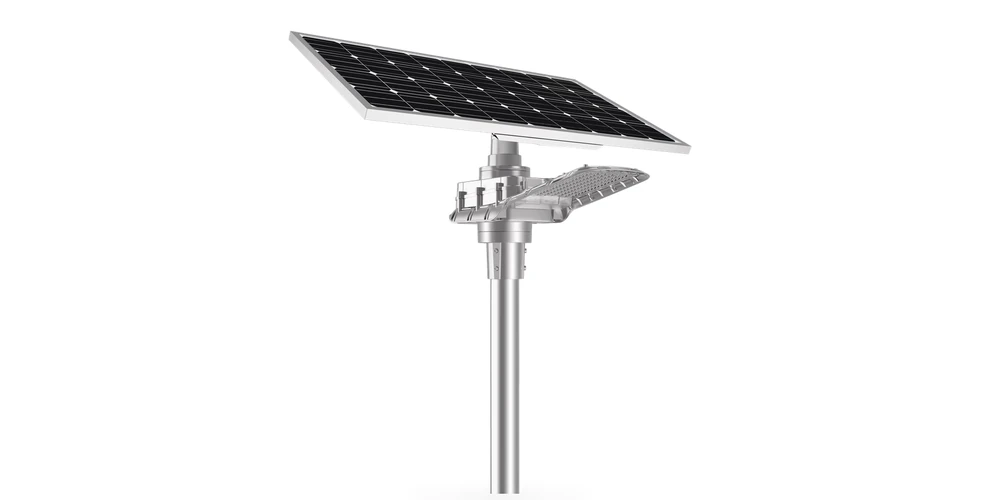
RoadSmart Solar Flyhorse Light features an adjustable solar panel and All-in-Two lighting structure.
How Can You Assess a Shaded Solar Street Light Site?
Before selecting a solar street light, the project team needs to establish where illumination is required and where the panel can receive sufficient sunlight. These positions may not always align, particularly along roads bordered by factories, walls, or mature trees.
A useful site survey should document the shading obstacles and their positions relative to each proposed lighting pole. Photographs taken at different times of day can reveal moving shadows, while a sun-path assessment or solar-resource model provides a stronger basis for evaluating longer-term exposure.
The following information is useful when reviewing the proposed installation.
| Assessment item | What to confirm |
|---|---|
| Shading obstacles | Nearby trees, buildings, walls, and other structures |
| Solar exposure | Timing, duration, and extent of shading |
| Panel positioning | Available mounting angle, orientation, and clearance |
| Lighting requirements | Road width, required illumination, pole height, and operating hours |
| Energy storage | Battery reserve required during reduced solar generation |
| Environmental conditions | Wind, rainfall, temperature, and mounting conditions |
| Control requirements | Dimming schedule, intelligent controls, and any communication requirements |
Roadway lighting performance should be assessed against the required illumination and uniformity, not luminous flux alone. For projects using intelligent control or communication equipment, the specified functions and compatibility should also be checked separately from the solar-charging assessment.
A shading study is particularly valuable where several poles are affected by different obstacles. The U.S. Department of Energy's solar photovoltaic guidance recommends evaluating both permanent and seasonal shading rather than relying on a single favorable observation.
The final objective is to determine whether the expected solar energy can support the lighting schedule and required reserve before approving the installation.
What Can You Do When Solar Street Lights Are Partially Shaded?
When shade affects the proposed installation, improving solar exposure should be considered before increasing system capacity.
If the panel's current orientation is unfavorable, adjusting its angle may improve energy collection. Where a nearby building or tree blocks sunlight regardless of panel angle, a different mounting position may be necessary.
RoadSmart's Solar Flyhorse Light uses an All-in-Two design with an adjustable solar panel. This allows panel orientation to be considered alongside the lighting requirements during project planning.
The series also features Multi-Peak MPPT charging technology, designed to track a suitable photovoltaic operating point under changing conditions, including certain partial-shading patterns.
However, MPPT cannot replace sunlight lost to an obstacle. Its benefit depends on the electrical characteristics of the solar panel and the actual shading conditions.
Similarly, a larger battery can extend the available reserve but cannot correct a persistent shortage of daily energy generation.
Where the proposed position remains heavily shaded, revising the panel location or system arrangement may be more effective than simply increasing the panel or battery specifications.
RoadSmart Malaysia Industrial Park Project: Solar Flyhorse Light FH120
Industrial parks illustrate why solar street lighting needs to be evaluated according to the installation environment. Warehouses, internal access roads, loading areas, and landscaping can create different lighting and solar-exposure conditions across the same site.
RoadSmart has a documented installation of Solar Flyhorse Light FH120 along an industrial park road in Malaysia.
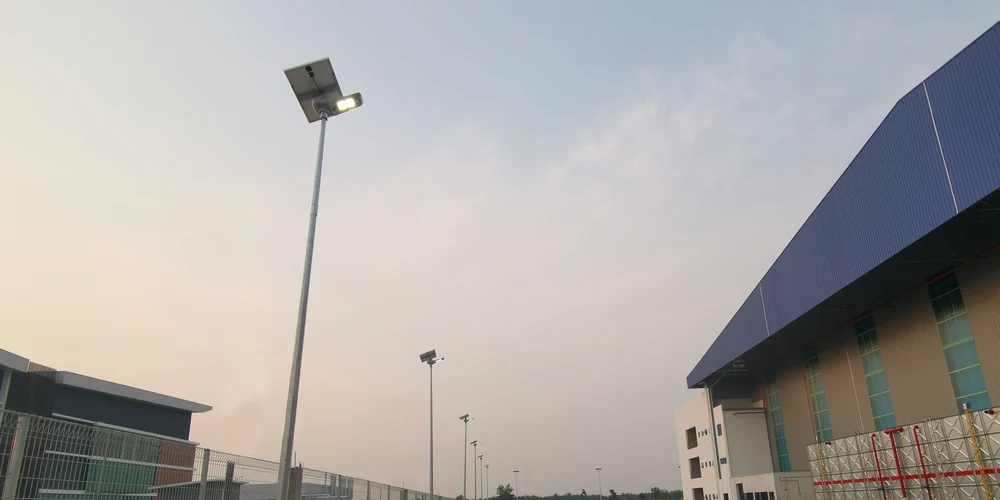
Solar Flyhorse Light FH120 installed along an industrial park road in Malaysia.
The documented project configuration includes:
| Project specification | Recorded value |
|---|---|
| Product model | Solar Flyhorse Light FH120 |
| Solar panel | 120 W |
| LiFePO4 battery | 460 Wh |
| Luminous flux | 7,500 lm |
| Color temperature | 6,000 K |
| Mounting height | 7 m |
| Pole spacing | 20 m |
| Project location | Malaysia |
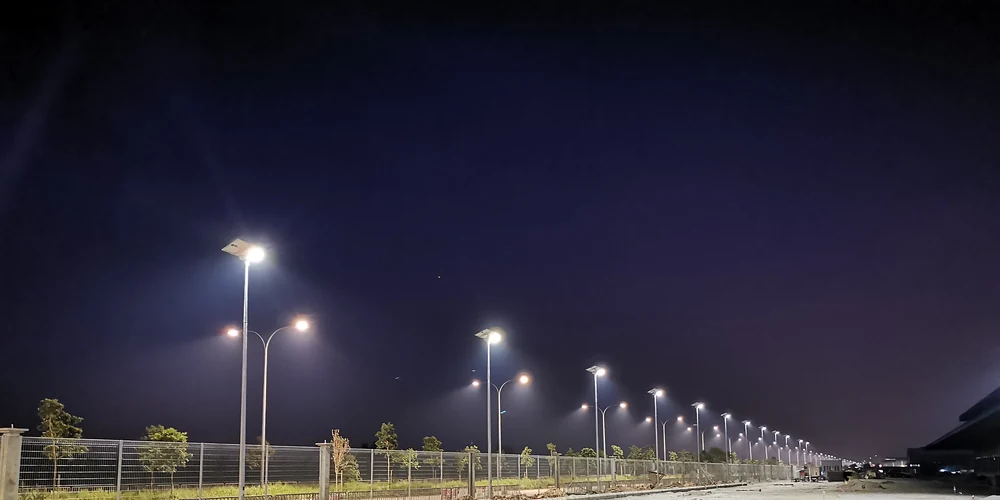
Nighttime view of the Solar Flyhorse Light FH120 industrial road installation in Malaysia.
The Malaysia industrial park project demonstrates how RoadSmart's Solar Flyhorse Light FH120 is applied to roadway lighting in an industrial environment. The installation uses a 120W solar panel, a 460Wh LiFePO4 battery, and a lighting configuration designed for the site's road layout.
Industrial parks often include warehouses, roadside trees, and buildings that create varying solar exposure across different lighting positions. The Flyhorse Series addresses these installation considerations through an adjustable solar panel, allowing the panel angle to be optimized according to the available sunlight.
Its Multi-Peak MPPT technology helps track the appropriate maximum power point when partial shading affects the panel's electrical output. RoadSmart's intelligent power control system also manages battery discharge according to operating conditions, helping make effective use of the stored energy.
For industrial roads where buildings or vegetation may affect solar charging, these features provide useful flexibility during system selection. By considering panel orientation, daily energy availability, and the required lighting schedule together, projects can select a configuration that balances solar charging with dependable roadway illumination.
When Does a Split Solar Street Light Make More Sense?
An All-in-Two solar street light can be appropriate where the lighting pole also offers adequate solar exposure and the required panel orientation is achievable within its mounting arrangement.
More complex locations may benefit from a different structure.
If the preferred lighting position is shaded but another suitable panel position is available, a split solar street light may provide greater flexibility in arranging the photovoltaic components.
RoadSmart's HS Series uses a split configuration with adjustable solar panels and Multi-Peak MPPT technology. It can be considered for roadway and industrial applications where panel positioning requires closer attention.
The choice should still be based on actual site conditions. Electrical connections, mounting compatibility, cable losses, available solar energy, and the lighting schedule must be reviewed before a split arrangement is approved.
A split design offers installation flexibility, but it does not make a persistently shaded solar panel capable of generating sufficient energy.
When Is a Shaded Location Unsuitable for Solar Street Lighting?
A shaded site should be reconsidered when the available solar energy cannot support the required lighting demand and battery reserve, even after reasonable adjustments to the installation arrangement.
This is particularly important for industrial access roads, public streets, and security-related applications where lighting reliability is essential.
If dense trees or nearby structures prevent adequate solar exposure, an alternative panel position, revised pole layout, or another power source may be necessary.
The decision should be based on expected energy availability and project lighting requirements rather than assuming that additional battery storage or a more advanced controller can resolve every shading problem.
FAQ: Solar Street Lights in Shaded Areas
Can solar street lights work under trees?
They may work where tree shading is limited and sufficient solar energy remains available. Dense or prolonged tree cover can substantially reduce charging, so the shade pattern should be assessed before selecting the system.
Can a larger battery compensate for reduced solar charging?
A larger battery can provide additional stored energy, but it does not increase the electricity produced by a shaded panel. If charging remains consistently inadequate, the installation or system design needs to change.
Can the solar panel be positioned separately from the light?
Some split solar street light systems allow more flexible panel arrangements. The available mounting options, electrical compatibility, wiring losses, and controller requirements must be verified for the selected configuration.
What information should be provided for a shaded street lighting project?
Useful information includes the site location, photographs, nearby obstacles, proposed pole positions, road dimensions, lighting schedule, and available solar exposure. This helps the manufacturer evaluate suitable configurations.
Conclusion: Match the Lighting System to the Site
Solar street lights can work in partially shaded areas, but whether they can provide dependable nighttime illumination depends on the energy available at the actual installation location.
Understanding the shade pattern, evaluating the available solar resource, and choosing an appropriate panel arrangement are essential before finalizing the system. In some locations, a correctly positioned All-in-Two unit may be suitable. Others may require a split configuration or an alternative power arrangement.
RoadSmart offers solar street lighting solutions for industrial roads, municipal projects, and other outdoor applications with different installation requirements.
Planning a solar street lighting project near trees, warehouses, or surrounding buildings?
Share your site photographs, proposed pole layout, and lighting requirements with RoadSmart to discuss an appropriate system configuration.
References
The following technical resources provide background on photovoltaic shading, energy-yield assessment, and system design.
- U.S. Department of Energy — Photovoltaic System Design and Energy Yield
Explains how environmental conditions, including shading, affect the actual energy harvested by photovoltaic systems. - National Renewable Energy Laboratory — Partial-Shading Assessment of Photovoltaic Installations via Module-Level Monitoring
Examines partial-shading losses and electrical mismatch in photovoltaic installations. - U.S. Department of Energy — Renewable Energy Ready Home: Solar Photovoltaic Specification, Checklist and Guide
Provides guidance on site suitability and the evaluation of permanent and seasonal solar shading.