Outdoor Sports Venue Solar Lighting: How to Choose All-in-One Street Lights (2026 Guide)
Jun 08, 2026
Read:376
Quick Answer:
Yes, easy installation and stable light-source lumen output are two very important factors when choosing all-in-one solar street lights for outdoor sports venues, but they are not the only selection factors. Lighting for outdoor sports scenarios is relatively special, and it is also necessary to consider the actual conditions of the specific venue, such as uniform lighting performance, anti-glare lighting design, battery endurance, and other factors. It is an entire supporting odm all in one led solar street light solution.
Introduction
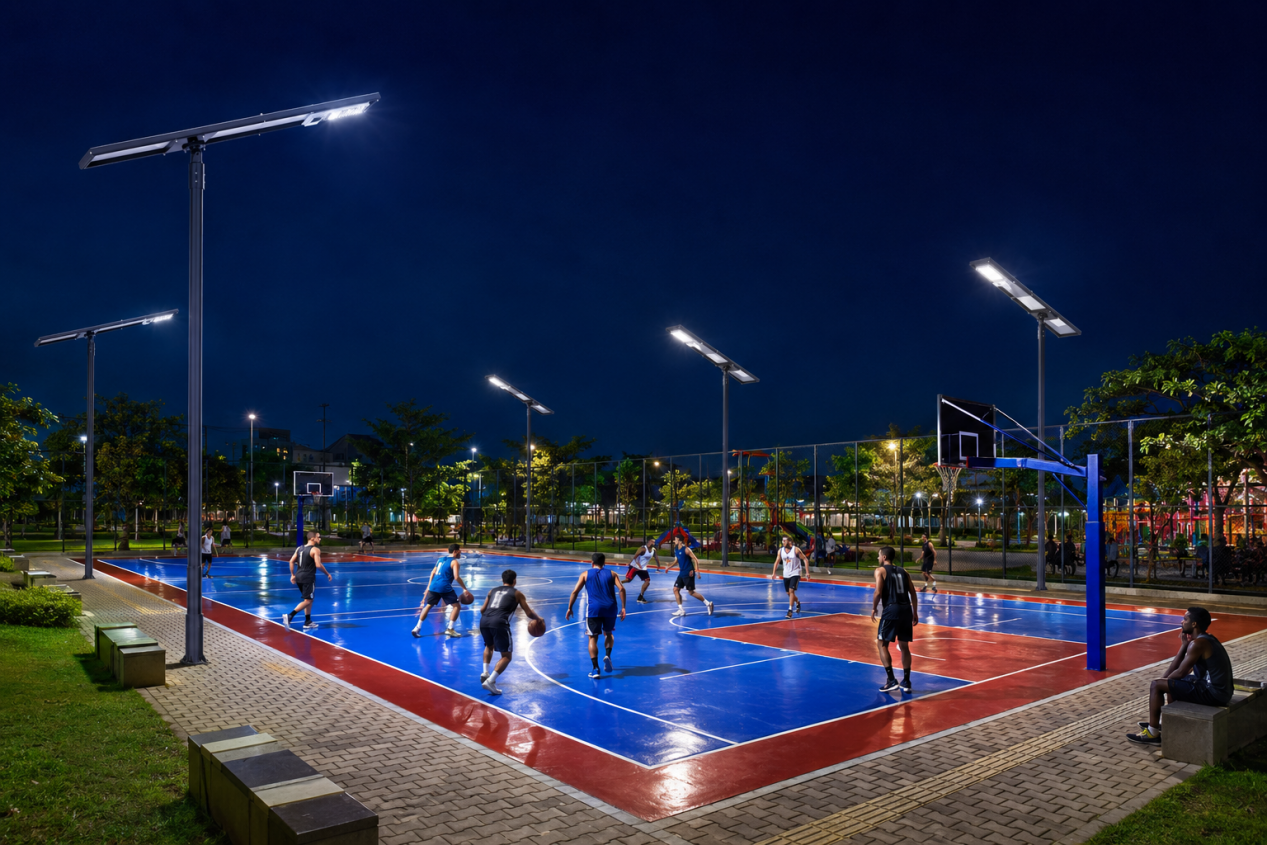
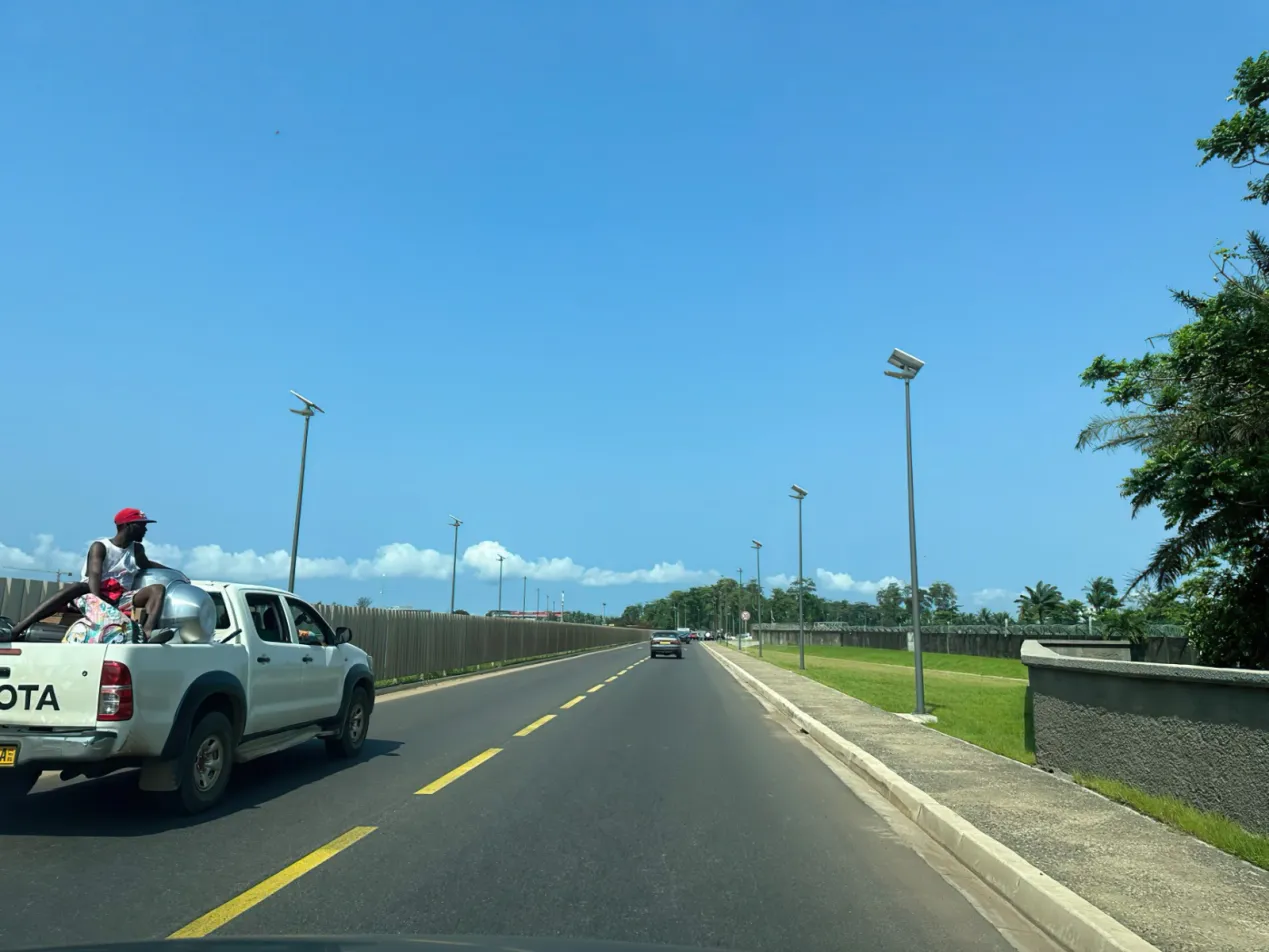
With the upgrading of sports facilities in different scenarios, especially outdoor sports venues, more and more outdoor sports venues have begun to pay attention to and plan night-time lighting in order to make public use safer and improve the sports experience. All-in-one solar street lights, with their significant advantages such as simple and convenient installation, off grid solar system design, no need for trenching and wiring, and fast construction, are becoming the choice of more and more projects.
However, lighting for outdoor sports venues is different from ordinary road lighting. It has certain requirements for light brightness, light distribution and glare design, lighting stability, and other aspects. A slight mistake may affect sports safety. Therefore, this article will explain how to select all in one led solar street light,s for outdoor sports venues from different aspects, hoping to bring some help to your project.
After reading this guide, you will know exactly which features to prioritize when selecting all-in-one solar lights for basketball courts, tennis courts, soccer fields, and multi-use sports areas.
Are All in One LED Solar Street Lights Suitable for Outdoor Sports Venues?
All in one solar street lightscan meet the lighting needs of outdoor sports venues. Therefore, the answer is that they are suitable. However, it should be noted that not all scenarios are suitable. To make it easier for everyone to distinguish, this article lists the outdoor sports venues with relatively high adaptability to all in one solar street lights, mainly including the following types:
Application Scenario | Selection Focus | Recommended Expression |
Community basketball court | Anti-glare, uniformity, timed control | Suitable for medium-to-high-brightness solar lights |
Tennis court | Fast ball speed, need to reduce shadows | Focus on uniformity and glare |
School playground | Fixed usage time | Suitable for timed + energy-saving mode |
Park sports area | Difficult to connect to electricity, high safety requirements | Focus on installation convenience and anti-theft |
Small football field | Larger area | Requires higher pole position and higher lumen output |
Township sports ground | Limited budget and maintenance | Focus on durability, battery, and easy maintenance |
All in one solar street lights are suitable for outdoor sports venues. However, it is worth noting that if the venue is a very professional-level sports competition site, or has special needs at a high-standard level, it will require a more complex lighting system and optical design. Ordinary solar street lights outdoor cannot simply be used as a replacement. The selection needs to be considered comprehensively based on actual requirements.
What are the Core Selection Dimensions for All in One Solar Lights in Outdoor Sports Venues?
For outdoor sports venue selection, multiple factors need to be considered comprehensively. Among them, easy installation and stable light-source lumen output are key dimensions, while lighting uniformity, glare design, endurance capacity, and other dimensions are also included.
1. Easy installation
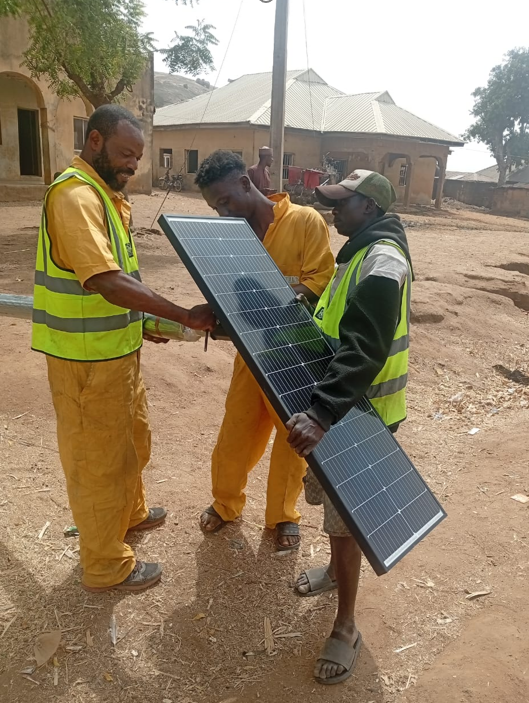
Easy installation is not only a significant advantage of outdoor all in one solar street lights, but also an important reason for outdoor sports venue projects to choose them. Many outdoor sports venues are basically renovated from old sites, and the renovation conditions are limited. If large-scale trenching and wiring are carried out, the original site will be continuously damaged and restored, wasting resources and increasing project renovation costs.
Outdoor all in one solar street lights do not need to be connected to traditional mains-powered lighting. They form an independent lighting system, off grid solar system design, with flexible and fast installation, and are suitable for basketball courts, park sports areas, school playgrounds, and township sports grounds that have already been built. While construction is simple, the construction period is also short, allowing the venue to resume operation quickly.
Installation time: A single all-in-one solar street light typically takes 30–60 minutes to install, including pole fixing, lamp head hoisting, and angle adjustment, saving over 70% of construction time compared to traditional wired systems.
Installation cost: No trenching, cabling, or grid connection required. Each light saves approximately $200–400 in installation costs, depending on site conditions.
Retrofit suitability: Ideal for existing sports grounds, such as school playgrounds and community basketball courts, as it avoids damaging the original surface structure.
2. Stable light-source lumen output
Stable light-source lumen output is the key to ensuring the user experience of outdoor sports venues. Different sports venues have different requirements for solar street lights outdoor brightness and lighting duration. A sports venue should not be judged by single brightness alone. What needs to be considered is the uniformity of lighting and the light distribution effect, so as to effectively improve the sports experience and ensure sports safety.
So, when selecting the appropriate lumen output for all in one solar lights, which configurations should mainly be examined? The quality of the LED lighting chip comes first. In addition, the stability of the driver power supply, battery capacity, heat dissipation structure of the lamp body, controller efficiency, and the charging capability of the solar photovoltaic panel will all affect the use of the light fixture and need special attention.
Luminous efficacy: LED chips should achieve ≥160 lm/W; premium products reach 180–210 lm/W. For the same 60W power, high-efficacy models deliver over 30% more effective lumens.
Lumen maintenance (L70 life): For sports venues, L70 ≥50,000 hours is recommended, meaning ≥70% of initial lumens after 50,000 hours. For high-intensity use, consider L90 ≥10,000 hours.
Recommended lumens (half basketball court example): Total luminous flux of 15,000–25,000 lumens, typically achieved by 2–4 light poles with 120–180W all-in-one solar lights each.
Driver requirement: Must use flicker-free high-frequency drivers (>3000Hz) to avoid visual retention or flicker interference during fast motion.
3. Light distribution design
Outdoor sports venues are different from other places. While ensuring brightness, attention must also be paid to brightness uniformity. Situations where one area is very bright while another area is very dark should not occur. If the changes between light and dark on the venue are too large, the eyes will easily become fatigued, visibility will be reduced, and collisions and mistakes will inevitably occur.
Therefore, after choosing the corresponding outdoor all in one solar street lights, their professional light distribution design also needs to fully consider the actual conditions of the venue. This includes not only brightness matching, illumination uniformity, anti-glare design, and reasonable light layout, but also maintaining uniform illumination across the venue. This should avoid affecting the surrounding environment while also creating a good sports lighting environment.
Illuminance uniformity (U0): Ratio of minimum to average illuminance should be ≥0.6; ratio of minimum to maximum illuminance (U1) should be ≥0.5. This ensures smooth vision and avoids “zebra-stripe” dark zones.
Glare rating (GR): For community/school level sports venues, GR ≤30 is recommended. For professional competition venues, such as formal basketball or tennis, GR ≤20 is required.
Shadow management: For tennis courts, badminton courts, and other fast-ball sports, avoid multiple shadows. Use symmetrical pole placement or cross-lighting to minimize shadows from a single fixture.
Verification method: Request IES files and use DIALux software to simulate illuminance distribution, uniformity, and pseudocolor plots. RoadSmart provides this service free of charge.
4. Battery endurance
All in one solar lights form an independent lighting system, charging and storing energy during the day and discharging electricity for lighting at night. Outdoor sports venues usually require longer lighting hours and higher illumination levels. Therefore, they have high requirements for battery endurance.
Based on this premise, when selecting all in one solar lights, it is necessary to first clarify the night-time lighting duration and the local use conditions during rainy and cloudy days, and to estimate in advance and consider extreme situations. At the same time, a time-segmented dimming mode can be adopted. High brightness can be maintained when there are many people exercising, while low brightness can be used late at night when there is no one, simply to meet basic lighting needs. This can ensure lighting for outdoor sports venues while also effectively extending battery endurance.
Typical usage duration: Sports venues typically need 4–6 hours of high-brightness lighting for training or matches, plus 2–3 hours of low-brightness lighting for cleanup and security.
Rainy/cloudy day autonomy: Recommend 3–5 days in high-brightness mode, or 5–7 days with intelligent dimming.
Battery type: Must be LiFePO4 (Lithium Iron Phosphate) with cycle life ≥2,000 cycles, 80% remaining capacity, and operating temperature range from -20°C to 60°C.
Capacity estimation example: For a 120W system with actual power consumption ≈120Wh/h, 5 hours of high-brightness per night, and 3 days of backup, the required capacity is ≈120W × 5h × 3 = 1,800Wh. A safety factor of 1.2 gives ≈2,160Wh.
5. Protection performance
Outdoor sports venues, as the name suggests, are located outdoors. This means they need to be affected by climate and environmental conditions, such as high temperatures, rainfall, strong winds, and other situations. Therefore, outdoor all in one solar street lights must fully consider the influence of the environment.
All in one solar light fixtures need to have a good waterproof and dustproof rating. Their structure must be strong, and the battery and controller must have safety protection. In coastal areas, attention should also be paid to corrosion resistance. In areas with strong winds, attention should be paid to the wind-resistant design of the pole and lamp body.
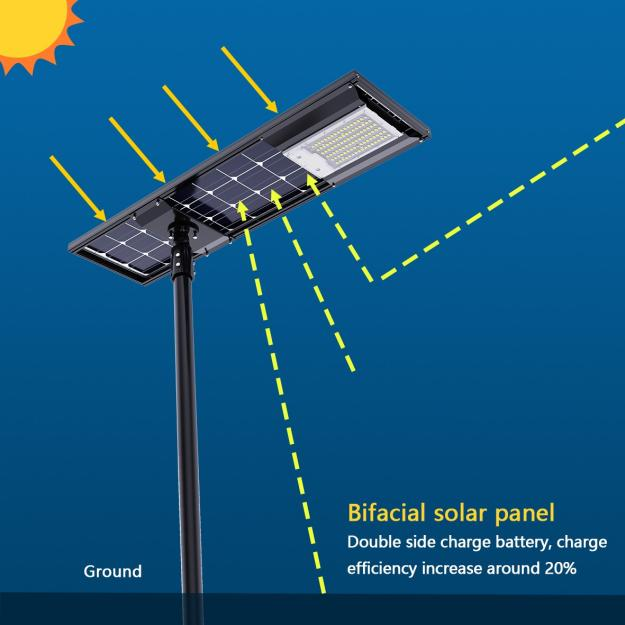
In addition to the above factors, the solar photovoltaic panel, controller, lamp body structure, and other parts of all in one solar lightss are also influencing factors in the selection for outdoor sports venues. These will affect long-term use and maintenance.
Ingress protection (IP): Outdoor sports lighting should be IP65, protected against powerful water jets, or IP66, temporary immersion. IP65 is sufficient for heavy rain and site washing; choose IP66 for coastal or flood-prone areas.
Wind resistance: The lamp and solar panel should withstand typhoon wind speeds of 32.7 m/s, Level 12. Request wind tunnel test reports or structural strength calculations.
Corrosion resistance (salt spray): For venues within 200m of the coast, require ASTM B117 salt spray test ≥500 hours with die-cast aluminum housing + anti-corrosion coating.
Key Differences:Sports Venue Lighting vs. Road Lighting
Aspect | Road Lighting | Sports Venue Lighting |
Primary Goal | See the road surface, identify obstacles | Athlete safety, spectator experience, TV broadcast (if applicable) |
Illuminance Uniformity (U0) | General: ≥0.4 | High: ≥0.6 (U1 ≥0.5 recommended) |
Glare Control (GR) | Basic: ≤40 | Strict: ≤30 (≤20 for professional competitions) |
Shadow Requirements | No special requirement | Avoid multiple shadows – affects ball trajectory judgment in tennis, badminton, etc. |
Lighting Duration | All night (10–12 hours) | Fixed sessions (4–6 hours high brightness for matches/training) |
Dimming Strategy | Time based (full brightness early night, half brightness late night) | Mode based (match mode / training mode / cleanup & security mode) |
Flicker Tolerance | Low sensitivity | Must be flicker free (high frequency driver >3000Hz) for fast moving balls |
Optical Design | Batwing or asymmetric lenses for road coverage | Symmetric or multi point distribution for uniform area coverage |
Typical Pole Height | 6–12 m | 6–12 m (but often multiple poles per court/field) |
Conclusion
Outdoor sports venues are relatively complex environments. When choosing outdoor all in one solar street lights, easy installation and stable light-source lumen output are key considerations, but they must also be combined with the actual situation to evaluate core configurations, light distribution effects, outdoor protection, and other factors. It is not a single choice, but a comprehensive and integrated lighting solution. If you need an odm all in one led solar street light solution for an outdoor sports venue, welcome to consult RoadSmart.
FAQ
Q1: Can I use regular all-in-one solar street lights for a basketball court?
A: Not recommended. Regular road lights may cause glare and uneven illumination, affecting player vision. Choose lights specifically designed with anti-glare optics and high uniformity for sports courts. RoadSmart offers customized optical designs for sports venues.
Q2: How many lumens do I need for a half-court basketball court?
A: A typical half-court (approx. 15m × 14m) requires 15,000-25,000 lumens total, usually achieved by 2-4 light poles (6-8m height) with 120-180W all-in-one solar lights each. RoadSmart provides free DIALux simulation to determine exact needs.
Q3: Can solar lights handle fast-moving sports like tennis or badminton?
A: Yes, if the lights have high-frequency drivers (no flicker) and proper anti-glare design. Flicker-free LEDs ensure that fast-moving balls are not blurred. RoadSmart’s all-in-one solar lights use high-quality drivers with no visible flicker.
Q4: How long can the lights stay on for a night game?
A: With a typical 5-7 day battery backup (for cloudy days), a well-configured system can provide 4-6 hours of high-brightness lighting plus 2-3 hours of low-brightness mode every night for 3-5 consecutive rainy days. Customizable based on local sunlight and usage.
Q5: What is the typical payback period for solar sports lighting vs grid-tied?
A: For outdoor sports venues without existing grid connection, solar is often the only feasible option. For venues with grid access, payback is typically 3-5 years through electricity savings alone, plus lower installation costs (no trenching). RoadSmart can provide a TCO analysis for your project.
Q6: Can RoadSmart provide a complete solution for a soccer field?
A: Yes. RoadSmart offers end-to-end solutions: site assessment, DIALux simulation, light pole design, all-in-one solar lights (260W+ for large fields), battery sizing, and installation guidance. Contact us with your field dimensions and usage schedule.