How to Choose All-in-One Solar Street Lights for Campus Projects
Jun 30, 2026
Read:548
Introduction
Campus outdoor lighting projects need to balance safety, visibility, installation difficulty, and long-term operating cost. Roads, parking lots, walkways, dormitory areas, and school entrances all have different lighting needs, so campuses usually need more than a one-model lighting approach.
This guide explains how to choose all-in-one solar street lights for campus projects based on road type, pole height, brightness needs, installation conditions, and long-term maintenance requirements. It is written for school project owners, contractors, distributors, and buyers evaluating solar lighting for campus roads and public areas.
For guidance on planning solar lights for parks and other public areas — including site assessment, system selection and light distribution — see our dedicated overview for parks and public spaces.
Quick Answer: All-in-one solar street lights are often suitable for campus projects because they reduce trenching and cabling, support flexible installation, and help control long-term electricity and maintenance costs. The right model still depends on road width, pole height, lighting area, usage time, and the specific campus scenario.
For school roads, parking lots, walkways, and campus corner areas, solar lighting should be selected according to the real application rather than by power label alone.
Core Challenges of Traditional Campus Outdoor Lighting
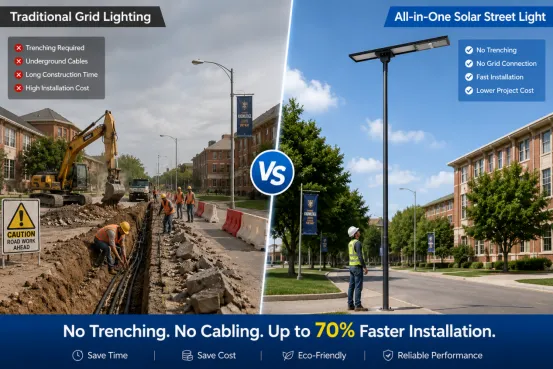
Campus outdoor lighting is different from an ordinary road project. It is not only about nighttime visibility, but also about student safety, vehicle order, maintenance pressure, and construction impact on daily campus operations.
First is construction difficulty. Many schools, especially older campuses, do not have reserved cabling for new lighting points. If traditional municipal-power street lights are installed, roads may need to be excavated, cables laid, and power distribution upgraded. This increases construction cost and may interfere with class schedules, pedestrian circulation, and vehicle movement.
Second is long-term cost. Outdoor lights operate every day. If campus roads, parking lots, dormitory areas, and sports-field surroundings all depend on grid-powered lighting, electricity and maintenance costs continue to accumulate over time.
Third is the variety of lighting scenarios. Main roads need stronger and more uniform illumination. Parking lots need broad and even coverage. Walkways and dorm areas need softer light with lower glare. School gates and entrances need visibility and a neat overall appearance. This is why campus lighting should be selected by scenario rather than by one fixed lamp configuration. [1]
Why Are All-in-One Solar Lights Suitable for Schools?
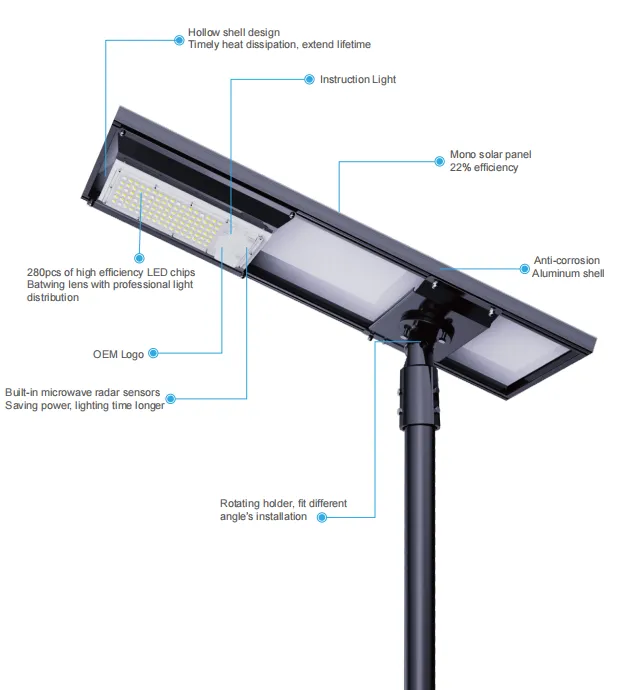
All-in-one solar lights integrate the solar panel, battery, LED light source, and controller into one system. They charge during the day and provide lighting automatically at night, without relying on municipal power wiring. [3]
For schools, this matters because installation is often easier in roadsides, parking-lot edges, dorm walkways, sports-field surroundings, and remote corners where rewiring would be expensive or disruptive. On campuses that are already in use, this can reduce the impact of construction on normal teaching and circulation.
Solar street lights can also help reduce long-term electricity expenses. Although the upfront procurement cost may be higher than basic municipal lamps, the total project cost becomes clearer when trenching, cabling, power distribution, electricity, and maintenance are considered together.
Intelligent control is another reason they fit campus use. Pedestrian and vehicle activity on campus usually changes over the night. With time-based dimming or motion-based control, the system can reduce output during quieter hours and increase brightness when people or vehicles pass by. This helps balance safety and energy use. [4]
What Should Buyers Check Before Choosing Campus Solar Street Lights?
Before selecting a model, school buyers should check the following points carefully.
1. Road or area type
Confirm whether the light will be used on a main road, a parking lot, a dorm walkway, a school entrance, or a sports-field perimeter.
2. Pole height and spacing
Pole height and spacing directly affect lighting coverage, brightness, and uniformity.
3. Brightness and glare control
Some areas need stronger visibility, while others need softer light to avoid glare or light spill.
4. Installation difficulty on existing campuses
Check whether rewiring would disrupt roads, teaching, parking, or pedestrian movement.
5. Long-term maintenance and operating cost
Evaluate not only the purchase price, but also battery autonomy, maintenance access, and long-term operating pressure.
How Should Different Areas of a School Choose All-in-One Integrated Solar Street Lights?
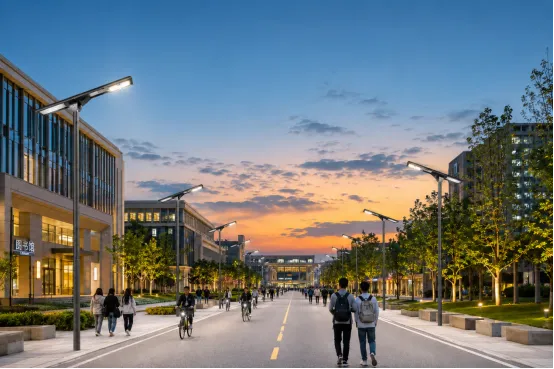
If you are unsure which power range fits your project, you can also review our comparison article: 60W vs 120W vs 260W Solar Street Light Power Selection Guide.
Campus Zone | Core Lighting Requirement | Recommended Pole Height | Suggested Power & Lumen | Light Color & Lens Design | Key Points to Prioritize |
Main Campus Roads | Stable brightness and broad coverage for mixed pedestrian and vehicle traffic | 6-8m | 120-200W / 11900-20000LM | Neutral white, bat-wing wide-angle lens | Uniform illumination, rainy-day autonomy, anti-glare control |
Broad and even coverage without dark gaps | 5-8m | 100-160W / 9000-18000LM | Neutral white, wide-distribution lens | Wide lighting area and consistent brightness | |
Dorm Walkways & Garden Paths | Soft light with low glare near dorm and residential areas | 3-5m | 60-100W / 6000-9000LM | Warm white 3000K, softer optical design | Motion dimming and lower light pollution |
School Gate & Vehicle Entrances | High visibility with clean appearance and driver comfort | 7-9m | 160-260W / 18000-25000LM | Neutral white, glare-control shielding | Adjustable lamp angle and stable coverage |
Sports Field Perimeters | Basic safety lighting for circulation, not professional competition lighting | 5-7m | 80-120W / 7000-15000LM | Neutral white, outdoor-resistant design | Weather protection and adequate runtime |
Schools located in coastal zones, high-temperature inland regions, or rainy mountain areas may also need extra anti-corrosion, high-temperature, or extended-autonomy configurations.
Project Selection Tips for Campus Solar Street Light Projects
For campus solar street light projects, buyers should first separate the lighting areas by function, such as main roads, parking lots, walkways, dormitory areas, school gates, sports field surroundings, and dark corner areas. Each area may require different pole heights, brightness levels, lens distribution, lighting time, color temperature, and motion-sensing control.
For school renovation and new campus construction, project teams should also confirm whether trenching, wiring, installation schedule, rainy-day backup, maintenance access, and centralized control are required. These project conditions help determine whether an all-in-one solar street light model can meet both safety and long-term maintenance requirements.
When Schools Procure, Which All-in-One Solar Street Light Quality Details Cannot Be Ignored?
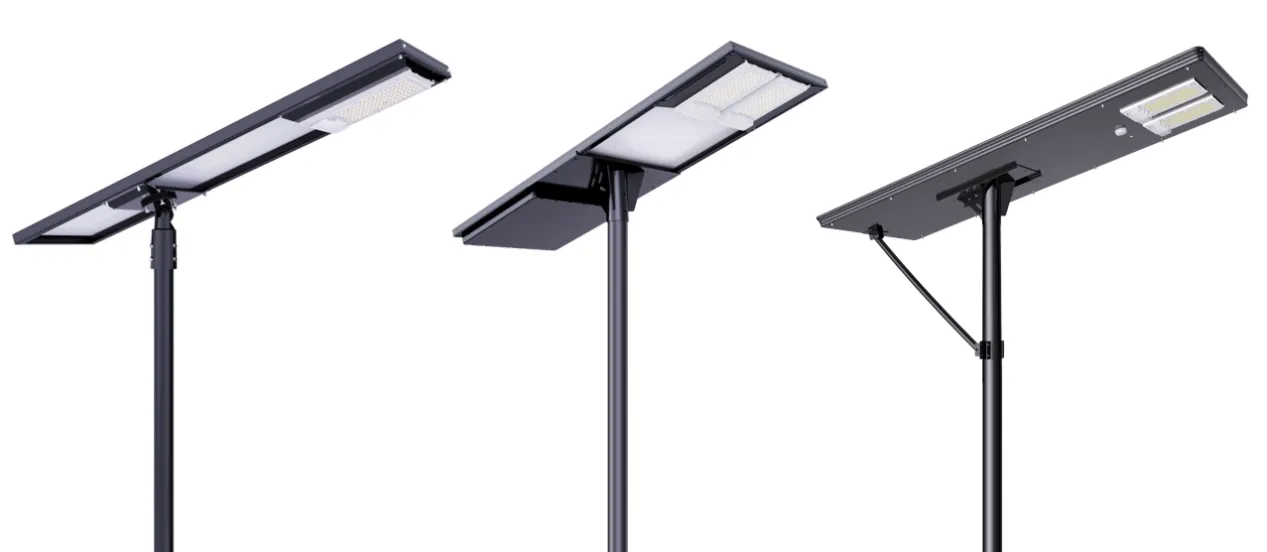
First, check the solar panel and battery configuration. The panel affects how much energy can be collected during the day, while the battery determines how long the light can operate at night. If the panel is too small or the battery is undersized, runtime may be shortened during consecutive cloudy or rainy days.
Second, check the controller. The controller works as the operating logic center of the light, managing charge and discharge protection, time-based dimming, and sensing control. Because campus pedestrian flow changes significantly over the night, intelligent control is often more practical than fixed full-brightness operation.
Third, check structure and protection performance. Campus lights stay outdoors for long periods and need to handle rain, dust, heat, and wind. Housing material, heat-dissipation design, and waterproof or dustproof protection all affect long-term stability. [5]
Finally, check whether the manufacturer can provide scenario-based recommendations. Campus lighting is not only about buying lamps. It requires matching the product to road width, pole height, installation position, local sunlight, and required lighting hours. A manufacturer that can support campus-road, parking-lot, and walkway selection is usually more useful than one that only recommends a single model.
Summary
When schools choose all-in-one solar street lights, they should not look only at the lowest price or at power labels alone. Campus roads, parking lots, walkways, dormitory areas, and entrances all have different lighting requirements, so the selection logic should also be different.
A more reliable method is to first confirm the application area, then evaluate pole height, lighting time, brightness target, battery autonomy, and installation conditions. Products selected this way are more likely to perform steadily in real campus use.
For new campus construction, old-campus lighting renovation, parking-lot expansion, or supplementary lighting for remote campus areas, all-in-one solar street lights can reduce cabling work, lower long-term electricity and maintenance pressure, and provide a more flexible campus lighting solution.
Frequently Asked Questions
Q1: Can solar street lights work for schools in rainy or mountain areas?
They can be used in rainy or mountain-campus projects when the solar panel, battery autonomy, and controller settings match the local sunlight and weather conditions. For more demanding sites, buyers should confirm a project-specific configuration before deployment.
Q2: Will campus solar lights near dormitories cause glare at night?
They can be configured to reduce glare through lower pole height, softer optics, warmer color temperature, and dimming control. For dorm walkways and residential-style campus zones, light comfort is as important as brightness.
Q3: How long does a campus lighting renovation project usually take?
The installation schedule depends on lamp quantity, site access, foundation conditions, and whether the campus is already in use. In many school projects, all-in-one solar lights can reduce installation complexity because they require less cabling and trenching than grid-powered systems.
Q4: Can schools manage all campus solar lights centrally?
Depending on the project configuration, some systems can support centralized monitoring, dimming schedules, and fault alerts through an IoT or remote-management platform. Buyers should confirm this function according to the selected model and project needs.
Q5: What quality documents are usually important for school projects?
School or public-sector projects usually pay attention to product certifications, waterproof and dustproof reports, photometric data, and manufacturer quality-management documentation. Exact document requirements depend on the local project or tender standard.
Q6: Should campus roads and parking lots use different light configurations?
In many cases, yes. Main roads usually need longer reach and stronger brightness, while parking lots focus more on broad and even coverage. Using one fixed configuration everywhere may lead to uneven lighting results.
Q7: Can RoadSmart help with campus lighting selection?
Yes. RoadSmart can support campus-lighting selection based on road width, pole height, lighting hours, local sunlight conditions, and zone distribution, so buyers can compare more suitable configurations for different campus areas.
References
- ANSI/IES RP-8-22: Lighting Roadway and Parking Facilities, ANSI / Illuminating Engineering Society.
- FHWA Roadway Lighting Details / FHWA Lighting Handbook Considerations, Federal Highway Administration.
- Outdoor Solar Lighting, U.S. Department of Energy.
- Lighting Controls, U.S. Department of Energy.
- Ingress Protection (IP) Ratings / IEC 60529, International Electrotechnical Commission.