MPPT vs PWM Solar Charge Controllers: Which Works Better for Solar Street Lights?
Nov 25, 2026
Read:32
Source: Yin Zhenkun
MPPT and PWM solar charge controllers differ primarily in how they harvest energy from solar panels. MPPT adjusts the photovoltaic operating voltage to capture more available power, while PWM generally operates the panel closer to battery voltage. For solar street lights, MPPT can improve daytime energy harvesting and battery recovery, particularly when panel voltage and battery voltage differ significantly.
Reliable nighttime illumination, however, depends on more than charging efficiency. Projects requiring continuous full-power operation, limited dimming, or extended rainy-day autonomy must maintain a balance between solar energy input, battery storage, and lighting consumption. Understanding how these factors interact helps determine which charging technology is better suited to the application.
MPPT vs PWM Charge Controllers: How Do They Work?
Both technologies regulate energy transfer from photovoltaic panels to batteries, but they use different electrical operating principles.
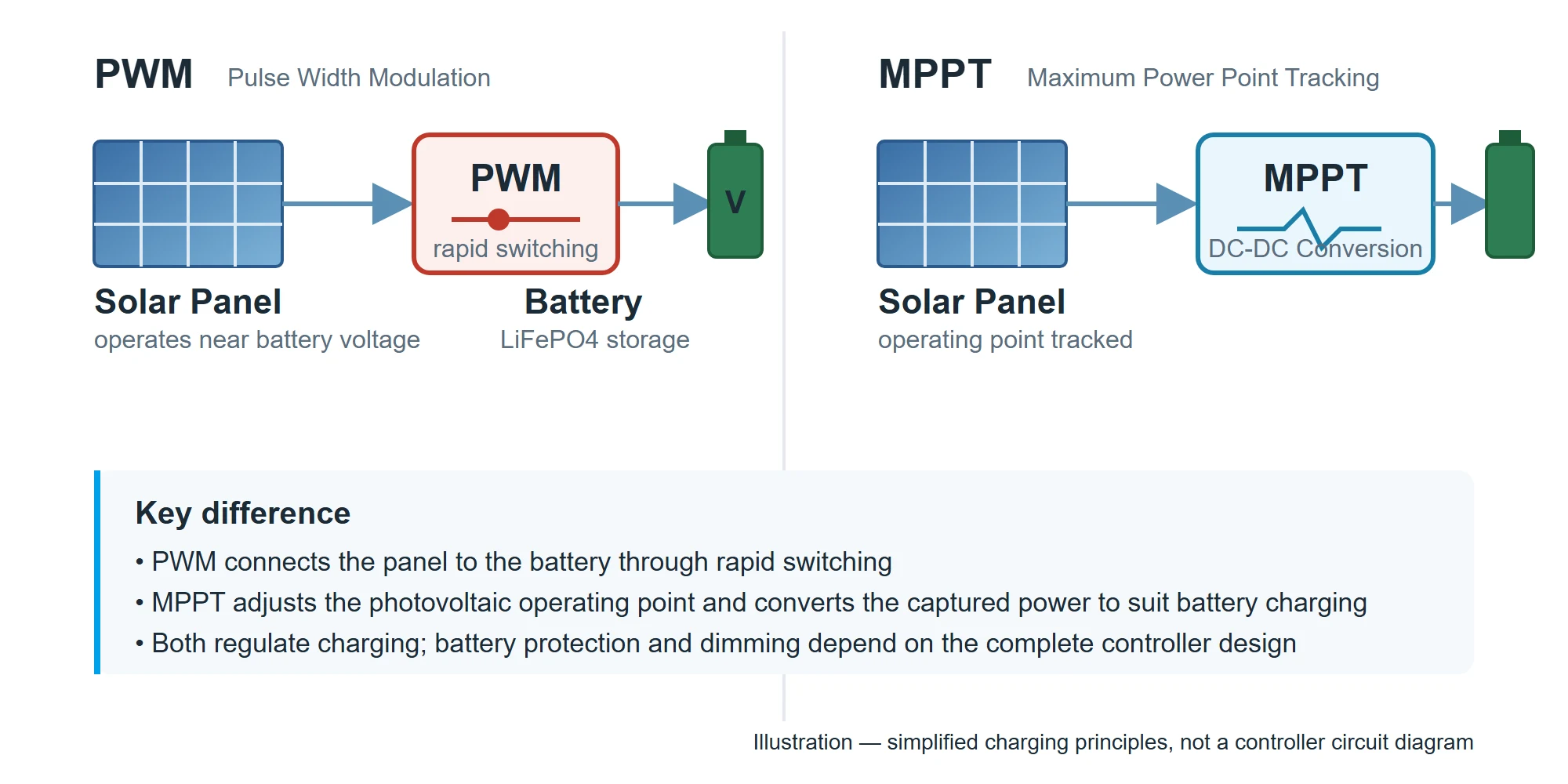
PWM, or Pulse Width Modulation, regulates charging by rapidly switching the connection between the solar panel and battery. During active charging, the panel typically operates near battery voltage. When its maximum power point occurs at a substantially higher voltage, part of the available generating potential remains unused.
MPPT, or Maximum Power Point Tracking, continuously adjusts the photovoltaic operating point to capture available power more effectively. Through DC-DC conversion, the controller delivers that power at a voltage and current suitable for battery charging. [1]
| Comparison | PWM | MPPT |
|---|---|---|
| Charging principle | Switching-based regulation | Maximum power point tracking and DC-DC conversion |
| PV operating voltage | Generally close to battery voltage | Adjusted according to available photovoltaic power |
| Panel-to-battery voltage matching | More restrictive | Greater flexibility within controller limits |
| Energy harvesting | Dependent on voltage matching | Can capture additional available energy |
| Circuit complexity | Generally lower | Generally higher |
| Battery protection | Design-dependent | Design-dependent |
| Nighttime dimming | Configuration-dependent | Configuration-dependent |
When evaluating PWM vs MPPT for outdoor lighting, battery protection, motion sensing, and nighttime power management should be considered separately. These functions depend on the complete controller design rather than its charging method alone.
MPPT vs PWM Efficiency: What Do the Numbers Actually Mean?
An efficiency rating of 99% and an energy improvement of 20% can describe entirely different aspects of controller performance. Understanding what each percentage represents is essential when evaluating how effectively a solar lighting system collects and uses energy.
Three indicators are particularly relevant to charging performance.
| Performance Indicator | What It Measures |
|---|---|
| MPPT Tracking Efficiency | How closely the controller captures the maximum available photovoltaic power |
| Charging Conversion Efficiency | How much photovoltaic input power reaches the charging output after electrical conversion |
| Energy Harvest Gain | Additional energy obtained over a defined period compared with another charging configuration |
A high tracking efficiency does not mean that the entire lighting system operates at the same efficiency. Power conversion, battery charging, energy storage, and LED operation introduce separate losses.
Temperature, solar irradiance, photovoltaic characteristics, and battery charging conditions also influence actual energy gains. For example, a battery approaching its charge limit may not accept all the power available from the solar panel.
Rather than comparing a single efficiency percentage, a meaningful MPPT vs PWM efficiency assessment considers how much usable energy reaches the battery throughout the day under comparable operating conditions.
Why Partial Shading Can Create Multiple Power Peaks
Under uniform sunlight, a photovoltaic module typically produces a power-voltage curve with one dominant maximum power point. Partial shading can change this behavior. When different sections of a solar panel receive unequal sunlight, multiple power peaks may appear depending on the module's electrical configuration and bypass diodes.
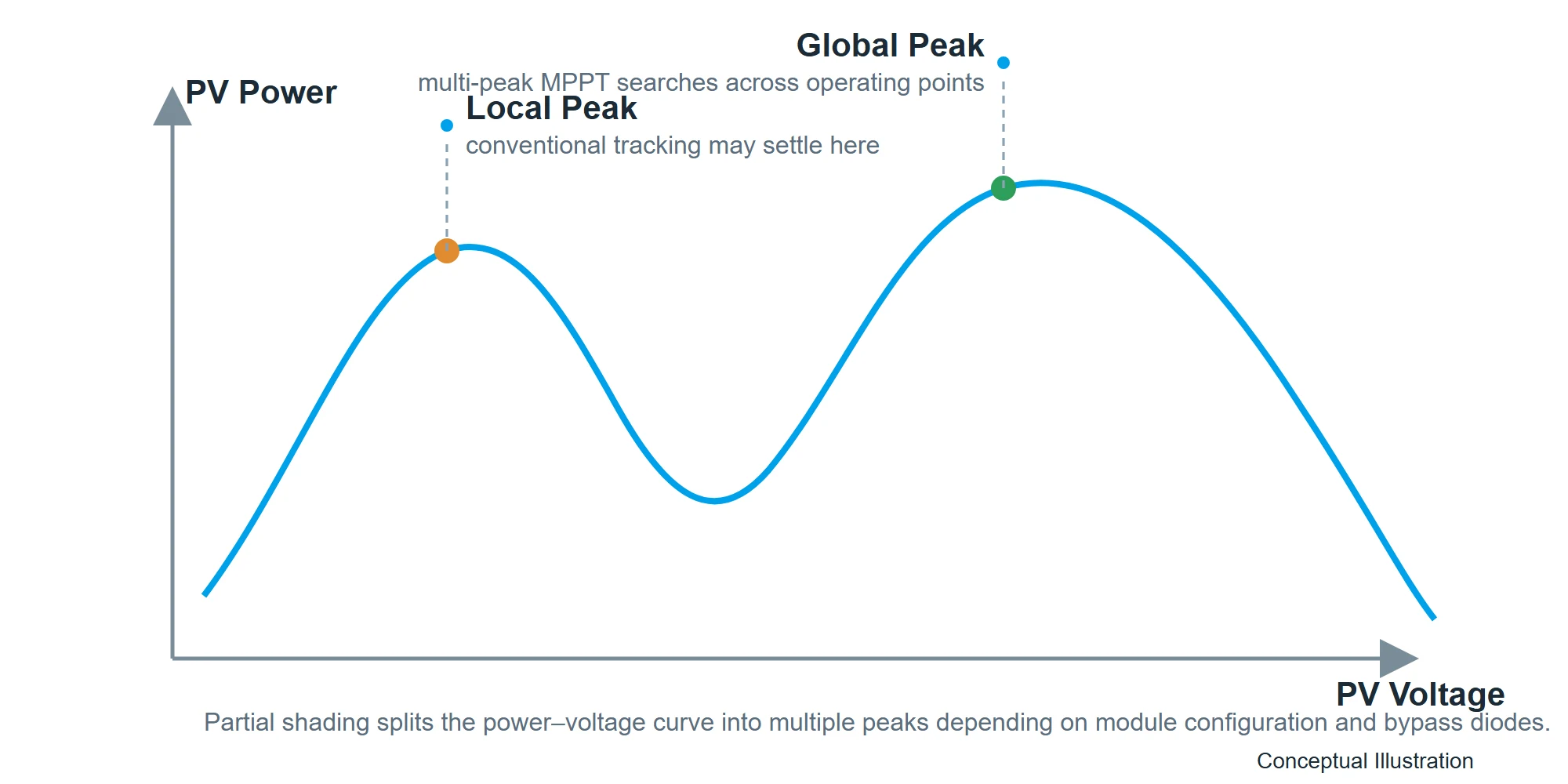
Conventional tracking algorithms may settle at a local maximum power point instead of identifying a higher available power point. Multi-peak MPPT technology addresses this challenge by searching across multiple operating points to improve photovoltaic energy utilization.
Roadside trees, nearby buildings, and moving shadows can create varying sunlight conditions throughout the day. In such environments, multi-peak tracking provides an additional way to utilize available photovoltaic power.
Its effectiveness depends on the shading pattern, solar panel configuration, and controller design. Advanced tracking improves the use of available energy but cannot eliminate the physical loss of sunlight caused by shading.
Can Better Charging Performance Support Longer Nighttime Lighting?
Consider a roadway lighting project that requires six consecutive hours of operation without dimming. Unlike installations that gradually reduce output after midnight, this application has a fixed lighting demand that cannot simply be lowered to conserve energy.
RoadSmart's HS Series split solar street lights combine high-power luminaires, separate photovoltaic panels, and LiFePO4 battery storage. Comparing two HS configurations helps illustrate the relationship between lighting power and energy requirements.
Lighting energy consumption can be estimated using a simple relationship:
E = P × t
Where:
- E = Energy consumption (Wh)
- P = Operating power (W)
- t = Operating time (h)
| Specification | RS-HS300 | RS-HS400 |
|---|---|---|
| Rated Lamp Power | 100 W | 130 W |
| Assumed Constant-Power Operating Time | 6 hours | 6 hours |
| Calculated Lighting Energy Demand | 600 Wh | 780 Wh |
| Total Rated PV Power | 300 W | 400 W |
| Nominal LiFePO4 Battery Capacity | 1,536 Wh | 1,920 Wh |
At a constant operating power of 100 W, six hours of lighting requires 600 Wh. Increasing the operating power to 130 W raises the theoretical demand to 780 Wh over the same period.
Actual battery energy requirements also depend on system losses, auxiliary consumption, usable battery capacity, temperature, and battery condition. Six hours of uninterrupted full-power operation is an illustrative project requirement, not the standard lighting mode of these models.
Switching from PWM to MPPT does not change the energy required by a fixed lighting load. Its advantage lies in capturing additional solar energy that can help replenish the battery during daylight hours.
Battery Recovery After Consecutive Cloudy Days
Rainy-day autonomy describes how long a solar lighting system can continue operating during periods of limited sunlight. Battery recovery, by contrast, describes how quickly depleted energy reserves can be restored once solar conditions improve.
Suppose a lighting system consumes 600 Wh from its battery every night. Two hypothetical charging scenarios demonstrate the practical value of additional energy harvesting.
| Daily Energy Balance | Scenario A | Scenario B |
|---|---|---|
| Net Energy Stored During Daylight | 600 Wh | 720 Wh |
| Nighttime Battery Energy Consumption | 600 Wh | 600 Wh |
| Net Daily Battery Recovery | 0 Wh | 120 Wh |
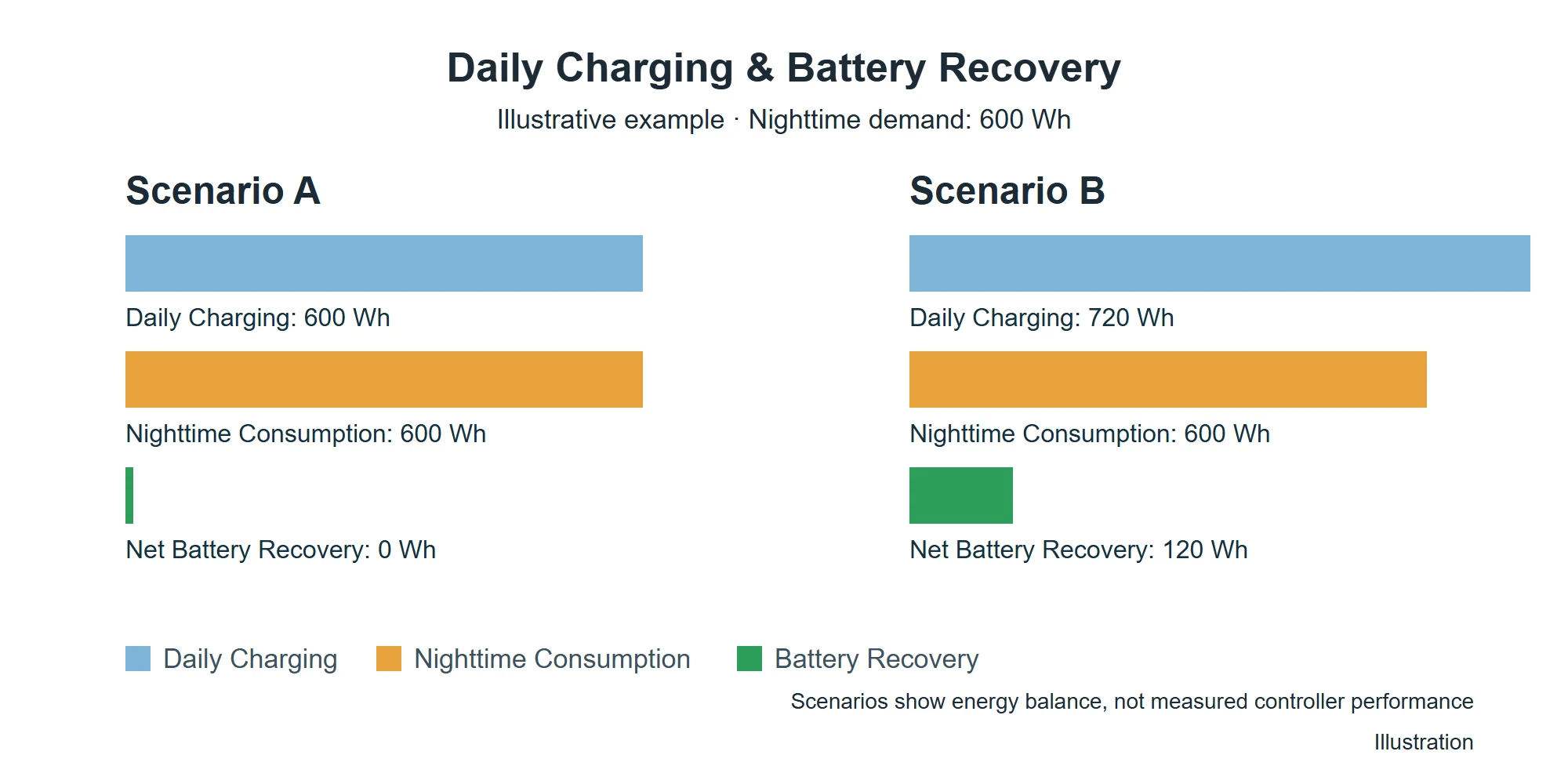
In Scenario A, daytime charging replaces only the energy consumed at night. Any existing battery energy deficit remains unchanged.
With 720 Wh of daily charging in Scenario B, the system gains an additional 120 Wh after meeting the same nighttime demand. When sufficient battery storage capacity remains available, this surplus contributes to restoring previously depleted energy reserves.
These scenarios illustrate the energy balance rather than measured MPPT and PWM performance.
For installations exposed to consecutive cloudy days, recovery capability deserves as much attention as autonomy. A sufficiently sized battery provides energy reserves, while effective solar charging helps restore those reserves when sunlight returns. Both factors influence the long-term reliability of outdoor lighting.
How RoadSmart Combines Multi-Peak MPPT with Intelligent Power Control
Efficient solar lighting requires coordination between energy collection during the day and electricity consumption after sunset. RoadSmart combines Multi-Peak MPPT, LiFePO4 battery storage, and intelligent power management to address these different stages of the energy cycle.
3.2V Multi-Peak MPPT: Making Better Use of Available Solar Energy
An independent high-power controller with 3.2V Multi-Peak MPPT technology is a key feature of the RoadSmart RSG-Pro Series. Designed around a low-voltage battery architecture, the series combines photovoltaic power tracking with different solar panel and energy storage capacities.
| Specification | RSG-90-Pro | RSG-120-Pro | RSG-150-Pro |
|---|---|---|---|
| Solar Panel | 90 W / 18 V | 120 W / 18 V | 150 W / 18 V |
| LiFePO4 Battery | 384 Wh / 120 Ah | 640 Wh / 200 Ah | 960 Wh / 300 Ah |
| Luminous Flux | 10,000 lm | 15,000 lm | 18,000 lm |
| Charging Technology | Multi-Peak MPPT | Multi-Peak MPPT | Multi-Peak MPPT |
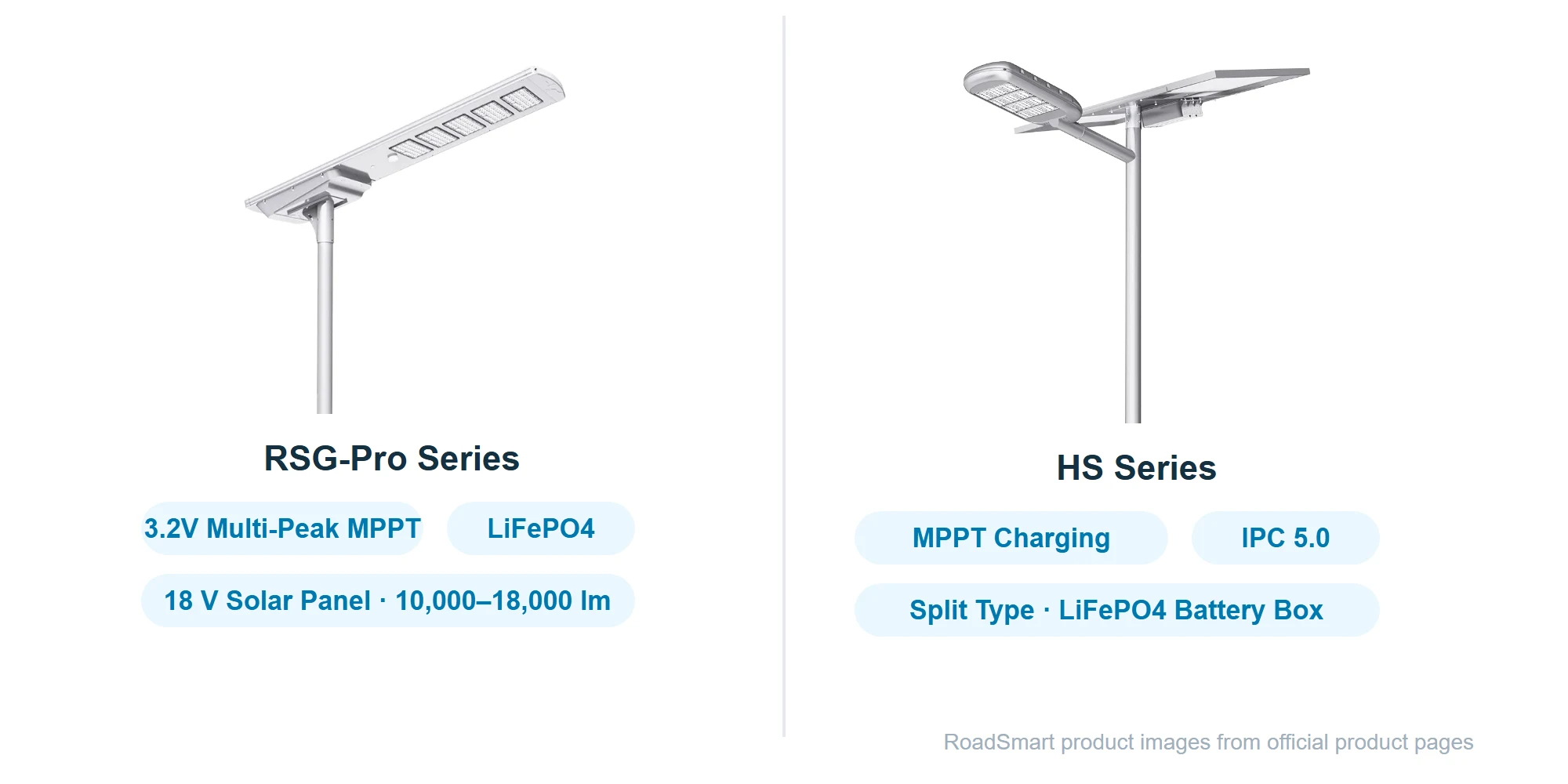
Combining 18 V solar panels with a 3.2 V battery architecture places particular importance on efficient power conversion. Multi-peak tracking helps utilize available photovoltaic power as sunlight and electrical operating conditions change.
In the HS Series, RoadSmart's MPPT charging technology targets a 15%–20% improvement in energy utilization compared with conventional PWM charging. [2] Actual gains vary with solar irradiation, photovoltaic operating voltage, battery charging conditions, and system configuration.
Additional harvested energy can support daily battery replenishment and contribute to energy recovery following periods of limited sunlight.
IPC 5.0: Balancing Nighttime Lighting and Energy Consumption
Collecting more solar energy during the day is only one part of reliable nighttime operation. Managing how that energy is consumed allows the lighting system to make better use of its available reserves.
RoadSmart's Intelligent Power Control 5.0 (IPC 5.0) manages nighttime discharge power according to operating conditions. Intelligent Charge and Discharge (ICD) and Intelligent Temperature Control (ITC) complement this process through battery management and temperature-related protection.
| RoadSmart Technology | Main Function |
|---|---|
| Multi-Peak MPPT | Photovoltaic power tracking and energy harvesting |
| LiFePO4 Battery | Electrical energy storage |
| IPC 5.0 | Intelligent discharge power management |
| ICD | Charge and discharge management |
| ITC | Temperature-related protection |
For example, the HS Series L mode operates at 100% output for the first two hours, followed by 70% for another two hours and 30% until dawn. This staged lighting schedule balances illumination requirements with nighttime energy consumption.
Projects requiring uninterrupted full-power lighting follow a different energy profile. Where dimming is not permitted, the selected photovoltaic capacity, battery storage, and operating configuration must support the specified lighting demand without relying on reduced output.
By coordinating charging and discharge management, RoadSmart addresses both sides of solar lighting performance: how much energy is collected and how effectively it is used throughout the night.
When Does MPPT Offer Better Value for Solar Street Lighting?
MPPT is particularly valuable when photovoltaic operating voltage differs significantly from battery voltage, sunlight conditions fluctuate, or daily energy demand leaves limited room for charging losses.
PWM remains a reasonable option for some smaller, voltage-matched systems with modest energy requirements. In these applications, the additional energy captured through MPPT may not always justify its higher circuit complexity and cost.
| Project Condition | Charging Technology Consideration |
|---|---|
| Small, voltage-matched lighting system | PWM may provide sufficient charging performance |
| Significant difference between PV and battery voltage | MPPT offers greater energy harvesting potential |
| High-power roadway lighting | MPPT can help support higher daily energy demands |
| Frequent partial shading | Multi-peak MPPT may improve utilization of available photovoltaic power |
| Fixed nighttime lighting schedule | Evaluate charging performance against the required energy consumption |
| Extended cloudy periods | Consider both battery autonomy and recovery capability |
Selecting a controller for municipal roads, highways, campuses, or industrial facilities therefore involves more than comparing efficiency ratings. A balanced configuration should account for local solar resources, photovoltaic capacity, usable battery storage, required lighting output, and permissible dimming.
Discuss Your Solar Lighting Energy Requirements
Whether your project requires continuous full-power lighting, limited dimming, or a specific rainy-day autonomy target, RoadSmart can help evaluate suitable photovoltaic, battery, and intelligent control configurations based on your operating requirements.
Request a Solar Lighting ConfigurationFrequently Asked Questions About MPPT and PWM
Is MPPT or PWM Better for LiFePO4 Batteries?
Both technologies can support LiFePO4 batteries when designed with compatible charging voltage, current limits, and protection functions. When comparing MPPT vs PWM for LiFePO4, MPPT primarily offers advantages in solar energy harvesting. Battery safety and service life also depend on charging profiles, temperature management, and discharge conditions.
Does MPPT Make Solar Street Lights Brighter?
Not directly. Brightness depends on LED output, driver power, optical design, and lighting control settings. Improved charging performance provides more energy to support the intended lighting schedule, but it does not automatically increase luminous flux.
Can MPPT Charge Batteries on Cloudy Days?
Yes, provided that the solar panel generates sufficient electrical output and the controller remains within its operating range. MPPT can improve utilization of available photovoltaic power under changing sunlight conditions, although charging performance remains limited by solar irradiance.
Can a PWM Solar Street Light Controller Be Replaced with MPPT?
Replacement may be possible if the electrical and control requirements are compatible. PV input voltage, battery chemistry, charging current, LED driver requirements, protection functions, and connectors must all be considered. Integrated solar lighting systems may require a compatible replacement specifically designed for the original equipment.
Can MPPT Compensate for an Undersized Solar Panel?
No. MPPT improves the harvesting of available photovoltaic power but cannot create additional solar energy. Proper solar panel sizing, sufficient battery storage, realistic weather assumptions, and appropriate lighting schedules remain essential for reliable operation.
References
[1] Victron Energy. Which Solar Charge Controller: PWM or MPPT?. Technical information on the operating principles and application differences between PWM and MPPT charge controllers.
[2] RoadSmart. Solar Street Light HS Specifications, 2025 V1.1. Manufacturer-published MPPT charging performance, IPC power management, and lighting mode specifications.
Table of Contents