3000K vs 4000K Street Lighting: Which Color Temperature Fits the Road?
Nov 13, 2026
Read:10
Source: Yin Zhenkun
Quick Answer: 3000K street lights produce a warm white appearance, while 4000K lights provide a more neutral white. For residential streets, walkways, and neighborhoods where warmer lighting is preferred, 3000K is often worth considering. A 4000K option may better match existing neutral-white installations or specific project requirements. Neither color temperature is automatically brighter, safer, or more energy-efficient. The better choice depends on the intended environment, actual luminaire performance, and local lighting requirements.
A difference of 1,000 kelvins may seem minor when selecting LED street lights from a product catalog. Once installed, however, the distinction becomes much more noticeable.
Imagine replacing the street lights in a residential neighborhood. Residents are accustomed to warm lighting outside their homes, but the new fixtures produce a noticeably whiter appearance. Even if the measured lighting level is satisfactory, the change may not match the community's expectations.
Now consider an industrial park extending its existing outdoor lighting system. If the original fixtures use 4000K, introducing 3000K models into the new section could create an inconsistent appearance across the site.
These situations explain why street light color temperature deserves more attention than a simple warm-white versus cool-white comparison.
For solar street lighting projects, buyers also need to know whether the requested color temperature changes the product's actual light output, electrical performance, or available configuration.
What Is the Difference Between 3000K and 4000K Street Lights?
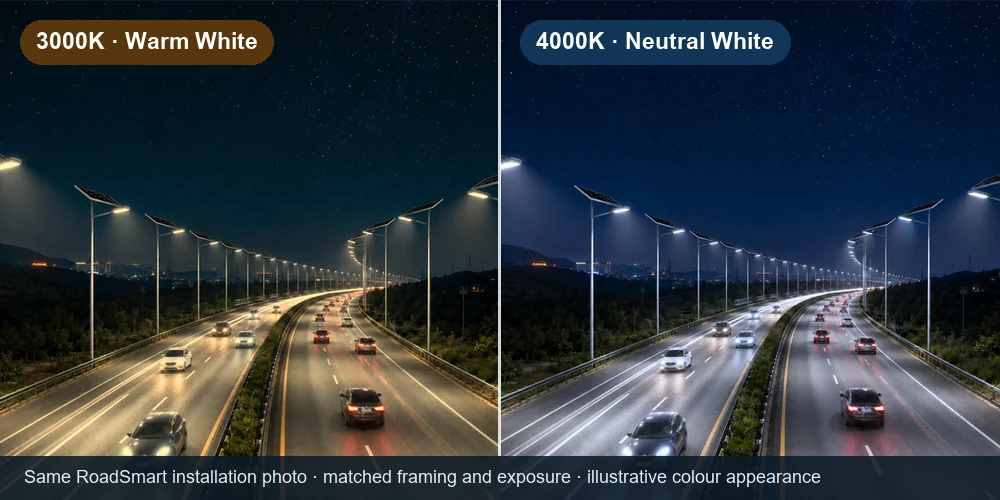
Both 3000K and 4000K are white-light options, but they create different visual impressions.
3000K street lights produce warm white light with a noticeable yellowish tone. The resulting atmosphere often feels softer and warmer, particularly in residential environments or locations with surrounding landscape lighting.
4000K street lights produce neutral white light. Compared with 3000K, the light appears less yellow and more neutral, which may be preferred where the goal is to maintain a consistent white-light appearance across a larger facility.
The distinction is easiest to observe when two fixtures illuminate similar surroundings under comparable conditions.
| Characteristic | 3000K | 4000K |
|---|---|---|
| White-light appearance | Warm white | Neutral white |
| Visual tone | Warmer, slightly yellowish | Whiter, less yellow |
| Common preference | Residential and pedestrian-oriented environments | Sites requiring neutral-white lighting |
| Short-wavelength content | Generally lower for comparable LED technology | Generally higher for comparable LED technology |
| Actual brightness | Depends on the luminaire | Depends on the luminaire |
| Energy consumption | Depends on electrical specifications | Depends on electrical specifications |
Color temperature is expressed in kelvins, but it does not indicate how much light a fixture produces.
Two LED street lights may both be rated at 3000K yet deliver very different luminous flux, beam distribution, and electrical performance.
Likewise, comparing a 3000K fixture with a 4000K fixture solely by their CCT values does not establish which one will perform better.
For a useful comparison, buyers should distinguish light color from measurable lighting performance.
Are 4000K Street Lights Brighter Than 3000K?
4000K light often appears whiter than 3000K, which can create the impression that it is brighter. But a whiter appearance does not necessarily mean the fixture produces more visible light.
Consider two street lights with the same published luminous flux of 6,000 lumens. One uses 3000K LEDs, while the other uses 4000K LEDs.
Their visual appearance will differ, but there is no basis for claiming that the 4000K version has a higher lumen output simply because its CCT is higher.
The actual difference depends on the LED packages, optical components, operating power, and measured output of each configuration.
Brightness perception also changes with the environment. Road surfaces, surrounding buildings, vegetation, and existing illumination can influence how a particular light color looks at night.
Does Whiter Light Make Road Signs or Pedestrians Easier to See?
Color appearance can influence how objects and surfaces are perceived, but road visibility is more complex than choosing a higher CCT.
Drivers and pedestrians need sufficient contrast to recognize obstacles, road markings, and other objects. Lighting level, glare, color rendering, and the spectral characteristics of the light source can all contribute to visibility.
A 4000K source may produce a different visual impression, but it does not automatically offer better obstacle detection under every road condition.
Similarly, a warmer 3000K source is not inherently unsuitable for traffic applications.
Research discussed in the FHWA Lighting Handbook highlights the importance of considering visual performance rather than judging outdoor lighting only by its color appearance.
For a project, the relevant question is whether the selected product delivers the required visibility and comfort—not whether its light looks whiter.
Where Should You Use 3000K or 4000K Road Lighting?
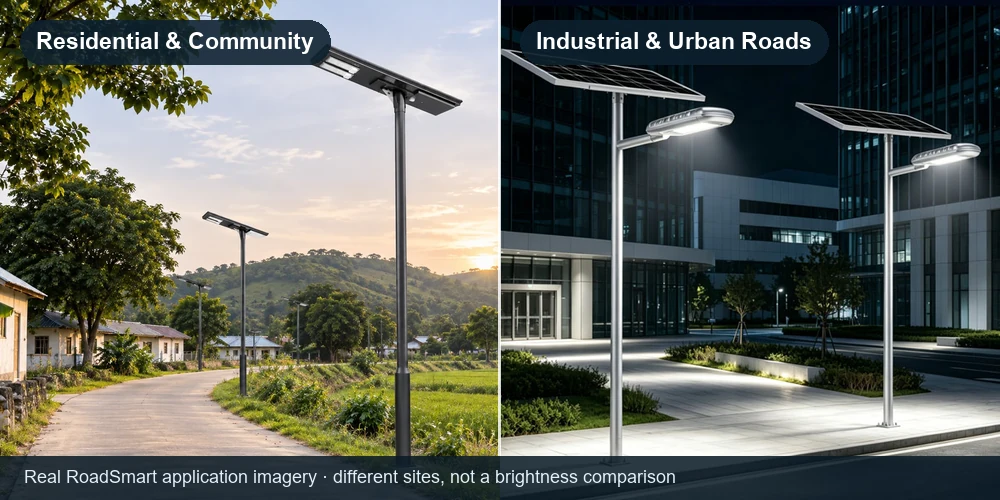
An effective color temperature decision starts with the character of the location.
A residential street and a logistics facility may need very different nighttime environments, even if both use LED street lights.
Residential Streets and Community Walkways
For residential neighborhoods, pedestrian walkways, and community spaces, warm white street lighting is often considered because of its warmer visual appearance.
3000K can be a reasonable option where the community prefers lighting that feels less stark or where existing outdoor fixtures already use similar warm tones.
Maintaining consistency is particularly relevant during partial lighting upgrades.
If one section of a neighborhood retains warm-white fixtures while another section receives neutral-white lighting, the difference may become noticeable when walking or driving between the two areas.
That does not mean every residential road should use 3000K. Local lighting policies, required lighting levels, and community preferences should still guide the selection.
Urban Roads, Industrial Parks, and Transport Facilities
4000K can be appropriate for projects that specify neutral-white lighting or need to match an existing installation.
For example, an industrial park may already use 4000K LED luminaires across its internal roads and loading areas. Selecting the same CCT for a new access road helps maintain a consistent appearance.
A transport facility may also specify a particular CCT to align with an existing lighting system or procurement standard.
However, the use of a road for vehicle traffic does not automatically make 4000K the preferred choice.
Some municipalities and road authorities select lower CCTs for road lighting, while others permit different values depending on location and project requirements.
The correct decision is therefore not simply “4000K for main roads and 3000K for residential roads.”
It is to identify the lighting requirements and the environmental characteristics of the site before choosing the CCT.
Coastal and Environmentally Sensitive Locations
For outdoor locations near homes, parks, waterways, or ecologically sensitive environments, spectral characteristics may also influence the decision.
Compared with many similar 4000K LEDs, 3000K LEDs generally contain a smaller proportion of short-wavelength light. This can be relevant when managing certain effects of artificial lighting at night.
However, choosing 3000K does not automatically make an installation environmentally responsible.
A poorly shielded 3000K street light operating at excessive output may still produce unwanted light spill and environmental impacts.
DarkSky International generally advocates warmer outdoor lighting, often recommending 2700K or lower in night-sensitive applications, together with effective shielding and appropriate controls.
Where a location has specific ecological or dark-sky requirements, buyers should check those requirements rather than assume that either 3000K or 4000K is automatically acceptable.
Does Color Temperature Affect Solar Street Light Energy Consumption?
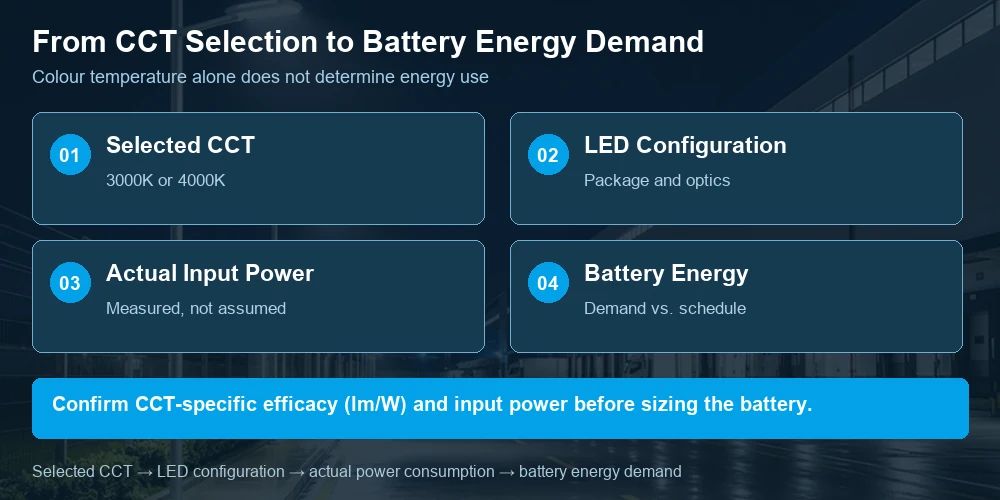
For solar street lighting, the comparison between 3000K and 4000K extends beyond visual appearance.
A solar street light must provide the required illumination while operating within the energy available from its solar panel and battery system.
This raises a practical question: Does choosing 3000K instead of 4000K require a larger battery?
Not necessarily.
Color temperature itself is not a measure of electrical consumption. However, different LED configurations may have different luminous efficacy, measured in lumens per watt (lm/W).
If two configurations have different efficacy, they may require different electrical power to produce the same target light output.
An earlier U.S. Department of Energy study on LED street lighting found that efficacy differences between warm-white and higher-CCT LED products varied by technology and model. Such historical comparisons cannot establish the performance of a current product without its specific technical data.
What Happens If Both Options Must Deliver the Same Light Output?
Suppose a project requires a certain luminous flux from each street light.
If the selected 3000K configuration requires more electrical power than the equivalent 4000K configuration, it may consume more battery energy over the same operating period.
But if both configurations have the same measured power consumption, there is no reason to assume that one uses more battery energy simply because of its color temperature.
The practical comparison should focus on three values:
- Actual luminous flux at the requested CCT
- Actual luminaire input power
- Luminous efficacy in lm/W
Once the electrical demand is established, it can be evaluated against the intended nighttime operating schedule and the available solar charging and battery capacity.
For example, a 240Wh battery rating alone cannot tell a buyer how many hours a fixture will operate. The useful calculation also depends on the luminaire's operating power, dimming schedule, usable battery capacity, and system losses.
This is why manufacturers' CCT-specific performance data matters more than general assumptions about warm-white or neutral-white LEDs.
RoadSmart ST2-60: What Changes Between 3000K and 4000K?
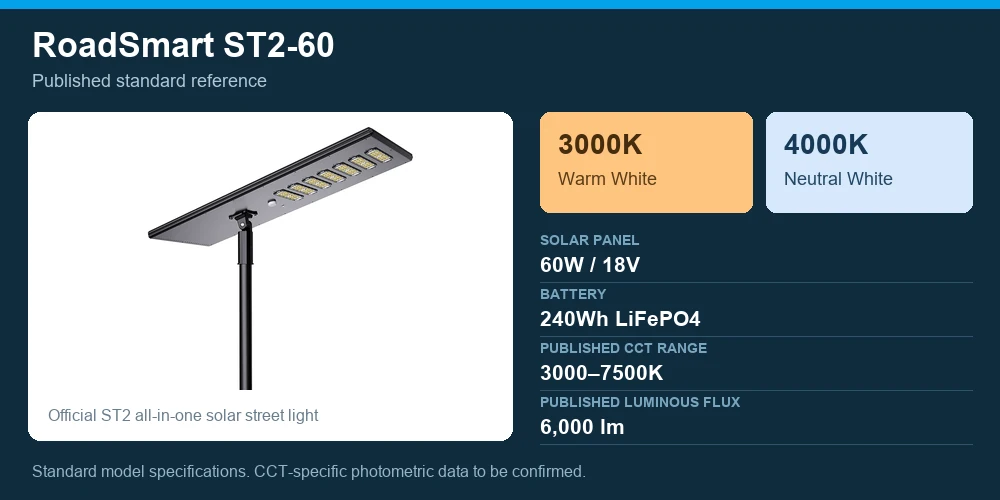
Using one model as a reference makes the comparison more meaningful.
RoadSmart's Solar Star Light II is an integrated solar street light series combining the LED lighting system, solar panel, LiFePO4 battery, and controller.
The manufacturer's published color temperature range is 3000–7500K, covering the nominal values of both 3000K and 4000K.
For the ST2-60 model, RoadSmart currently publishes the following standard specifications:
| Specification | ST2-60 Standard Model |
|---|---|
| Solar Panel | 60W / 18V |
| Battery | 240Wh LiFePO4 |
| Published Luminous Flux | 6,000 lm |
| Published CCT Range | 3000–7500K |
| Optical Design | Batwing lens with polarized light |
| Recommended Mounting Height | 6–7 m |
These specifications provide a standard product reference. They do not establish separately measured luminous flux or efficacy values for individual 3000K and 4000K configurations.
Comparing Two CCT Selections of the Same Model
The main visible difference between the two options is light appearance.
A 3000K version would produce a warmer white light, while a 4000K version would produce a more neutral appearance.
Before requesting either configuration, buyers should also confirm whether the model is available with the exact CCT and whether the associated optical and electrical specifications meet their requirements.
| Comparison | ST2-60 at 3000K | ST2-60 at 4000K |
|---|---|---|
| Visual appearance | Warm white | Neutral white |
| Within published series CCT range | Yes | Yes |
| Standard solar panel reference | 60W / 18V | 60W / 18V |
| Standard battery reference | 240Wh | 240Wh |
| Actual CCT-specific luminous flux | Confirmation required | Confirmation required |
| Actual input power and efficacy | Confirmation required | Confirmation required |
| CCT-specific photometric data | Confirm availability | Confirm availability |
The shared solar panel and battery figures are published standard-model references, not separate test results for each CCT option.
Two Different Projects, Two Different CCT Decisions
Consider a residential access road where the surrounding outdoor lighting uses warm white LEDs.
If the local requirements allow 3000K, a warm-white ST2-60 configuration may be considered to maintain a consistent nighttime appearance. The buyer should confirm the requested CCT and its relevant product performance before placing the order.
Now consider an industrial park that already uses 4000K lighting. Its procurement team may prefer the same CCT when purchasing additional solar street lights to avoid introducing a noticeably different light color.
In both situations, the product reference is the same. What changes is the color temperature requirement and the need to verify the corresponding configuration.
Neither example establishes that 3000K is the better-performing choice for residential roads or that 4000K is technically superior for industrial areas.
The difference lies in what each project needs from its lighting environment.
Where another RoadSmart product series is more appropriate, the RSG-Pro Series offers additional outdoor lighting configurations with a published 3000–7500K CCT range.
Can 3000K Replace 4000K in a Street Lighting Project?
A color temperature substitution may seem like a small product change, especially when the luminaire housing, solar panel, and battery specifications remain the same.
But it can become a significant procurement issue.
Suppose a project tender specifies 4000K LED street lighting, and the available product is quoted at 3000K.
Even if both configurations appear suitable for the site, the buyer should not treat them as interchangeable without reviewing the project requirements.
The specified CCT may reflect an existing lighting scheme, an authority's policy, or a contractual requirement. Supplying a different color temperature could lead to inconsistent appearance or nonconformance with the approved specification.
The buyer should confirm the requested nominal CCT, permitted tolerance, actual luminaire configuration, and any approval required for substitution.
This is also important for distributors preparing purchase orders.
A purchase order that identifies only the product model and power rating may not fully define the required light color. Including the agreed CCT and relevant configuration details can reduce misunderstandings during production and delivery.
For RoadSmart solar street lighting projects, the practical approach is to confirm the exact CCT option before finalizing the product configuration rather than assume every listed color temperature has identical measured performance.
Choosing 3000K or 4000K Solar Street Lights?
RoadSmart's Solar Star Light II series has a published CCT range that includes both warm-white and neutral-white selections. Share the required model, color temperature, and application to confirm available configurations and relevant product specifications.
Request Color Temperature Options
Frequently Asked Questions About Street Light Color Temperature
1. Is 3000K or 4000K better for residential street lighting?
3000K is often worth considering for residential streets because it produces warmer white light and may better suit community preferences. However, the final choice should follow local lighting policies and project requirements. The selected luminaire must still provide suitable lighting performance.
2. Are 4000K street lights brighter than 3000K?
Not necessarily. A 4000K fixture may look whiter, but CCT does not directly measure luminous flux or illuminance. Compare the actual output and electrical performance of the selected luminaires rather than assuming higher CCT means higher brightness.
3. Is 3000K more energy-efficient than 4000K?
Neither CCT is inherently more efficient. Actual efficacy depends on the LED design and operating conditions. For solar street lights, use CCT-specific power and luminous flux data to determine whether the choice affects battery energy consumption.
4. Can RoadSmart solar street lights be supplied in 3000K or 4000K?
RoadSmart publishes a 3000–7500K CCT range for Solar Star Light II, which includes both nominal values. The availability and technical performance of each requested CCT should be confirmed for the exact model before ordering.
5. Does 3000K street lighting reduce light pollution?
3000K often has less short-wavelength content than comparable 4000K LED light, but color temperature is only one factor. Shielding, output, operating hours, and the direction of the light are also important. Sensitive locations may require warmer CCTs or additional controls.
References
U.S. Department of Energy. An Investigation of LED Street Lighting's Impact on Sky Glow. LED spectral characteristics, efficacy differences, and environmental impacts.
Federal Highway Administration. FHWA Lighting Handbook. Roadway visibility and outdoor lighting performance.
DarkSky International. Home Outdoor Lighting Assessment. Guidance on warmer light, shielding, and outdoor lighting control.
RoadSmart. Solar Star Light II. ST2-60 standard specifications and published CCT range.
RoadSmart. RSG-Pro Series. Product configurations and published color temperature range.
Table of Contents