Can You Retrofit Solar Street Lights on Existing Poles?
Nov 24, 2026
Read:6
Source: Yin Zhenkun
Existing street light poles can be reused for solar lighting if their mounting dimensions, structural condition, load capacity, and solar exposure are suitable for the new equipment. Depending on these conditions, a solar street light retrofit may involve replacing the existing luminaire, using an engineered mounting adapter, or modifying the supporting structure.
For municipalities, campuses, and industrial facilities planning to retrofit solar street lights, retaining existing infrastructure can reduce civil works and avoid unnecessary pole replacement. However, mechanical compatibility alone does not guarantee structural safety, sufficient solar charging, or adequate lighting performance.
Solar Lighting Retrofit for Street Poles: What Can Be Reused?
Converting grid-powered street lighting to solar energy does not necessarily require rebuilding the entire installation. Existing poles and foundations may have considerable service life remaining, while mounting arms and electrical infrastructure can sometimes be retained depending on the proposed system.
| Existing Component | Reuse Potential | Main Requirement |
|---|---|---|
| Street light pole | Conditional | Structural condition and load capacity |
| Concrete foundation | Conditional | Capacity to support revised structural loads |
| Mounting arm | Configuration-dependent | Compatible diameter, orientation, and mounting length |
| Existing luminaire | System-dependent | Electrical and control compatibility |
| Underground cables | Project-dependent | Safe isolation or continued use |
Standalone solar-powered street lights generally operate without an external electricity supply. Underground cables, however, may serve other lighting points or electrical equipment. Decisions about retaining, removing, or isolating these circuits must form part of an approved electrical design.
Remaining service life also matters. Investing in new solar equipment may offer limited long-term value if the supporting poles are likely to require replacement shortly afterward. Evaluating existing infrastructure before equipment selection helps establish a more realistic retrofit scope.
How to Match a Solar Street Light Mounting Bracket to an Existing Pole
A small difference in mounting dimensions can determine whether a luminaire fits directly or requires an adapter. When installing a solar street light on an existing pole, measure the actual connection point rather than relying exclusively on the original pole specifications. Previous maintenance work, replacement mounting arms, protective coatings, and additional fittings may have changed the available installation dimensions.
Will a 60.3 mm Spigot Fit a 60 mm or 76 mm Mount?
A spigot is the projecting section of a lighting column or mounting arm onto which a luminaire is fitted. Its measured outside diameter must fall within the permitted dimensional range of the receiving bracket.
Several RoadSmart product series specify pole-top diameters of 60 mm or 76 mm. For an existing spigot measuring 60.3 mm, neither specification should be treated as an automatically compatible fit.
| Existing Spigot Diameter | Product Mounting Reference | Compatibility Consideration |
|---|---|---|
| 60 mm | 60 mm | Verify fitting dimensions and fastening requirements |
| 60.3 mm | 60 mm | Confirm the permitted diameter range |
| 76 mm | 76 mm | Check insertion depth and fixing arrangement |
| 60.3 mm | 76 mm | Evaluate an engineered adapter |
| Non-standard diameter | Model-dependent | Review dimensioned mounting drawings |
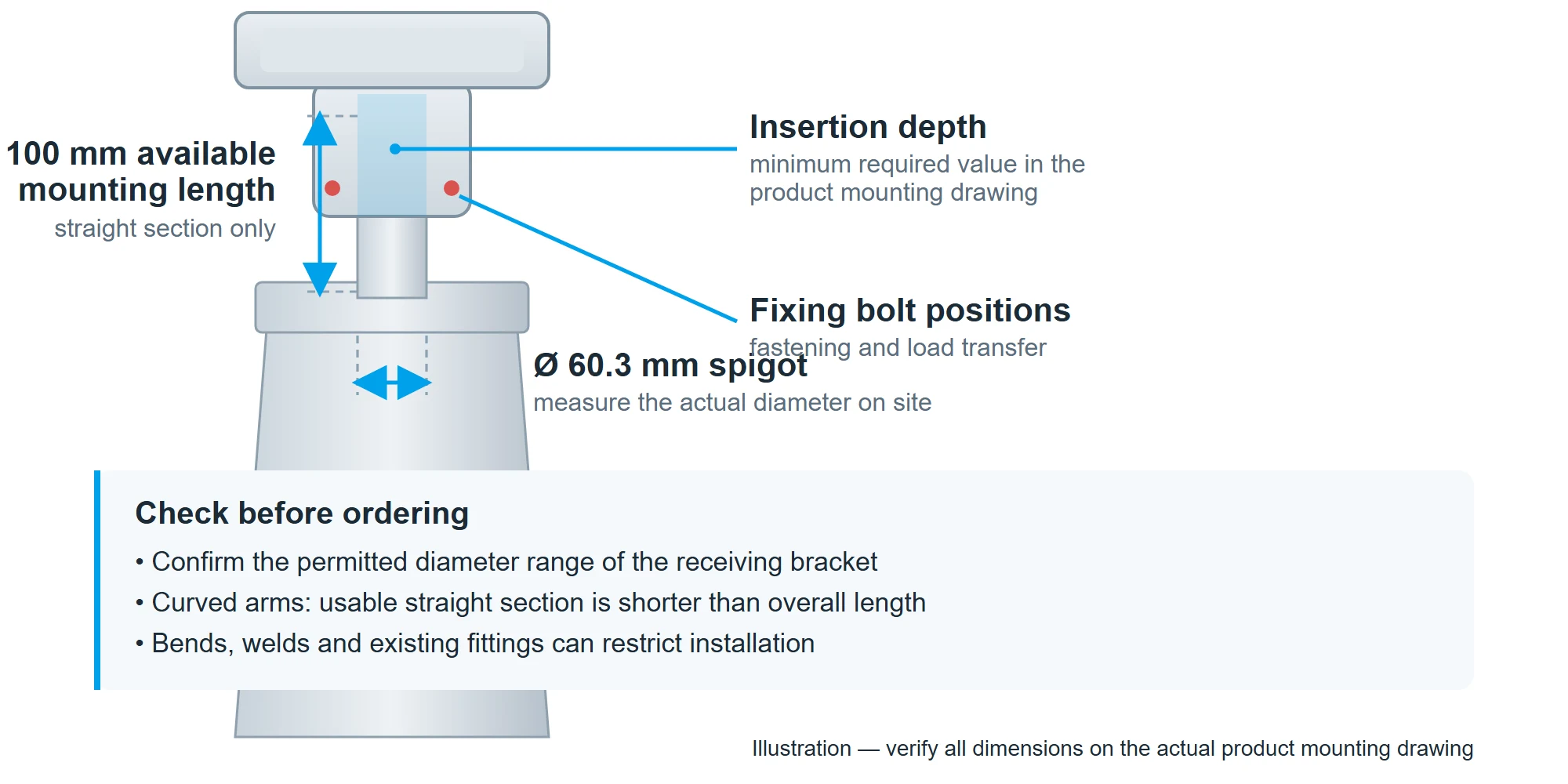
Although 60 mm and 60.3 mm differ by only 0.3 mm, manufacturing tolerances and actual bracket dimensions determine whether secure installation is possible.
Moving from a 60.3 mm spigot to a product specified for a 76 mm pole introduces a different challenge. Rather than simply filling the dimensional gap, a street light pole adapter must provide suitable fastening and structural load transfer between the two components. Any additional offset introduced by the adapter should also be considered in the structural assessment.
Is 100 mm of Available Mounting Length Enough?
Consider an existing lighting column with a 60.3 mm spigot and only 100 mm of straight mounting space. Even after confirming diameter compatibility, limited insertion length may prevent the bracket from engaging correctly.
Compare the available space with the following information in the product mounting drawing:
- Minimum required insertion depth.
- Fixing bolt positions.
- Clearance between the bracket and pole shoulder.
- Mounting arm angle and direction.
- Additional connection length required by an adapter.
Curved mounting arms deserve particular attention because their usable straight section may be considerably shorter than their overall length. Nearby bends, welds, or existing fittings can also restrict installation.
Whether 100 mm is sufficient depends on the selected bracket and fastening design. Confirming these dimensions before ordering helps prevent unexpected modifications and installation delays.
Can Existing Lighting Columns Support Solar Panels and Batteries?
Unlike conventional grid-powered luminaires, solar lighting systems incorporate additional energy generation and storage components. Depending on their arrangement, these components can change equipment weight, center of gravity, and exposure to wind.
An existing 12 m lighting column, for example, may originally have been designed for a compact conventional luminaire. Selecting a solar model with a recommended mounting height of 12 m does not establish that the original column can safely support the replacement equipment.
Guidance from the Institution of Lighting Professionals (ILP) highlights the importance of equipment weight, load position, and windage when upgrading existing lighting columns. [1]
When original pole drawings are unavailable, a qualified structural professional may require additional measurements and equipment data before assessing reuse feasibility.
| Assessment Factor | Information to Verify |
|---|---|
| Pole construction | Material, outside diameter, taper, and wall thickness |
| Structural condition | Corrosion, deformation, welds, and access opening condition |
| Base and foundation | Base plate, anchor bolts, foundation condition, and connection details |
| Equipment loading | Total weight, center of gravity, and mounting position |
| Wind exposure | Effective projected area (EPA), equipment orientation, and local design wind conditions |
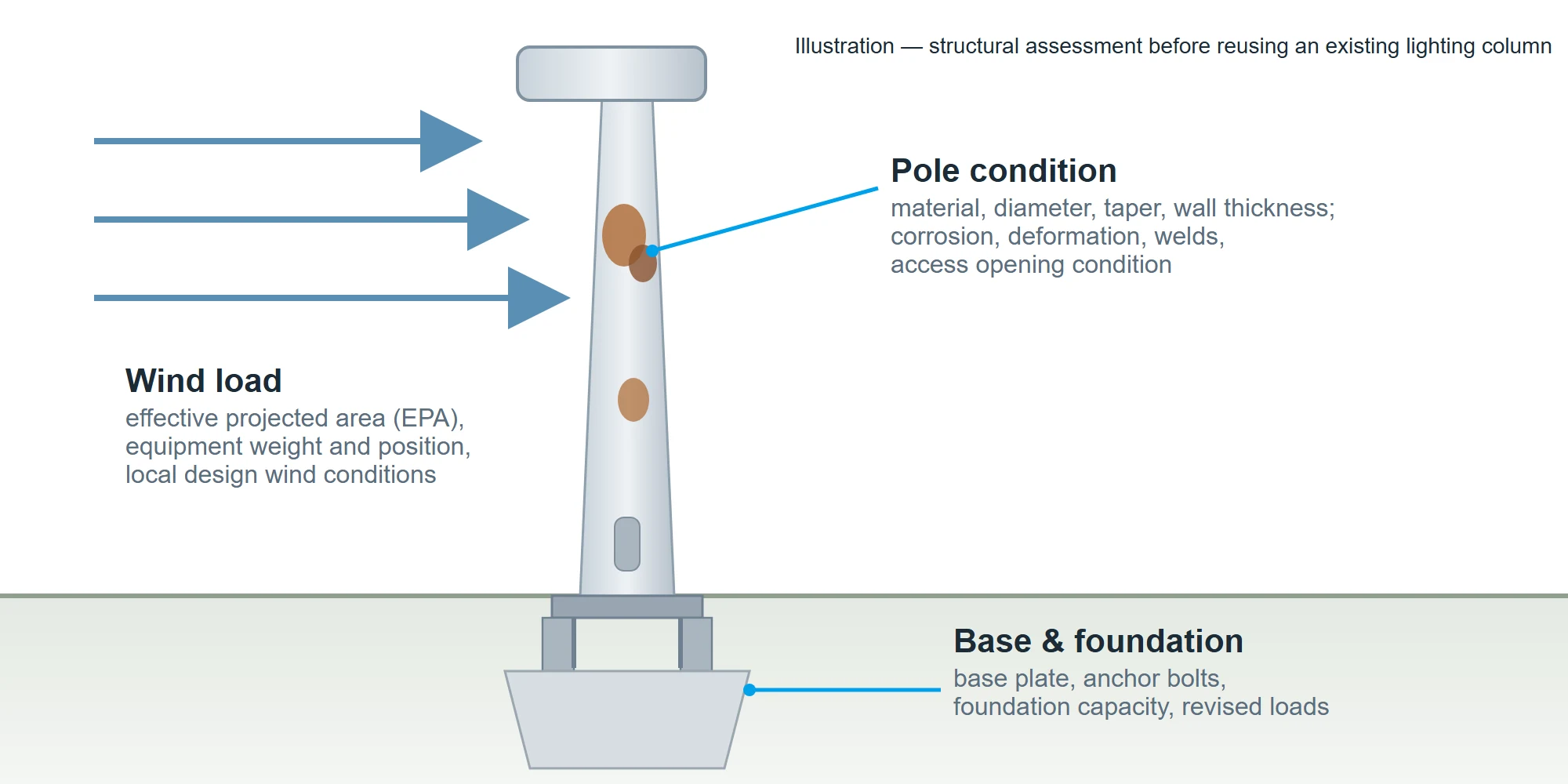
Solar panel dimensions alone are insufficient for evaluating wind load. Effective projected area, aerodynamic characteristics, and installation height influence the forces and bending moments transferred to the pole.
Request relevant weight, center-of-gravity, and wind-loading information for the proposed equipment configuration. Where original structural records are incomplete, additional inspection or testing may be necessary.
Ireland's Public Lighting Retrofitting Guidance Document also emphasizes assessing existing lighting columns before retaining them for lighting upgrades. [2] Although these references address conventional LED lighting upgrades, their structural assessment principles are relevant when introducing solar equipment.
Approval of the complete installation should remain with a qualified structural professional working to applicable local requirements.
Which Solar Street Lighting Retrofit Configuration Fits Your Pole?
Existing mounting arms were generally positioned to illuminate the road rather than collect solar energy. A replacement luminaire may therefore provide suitable lighting direction while placing its solar panel at an unfavorable angle.
Instead of evaluating equipment only by pole diameter or light output, consider how its solar panel, battery, and luminaire are arranged. RoadSmart offers several configurations for different retrofit conditions.
| RoadSmart Product | System Type | Published Pole-Top Diameter | Main Retrofit Consideration |
|---|---|---|---|
| RSG-Pro Series | All-in-One | 76 mm | Integrated equipment weight and service access |
| Solar Sailing Light II | All-in-Two | 60 mm | Adjustable mounting and solar exposure |
| HS Series | Split Type | 60 mm | Separate component mounting locations |
| Solar Pole Solution | Vertical Photovoltaic | Project-specific | Pole geometry and photovoltaic module attachment |
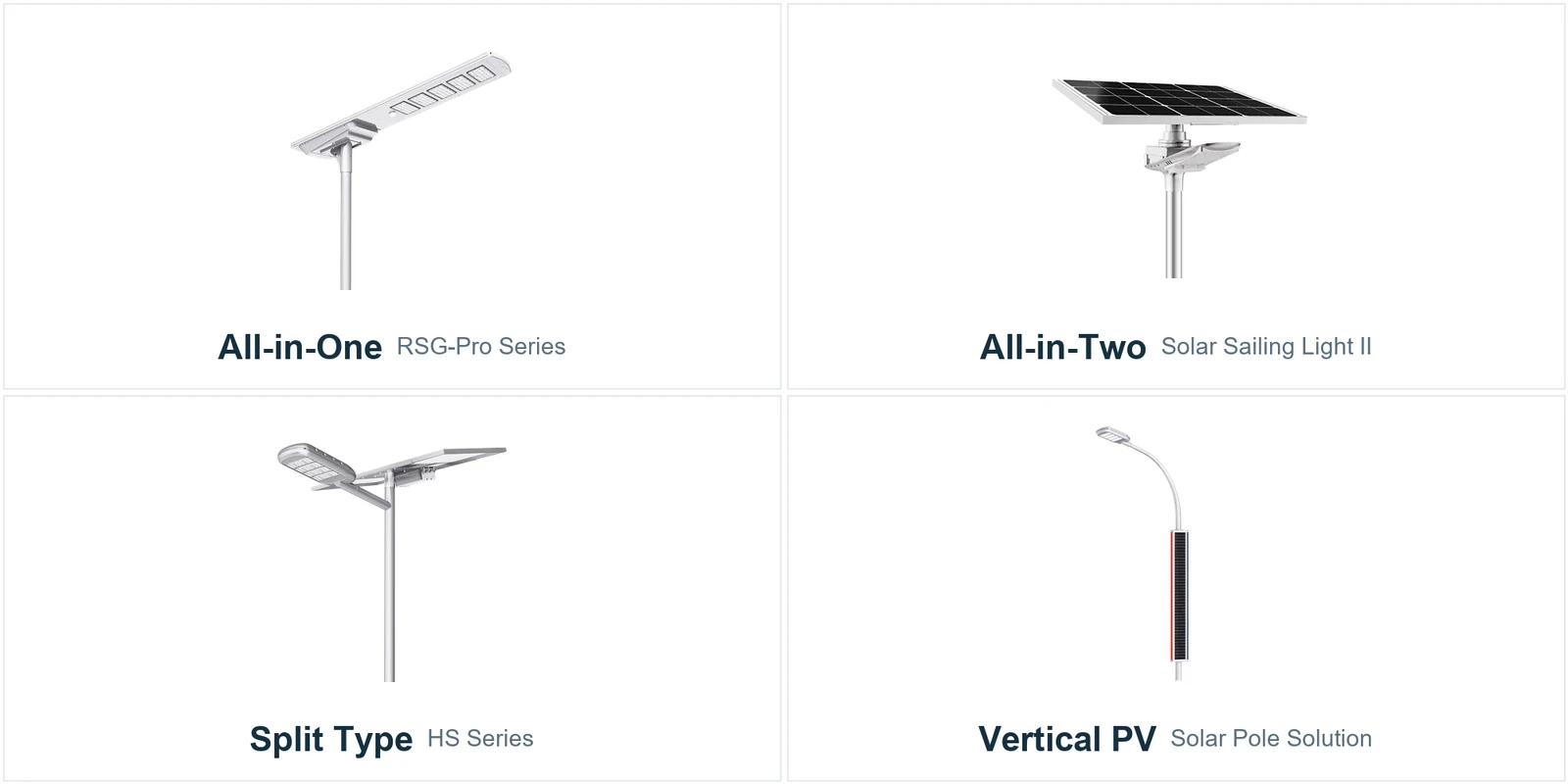
Published pole-top diameters serve as initial selection references rather than confirmed fitting tolerances.
RSG-Pro Series — Fewer External Mounting Components
Combining lighting, charging, and energy storage within an integrated assembly, the RSG-Pro Series reduces the need for separately mounted system components. Three models provide luminous flux ratings of 10,000–18,000 lm, with a published 76 mm pole-top diameter.
For municipal and campus lighting retrofits, this configuration can simplify equipment arrangement. Battery maintenance, however, generally requires access to the elevated luminaire, while the combined assembly must remain within the pole's verified structural capacity.
Solar Sailing Light II — Adjusting to Existing Mounting Directions
Existing lighting arms may point in directions that are less favorable for solar charging. With its rotating holder and adjustable mounting arrangement, Solar Sailing Light II provides additional positioning flexibility.
Its all-in-two design and published 60 mm pole-top diameter offer another option where mounting direction and sunlight exposure influence product selection. Review the achievable equipment angle together with seasonal shading from trees, buildings, signs, and other nearby structures.
HS Series — Separate Panel and Battery Placement
Highway and industrial lighting upgrades may require greater flexibility in positioning equipment. HS Series split solar street lights combine adjustable solar panels with a separate pole-mounted battery enclosure and a published 60 mm pole-top diameter.
Independent component placement allows the solar panel's position to be evaluated separately from the luminaire's lighting direction.
A separate battery enclosure also shifts battery weight away from the luminaire and creates different maintenance access possibilities. Enclosure temperature, attachment security, cable protection, and servicing space should be considered when selecting its mounting location.
Solar Pole Solution — Vertical Photovoltaic Arrangement
Rather than relying on a large panel above the lighting column, RoadSmart Solar Pole retrofit solutions arrange photovoltaic modules vertically along the pole structure.
Vertical photovoltaic modules offer an alternative where conventional top-mounted panels present installation constraints. Compatibility depends on pole geometry, module attachment, structural capacity, and available solar exposure.
Maintaining the Required Road Lighting Performance
Retaining existing poles also means inheriting their mounting heights and spacing. Matching the wattage or lumen output of the original luminaire does not guarantee equivalent illuminance or uniformity.
Review the proposed light distribution against the site's lighting requirements, including any scheduled nighttime dimming. Where original lighting records are unavailable, photometric assessment and measurements of the existing installation can provide useful design information.
For fixed pole layouts, our solar street light pole spacing guide explains how mounting height, light distribution, and spacing influence road coverage.
Reuse, Adapt or Replace: Choosing the Right Retrofit Approach
Retrofitting an existing lighting column can range from a straightforward equipment replacement to a substantial structural modification. Procurement requirements should reflect the actual condition of the supporting infrastructure.
| Retrofit Approach | Applicable Conditions | Procurement Scope |
|---|---|---|
| Direct Reuse | Structure and mounting interface are suitable | Solar lighting equipment and compatible accessories |
| Adapter-Based Retrofit | Structure is suitable, but the mounting interface differs | Lighting equipment and an engineered adapter |
| Structural Reinforcement | Existing support requires modification | Equipment and professionally designed reinforcement |
| Pole Replacement | Original infrastructure is unsuitable for the proposed system | New pole, lighting equipment, and necessary foundation work |
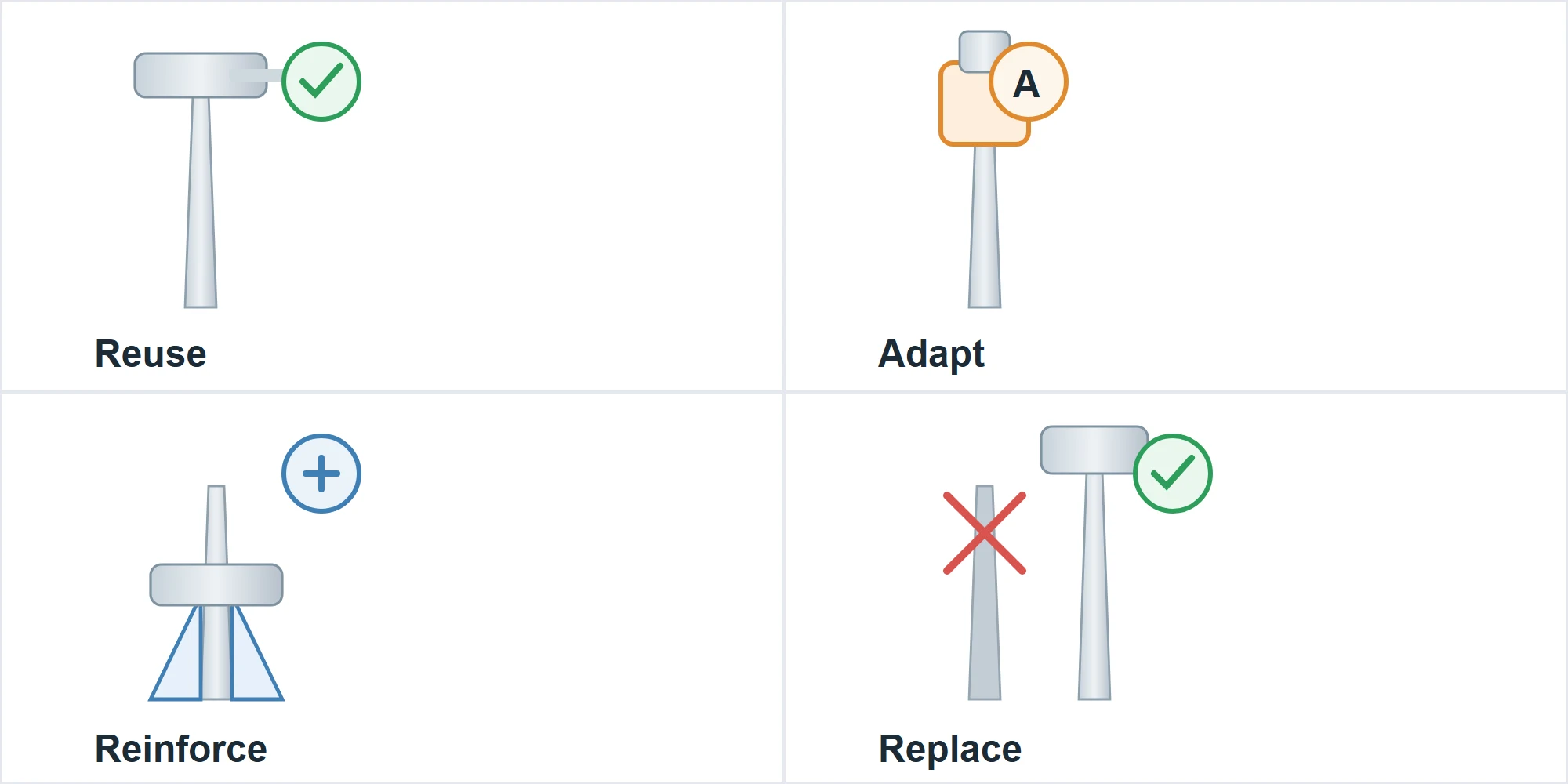
Retaining suitable poles may reduce expenditure on excavation, foundations, and supporting structures. Extensive reinforcement, specialized mounting accessories, or electrical network modifications can offset these savings.
When comparing quotations for a solar street lighting retrofit, request technical information that clarifies both the equipment and installation scope.
| Technical Documentation | Purpose |
|---|---|
| Dimensioned mounting and interface drawing | Verify bracket fit, insertion depth, and fastening details |
| Equipment weight and wind-loading data | Support structural assessment |
| Component layout and wiring diagram | Clarify panel, battery, controller, and cable arrangements |
| Lighting design and operating schedule | Evaluate road coverage and nighttime performance |
| Maintenance and warranty requirements | Establish servicing conditions and long-term responsibilities |
Required documentation should be agreed upon before placing an order, particularly when an existing pole requires a non-standard mounting arrangement.
Check Your Existing Pole Compatibility
Planning to retrofit existing street light poles? Share your pole diameter, available mounting length, installation height, mounting direction, and photographs or drawings of the existing structure.
We can help evaluate relevant RoadSmart configurations and identify the mounting information needed for further project assessment.
Request a Retrofit Compatibility ReviewFrequently Asked Questions About Retrofitting Solar Street Lights
Can I convert an existing electric street light to solar?
Yes. Standalone solar equipment can replace conventional grid-powered fixtures while retaining suitable poles and foundations. Successful conversion requires compatible solar panels, energy storage, controls, and mounting equipment, together with appropriate treatment of the original electrical infrastructure.
Can solar street lights be installed without replacing the concrete foundation?
An existing foundation may remain in service if its condition and structural capacity are suitable for the revised equipment loads. Foundation design, anchor bolts, pole connections, and wind-induced forces should be assessed before approving reuse.
Can an all-in-one solar street light fit a curved pole arm?
Compatibility depends on the arm's outside diameter, usable straight length, angle, and bracket design. Curved arms may restrict insertion depth or place the solar panel at an unfavorable orientation. Review dimensional drawings before selecting a luminaire.
Can existing electrical cables be retained for backup power?
Potentially, but only when the proposed lighting configuration supports an approved grid-backup arrangement. Standalone solar products should not be assumed to accept an existing AC supply. Electrical compatibility, circuit protection, and ongoing connection requirements must be confirmed.
Is retrofitting solar street lights cheaper than installing new poles?
Reusing suitable infrastructure can reduce material and civil construction expenses. Actual savings depend on remaining pole service life, adapter requirements, structural modifications, installation labor, and future maintenance. Comparing complete project costs provides a more reliable assessment than comparing equipment prices alone.
References
[1] Institution of Lighting Professionals (ILP). Guidance Note 6/17: Retrofitting LED Luminaires on Existing Lighting Columns. Guidance on retrofitting LED luminaires onto existing lighting columns, including equipment weight, load position, and windage considerations.
[2] Local Authorities Ireland. Public Lighting Retrofitting Guidance Document, August 2020. Assessment of existing lighting columns before retaining them for lighting upgrades.
Table of Contents