Solar Street Light with Battery in the Philippines: 2026 Project Buyer’s Guide
Jul 31, 2026
Read:7
Choosing a solar street light with battery in the Philippines requires more than comparing advertised wattage and unit price. A reliable project system must match the LED light, solar panel, battery, controller, pole and lighting schedule to the project location, road conditions and expected rainy-season performance.
For Philippine LGUs, barangay road projects, EPC contractors, developers and solar lighting distributors, the central question is not simply, “Which solar street light is the brightest?”
The more useful question is:
The more useful question is: Which complete solar street lighting system can provide the required road illumination throughout the night, recharge reliably during local weather conditions and remain serviceable over its expected operating life?
This guide explains how to evaluate a solar street light with battery in the Philippines, including battery sizing, solar panel capacity, actual LED power, rainy-day autonomy, pole design, typhoon resistance, project cost and supplier comparison.
Quick Answer
A complete solar street light for a Philippine project normally includes an LED luminaire, photovoltaic panel, rechargeable battery, charge controller, mounting structure, pole, anchor bolts and foundation.
LiFePO₄ batteries are commonly considered for project-grade solar street lighting because of their energy efficiency, cycle performance and suitability for integrated energy-storage applications. However, battery chemistry alone does not guarantee a reliable system.
Buyers must also verify:
· Actual LED power and lumen output
· Battery voltage, capacity in amp-hours and total energy in watt-hours
· Solar panel rated power
· Nightly lighting schedule
· Required rainy-day autonomy
· Pole height and installation spacing
· Wind-load and corrosion requirements
· IP protection and surge protection
· Installation, warranty and spare-parts responsibilities
The final configuration should be based on the project location rather than a standard national package.
Key Takeaways
· Compare battery capacity in watt-hours, not milliamp-hours alone.
· Compare actual lumen output and light distribution, not advertised wattage.
· Size the solar panel and battery according to the project’s worst-weather period.
· Include the pole, foundation, shipping, installation and maintenance in the total project cost.
· Treat all-in-one, all-in-two and split solar street lights as different engineering options.
· Check DPWH or project-specific requirements before finalizing a national-road lighting design.
· Request an itemized technical quotation before comparing solar street lights prices.
Why Solar Street Lights Are Relevant in the Philippines?
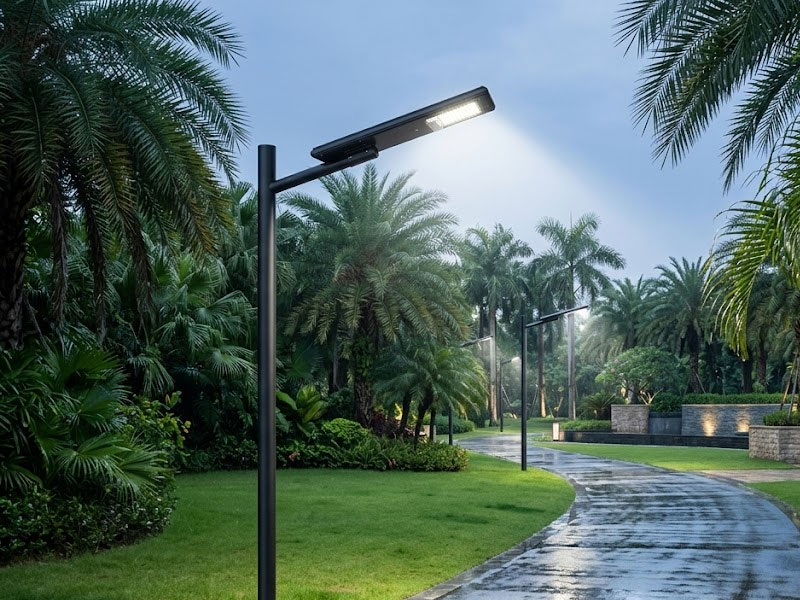
Solar-powered street lighting can be useful where extending grid infrastructure would require trenching, cables, transformers, distribution equipment or lengthy connection work.
Common Philippine applications include:
· Barangay and rural roads
· Municipal roads
· Subdivisions and residential communities
· School and university campuses
· Public parks and walkways
· Commercial parking areas
· Industrial parks and warehouse roads
· Coastal roads
· Island and remote-area infrastructure
· Emergency and disaster-recovery access routes
The Philippine Department of Energy’s 2024–2028 Missionary Electrification Development Plan emphasizes sustainable energy access and renewable-energy deployment in off-grid and underserved areas. Although the plan is broader than street lighting, it demonstrates the continuing importance of decentralized energy systems in locations where conventional infrastructure is limited.
A solar street lighting system does not need an underground power cable between each pole and the grid. This can reduce civil construction in suitable locations and allow projects to be installed in phases.
However, the absence of a grid connection also means that every pole must generate, store and manage enough energy independently. Incorrect component sizing can therefore cause early shutdown, weak illumination or battery failure during periods of poor weather.
What Is Included in a Complete Solar Street Light System?
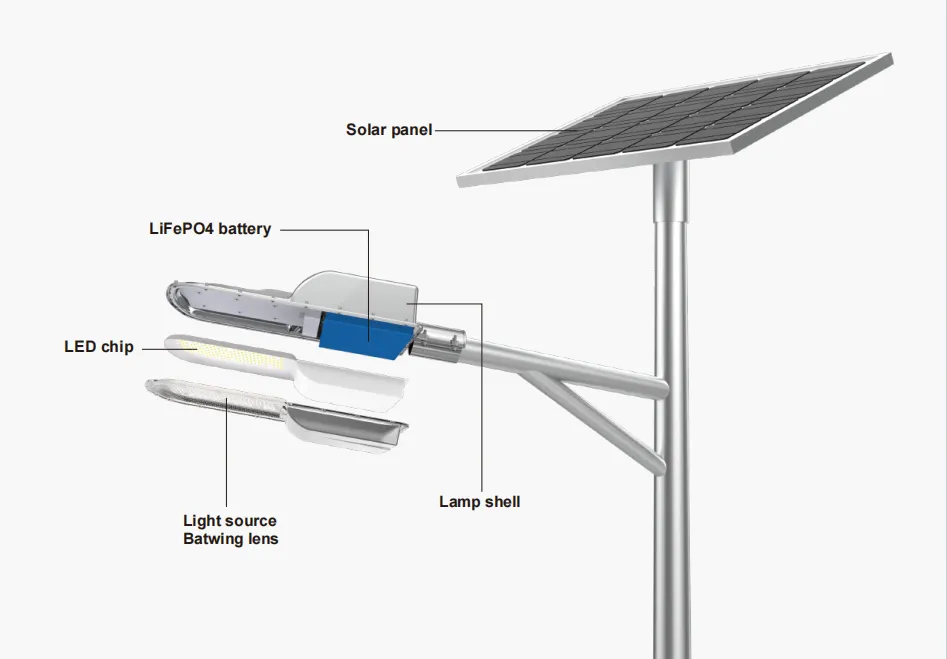
A project-grade system usually contains several interdependent parts. Understanding how a solar street light works helps buyers evaluate whether the panel, battery, controller and LED have been matched as one energy system.
LED Luminaire
The LED luminaire converts stored electrical energy into light. Important specifications include:
· Actual LED input power
· Luminous flux in lumens
· Luminous efficacy
· Optical lens and beam distribution
· Color temperature
· Thermal management
· Housing material
· Surge protection
· IP rating
Two lamps described as “100W solar street lights” can produce very different road performance if they use different LEDs, optical lenses, drivers and dimming schedules.
Solar Panel
The photovoltaic panel determines how much energy the system can collect during the day.
Buyers should confirm:
· Rated power in watts peak
· Cell type
· Conversion efficiency
· Panel dimensions
· Mounting angle
· Cable and connector specifications
· Mechanical load rating
· Product warranty
A panel must provide enough energy for the normal nightly load while also helping the battery recover after cloudy or rainy periods.
Rechargeable Battery
The battery stores daytime solar energy for use at night.
Important battery data includes:
· Battery chemistry
· Nominal voltage
· Rated capacity in amp-hours
· Total energy in watt-hours
· Recommended depth of discharge
· Battery management system
· Charge and discharge protection
· Operating-temperature range
· Cycle-life test conditions
· Replacement method
Solar Charge Controller
The controller manages charging, discharging and lighting behavior.
Depending on the system, it may support:Depending on the system, it may support MPPT solar charging, PWM charging, overcharge protection, over-discharge protection and programmable lighting modes.
The controller is the energy-management center of the solar street lighting system. A large solar panel and battery cannot compensate fully for poor control logic or excessive nighttime consumption.
Pole and Mounting Structure
A complete solar street light with pole should specify:
· Pole height
· Pole material
· Top and bottom diameter
· Wall thickness
· Galvanizing or coating
· Bracket dimensions
· Solar panel orientation
· Anchor bolts
· Base plate
· Design wind load
· Foundation requirements
The pole should be evaluated as part of the system rather than as a generic accessory.
How Philippine Climate Conditions Affect System Design?
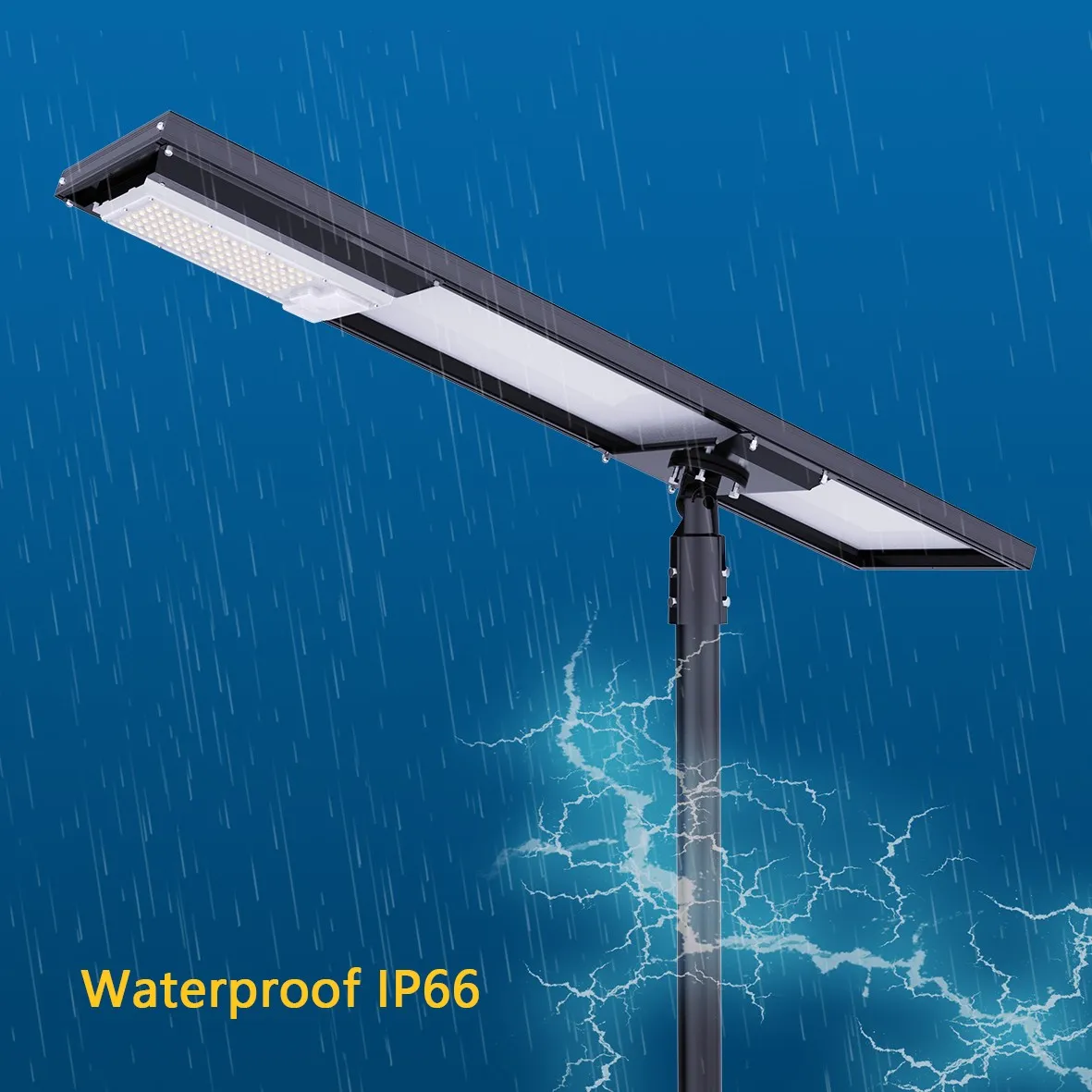
PAGASA describes the Philippines as having a tropical and maritime climate characterized by high temperatures, high humidity and abundant rainfall. It identifies June to November as the general rainy season and December to May as the general dry season. PAGASA also recognizes four rainfall-based climate types, meaning rainfall distribution varies significantly among regions.
This variation matters when sizing a solar street light with battery in the Philippines.
A project in Metro Manila should not automatically use the same energy configuration as a project in Eastern Samar, Palawan, Cebu, Baguio, General Santos or a coastal municipality.
Design inputs should include:
· Exact project coordinates
· Monthly solar radiation
· Rainfall pattern
· Tree and building shading
· Required operating hours
· Acceptable dimming level
· Required backup nights
· Local temperature and humidity
· Road safety importance
· Maintenance accessibility
PAGASA also reports that an average of approximately 20 tropical cyclones enter the Philippine Area of Responsibility each year, with about eight or nine crossing the country. The peak period is generally July through October.
For many projects, this makes mechanical design as important as battery capacity.
A reliable system should therefore address:
· Pole wind resistance
· Solar panel wind area
· Bracket strength
· Foundation engineering
· Water ingress
· Cable sealing
· Corrosion protection
· Surge and lightning risk
· Post-storm inspection access
Which Battery Is Best for Solar Street Lights in the Philippines?
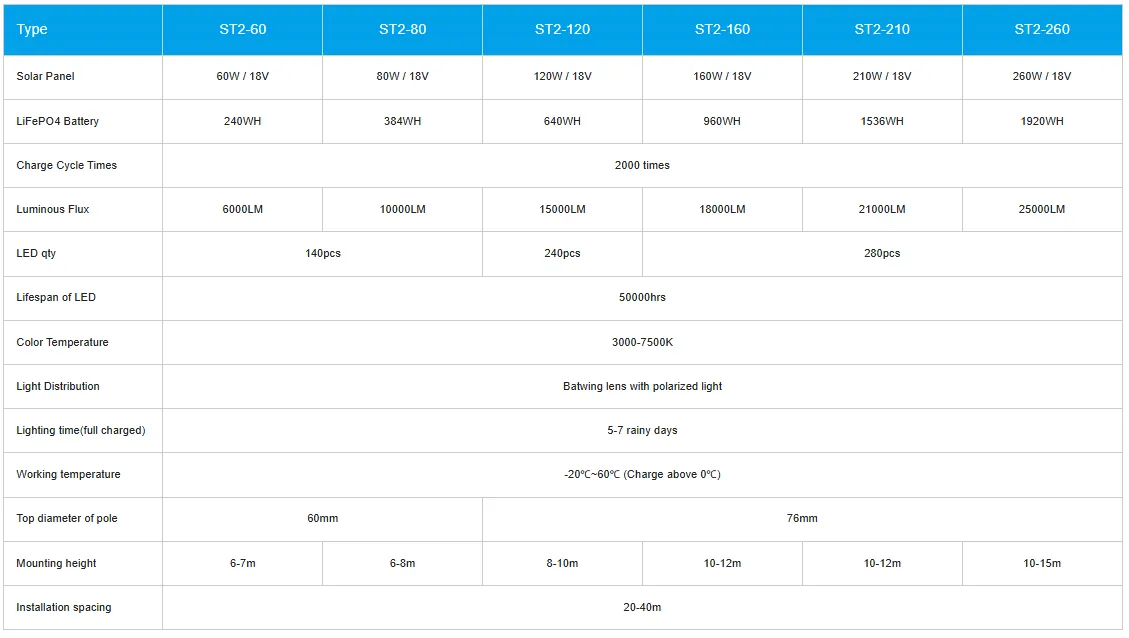
LiFePO₄ batteries are widely used in modern solar street lights because they can provide a practical balance of energy efficiency, cycle performance, thermal stability and compact system design.
They are commonly used in:
· All-in-one solar street lights
· All-in-two solar street lights
· Split solar street lights
· Municipal solar street lights
· Commercial solar street lights
· Off-grid outdoor lighting systems
However, “LiFePO₄ battery” should not be treated as a complete specification.
Two LiFePO₄ battery packs may differ in:
· Cell grade
· Actual usable capacity
· Internal resistance
· BMS quality
· Cell balancing
· Temperature protection
· Pack construction
· Waterproofing
· Testing method
· Warranty terms
Compare Watt-Hours, Not Amp-Hours Alone
Battery capacity is often promoted in Ah or mAh. These values are incomplete unless the battery voltage is also provided.
The correct basic calculation is:
Battery energy in Wh = Battery voltage × Battery capacity in Ah
For example:
· A 12.8V, 60Ah battery stores 768Wh.
· A 3.2V, 60Ah battery stores 192Wh.
Both batteries are described as 60Ah, but the first stores four times as much nominal energy.
This is why buyers should request battery voltage, Ah and Wh in every quotation.
Check Usable Energy
A battery should not normally be evaluated on nominal energy alone.
Usable energy depends on:
· Recommended depth of discharge
· BMS protection settings
· Conversion losses
· Battery temperature
· Battery age
· Cable losses
· Controller efficiency
A 768Wh battery does not necessarily deliver the entire 768Wh to the LED lamp every night.
Battery capacity determines nightly operation, while cell quality, charging conditions and depth of discharge also affect the solar street light battery lifespan.
How Much Battery Capacity Does a Solar Street Light Need?
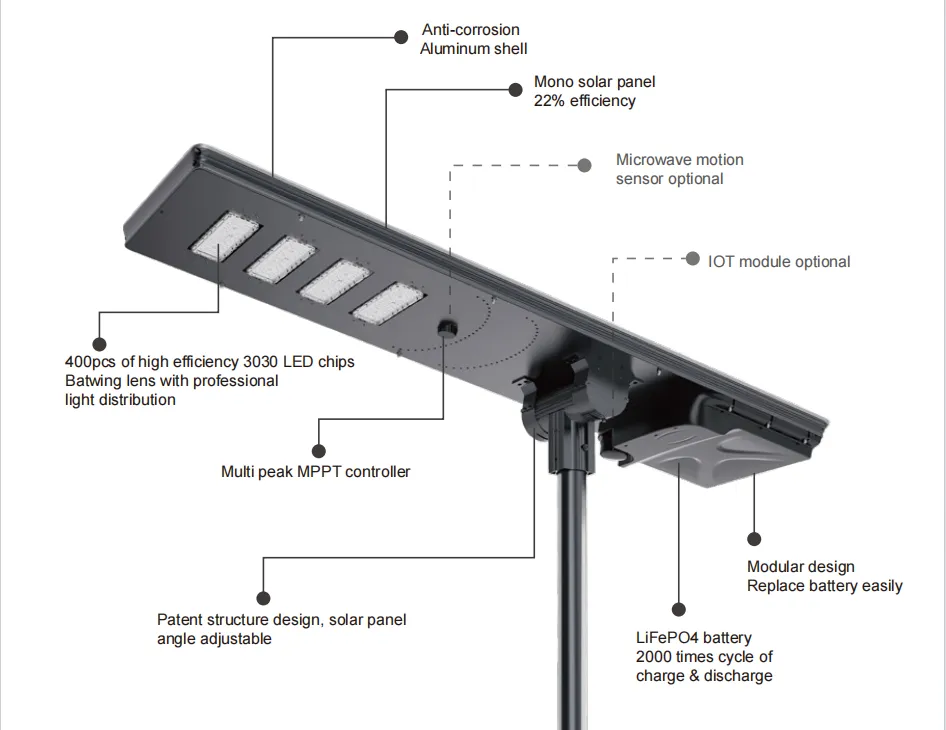
The first step is to calculate the LED’s equivalent full-power operating time.
Consider an illustrative project with:
· Actual LED power: 40W
· First four hours: 100% output
· Next six hours: 50% output
· Final two hours: 30% output
The equivalent full-power operating time is:
4 + (6 × 0.5) + (2 × 0.3) = 7.6 hours
The nightly LED energy consumption is therefore:
40W × 7.6 hours = 304Wh
If the buyer requires two nights of battery autonomy, assumes 80% usable depth of discharge and allows for approximately 90% electrical efficiency, the preliminary battery requirement is:
304Wh × 2 ÷ 0.8 ÷ 0.9 = approximately 844Wh
The supplier might therefore begin evaluating a battery pack with around 850Wh or more of nominal energy.
This is only an illustrative calculation. The final battery should also account for:
· Battery aging
· Actual temperature
· Controller consumption
· Cable losses
· Recharge expectations
· Safety margin
· Required lighting during severe weather
Operating Hours Are Not the Same as Rainy-Day Autonomy
These terms should not be confused:
Operating hours
The number of hours the lamp runs during one night.
Rainy-day autonomy
The number of low-solar-input nights the battery is expected to support.
Battery service life
The expected time or cycle count before battery capacity declines to the replacement threshold.
A supplier stating “12 hours of backup” may only mean one normal night of operation, not two or three consecutive rainy nights.
How Should the Solar Panel Be Sized?
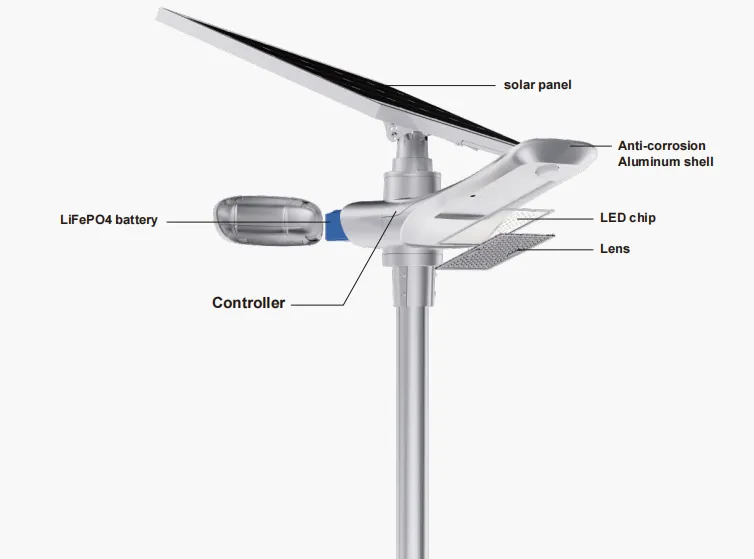
The solar panel must recover the energy used by the light while accounting for charging losses and local solar conditions.
A simplified preliminary calculation is:
Solar panel power = Daily energy demand ÷ Peak sun hours ÷ Charging efficiency
Using the previous 304Wh nightly load as an example:
· Nightly demand: 304Wh
· Assumed peak sun hours: 4
· Assumed charging-system efficiency: 75%
The theoretical minimum is:
304Wh ÷ 4 ÷ 0.75 = approximately 101W
After adding a design margin, the preliminary panel range might begin around 130–150Wp.
This does not mean that every 40W LED lamp in the Philippines should use a 130W solar panel.
The final configuration must consider:
· Worst-month solar data
· Panel orientation
· Shading
· Dirt accumulation
· Battery recovery requirement
· Rainy-day autonomy
· Lighting schedule
· System degradation
The panel should be selected using project-specific energy modelling rather than a fixed ratio such as “three times the LED wattage.”
Can Solar Street Lights Work During the Philippine Rainy Season?
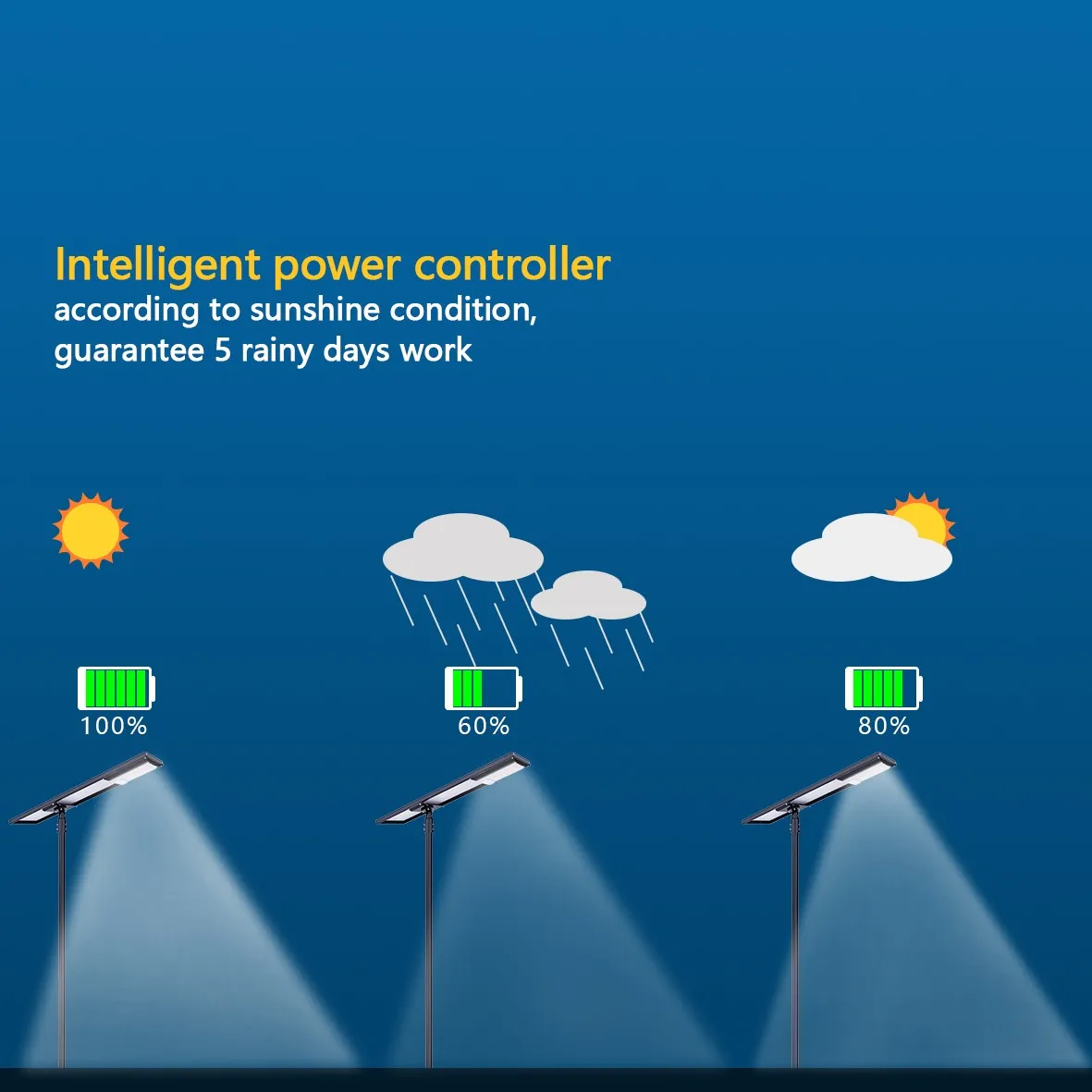
Yes, properly designed solar street lights can continue working during cloudy and rainy periods because they use energy stored in the battery.
However, performance depends on how the system has been configured.
A reliable rainy-season design may use several strategies:
Larger Battery Reserve
Additional battery energy allows the system to operate through periods of reduced solar charging.
Increased Solar Panel Capacity
A larger panel can collect more energy during limited sunlight and can help the battery recover faster when conditions improve.
Intelligent Dimming
The controller may reduce output during low-traffic periods rather than running at full power throughout the night.
Motion-Based Lighting
In appropriate applications, motion sensing can maintain a lower standby level and increase brightness when pedestrians or vehicles are detected.
Weather-Based Energy Management
More advanced smart solar street lights can adjust lighting schedules according to battery state of charge and recent charging conditions.
The objective is not simply to install the largest possible battery. The solar panel, battery, LED and control program must be designed as one energy system.
Are 100W, 300W and 500W Solar Street Lights Real?
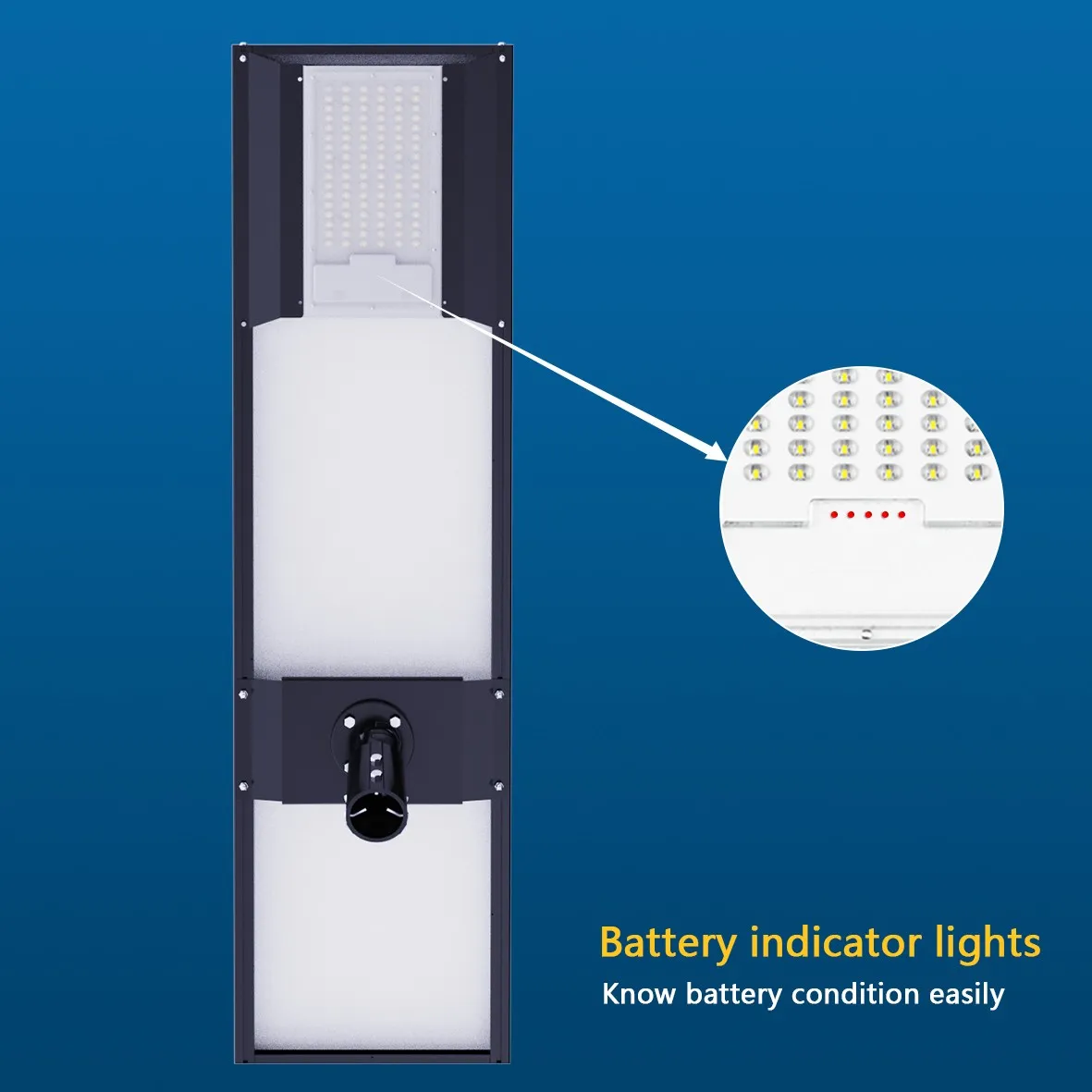
The Philippine retail market includes many products promoted with extremely high wattage figures. These numbers may describe a model name, an equivalent brightness claim or a marketing category rather than the LED’s continuous electrical input.
A quick energy check can help buyers identify unrealistic specifications.
Suppose a product claims:
· LED power: 300W
· Battery: 12.8V, 30Ah
· Operating time: 12 hours
The battery stores:
12.8V × 30Ah = 384Wh
Assuming 80% usable depth of discharge and 90% system efficiency, the average sustainable LED power would be approximately:
384Wh × 0.8 × 0.9 ÷ 12 hours = 23W
This system could not operate a real 300W LED continuously for 12 hours.
A professional quotation should therefore provide:
· Actual LED input power
· Luminaire output in lumens
· LED luminous efficacy
· Battery energy in Wh
· Solar panel power in Wp
· Lighting schedule
· Tested operating time
For road projects, buyers should also request an IES photometric file or lighting simulation. A high lumen number is not enough if the light is distributed outside the required road area or creates strong bright and dark zones.
All-in-One vs All-in-Two vs Split Solar Street Lights
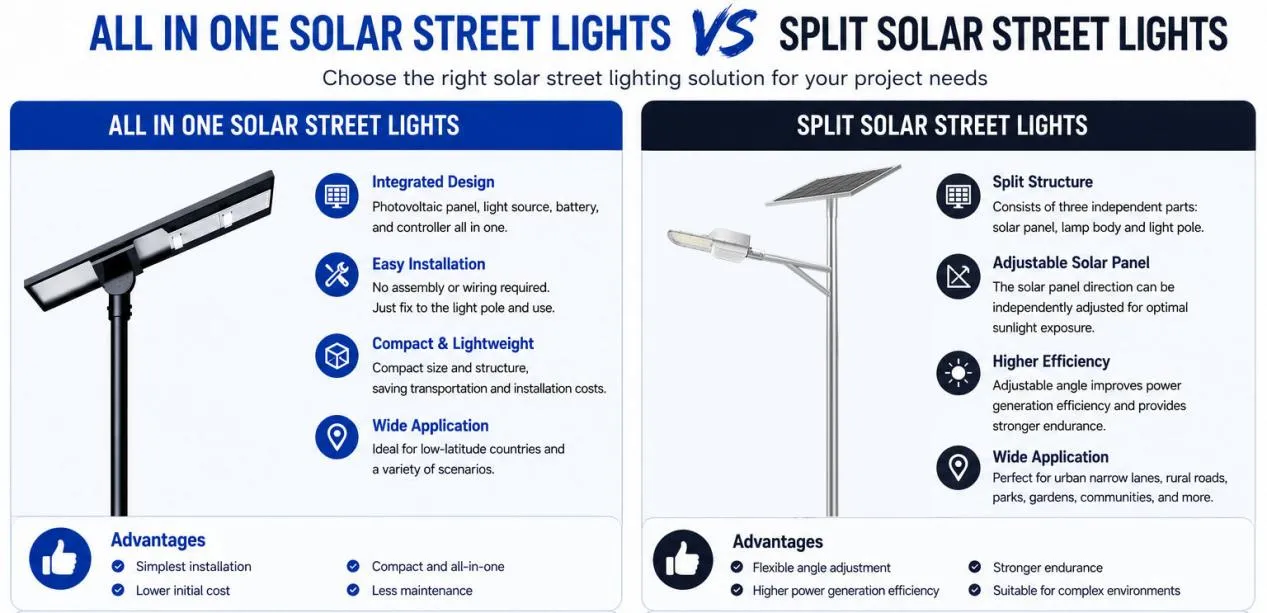
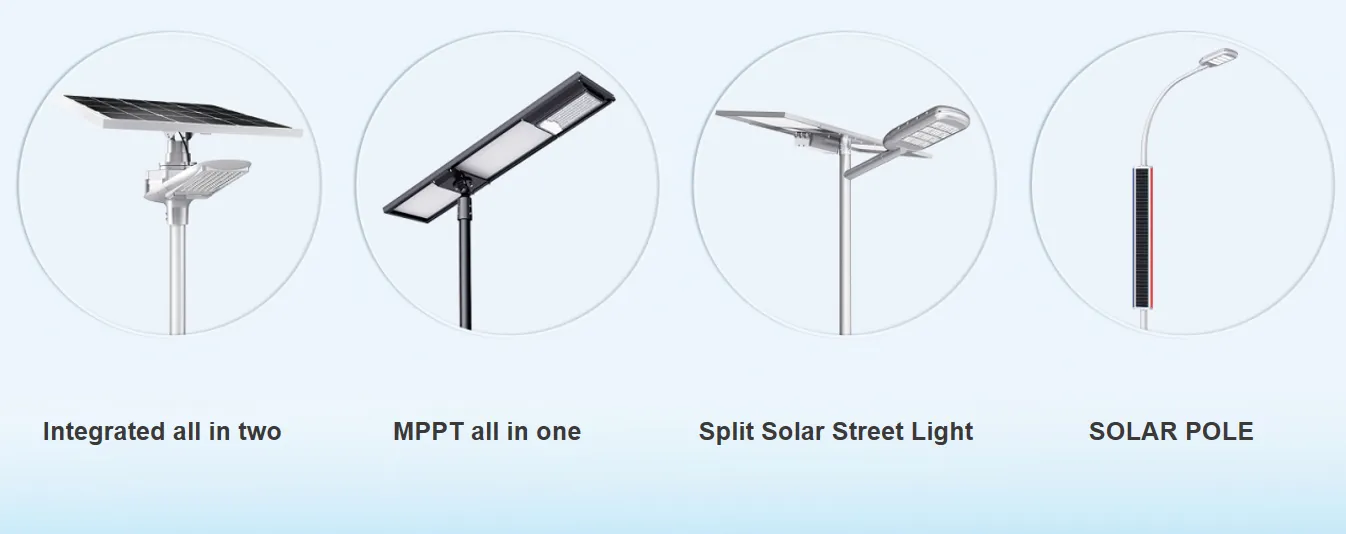
For a more detailed comparison of structure, installation and maintenance, see this guide to all-in-one vs split solar street lights.The best structure depends on installation speed, power demand, maintenance access and site conditions.
Comparison | All-in-One Solar Street Light | All-in-Two Solar Street Light | Split Type Solar Street Light |
Structure | Panel, battery, controller and LED are highly integrated | LED and battery are integrated while the panel is separate | Panel, battery, controller and lamp are installed separately |
Installation | Fastest and simplest | Moderate installation complexity | More wiring and assembly |
Panel orientation | Usually follows the fixture structure | Panel angle can be adjusted separately | Highest flexibility |
System capacity | Suitable for many standard projects | Supports larger or more flexible panels | Suitable for high-output or customized systems |
Maintenance | Complete fixture access may be required | Battery and lamp are grouped | Individual components can be serviced separately |
Typical applications | Barangay roads, parks, campuses, community roads | Municipal roads, parking areas, commercial projects | Wide roads, demanding projects, special solar conditions |
When to Choose an All-in-One Solar Street Light?
An all in one solar street light may be suitable when the project needs:
· Fast installation
· Fewer external cables
· Compact appearance
· Standardized deployment
· Lower on-site assembly complexity
When to Choose an All-in-Two Solar Street Light?
An all-in-two solar street light can be useful when buyers:
· A separately adjustable solar panel
· Larger panel capacity
· Integrated battery and luminaire maintenance
· More flexibility than a fully integrated design
When to Choose a Split Solar Street Light?
A split type solar street light may be preferable when the project requires:
· Larger battery storage
· High-output road lighting
· Independent panel orientation
· Easier component replacement
· Custom pole and equipment placement
No structure is universally better. The correct choice depends on the project.
Typical Selection Priorities by Philippine Application
The following table is an initial planning reference rather than a substitute for photometric or structural design.
Application | Main Selection Priorities | Common Procurement Risks |
Barangay road | Cost control, reliable nightly operation, simple installation | Buying by advertised wattage only |
Municipal road | Lighting uniformity, pole spacing, battery autonomy, warranty | Using one configuration for every road width |
National road | Project drawings, DPWH requirements, photometric performance | Treating a commercial product sheet as final design |
Subdivision | Appearance, low maintenance, pedestrian and vehicle safety | Ignoring tree and building shading |
School campus | Controlled brightness, safety, scheduled operation | Excessive late-night energy use |
Commercial parking area | Wide-area distribution, security lighting, sensor control | Focusing on center brightness instead of coverage |
Industrial park | High reliability, traffic movement, maintenance access | Undersized batteries and poor surge protection |
Coastal road | Corrosion protection, strong brackets, wind-load design | Using standard coating and fasteners |
Remote island | Battery reserve, spare parts, serviceability | Selecting a system that is difficult to repair locally |
Municipal solar street lights normally require more engineering verification than small residential products because a failure may affect public safety and several connected project stakeholders.
Commercial solar street lights may place greater emphasis on security, parking coverage, operating schedules and maintenance cost.
DPWH Requirements and Philippine Road Projects
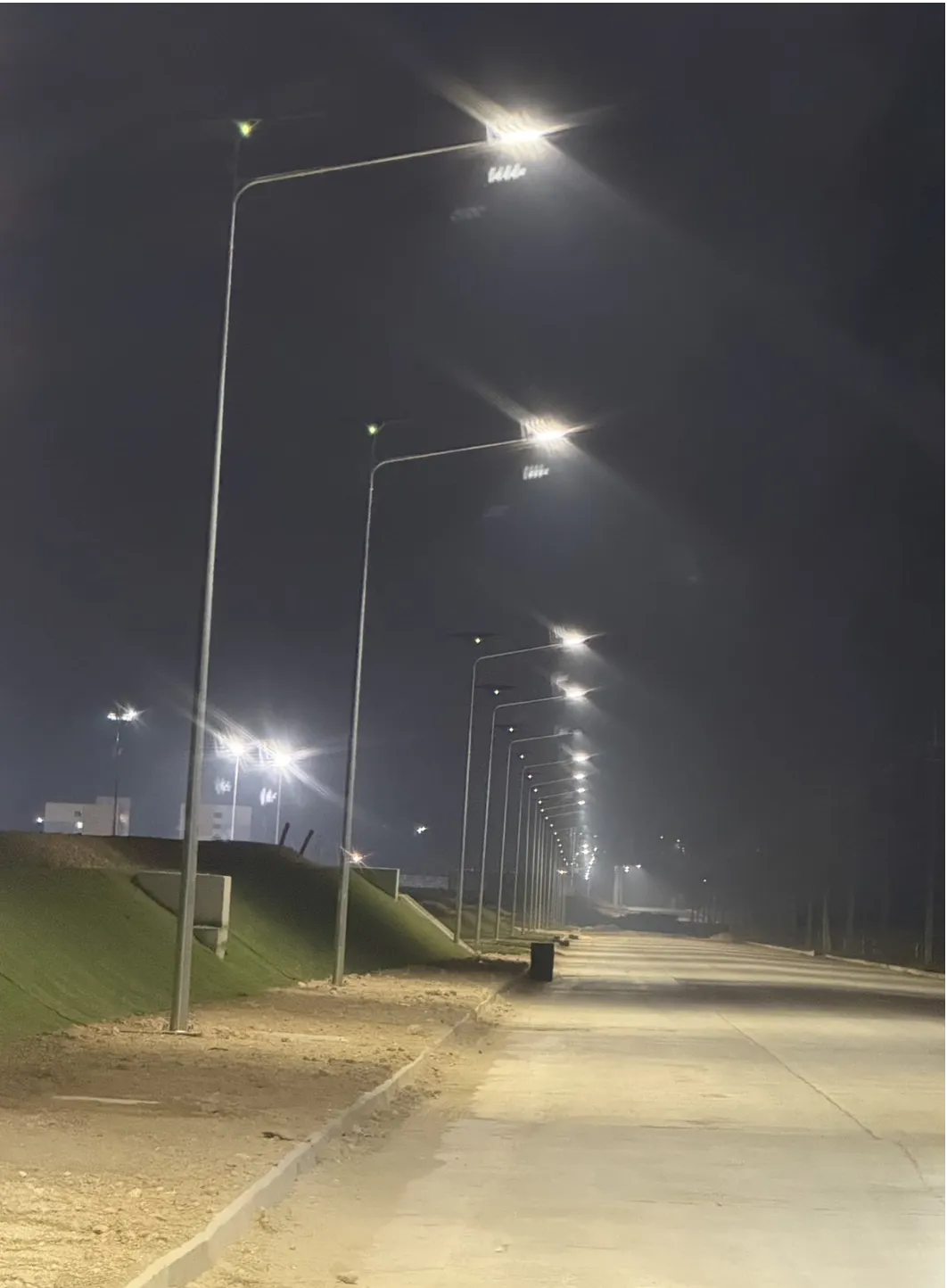
The Philippine Department of Public Works and Highways issued Department Order No. 19, Series of 2023, covering guidelines and standard design drawings for solar-powered roadway lighting along national roads.
The guidance reinforces an important procurement principle: roadway lighting should be evaluated as a designed system, not simply as a collection of high-wattage lamps.
For a national-road or government project, buyers should verify:
· Applicable DPWH documents
· Project bidding specifications
· Road classification
· Required lighting levels
· Lighting uniformity
· Pole arrangement
· Foundation drawings
· Structural requirements
· Product testing documents
· Installation and inspection procedures
For barangay roads, private subdivisions, industrial sites and commercial properties, the project may follow different local or owner-specific requirements.
The final design should be confirmed by the responsible engineer or approving authority.
Typhoon Resistance, Waterproofing and Coastal Corrosion
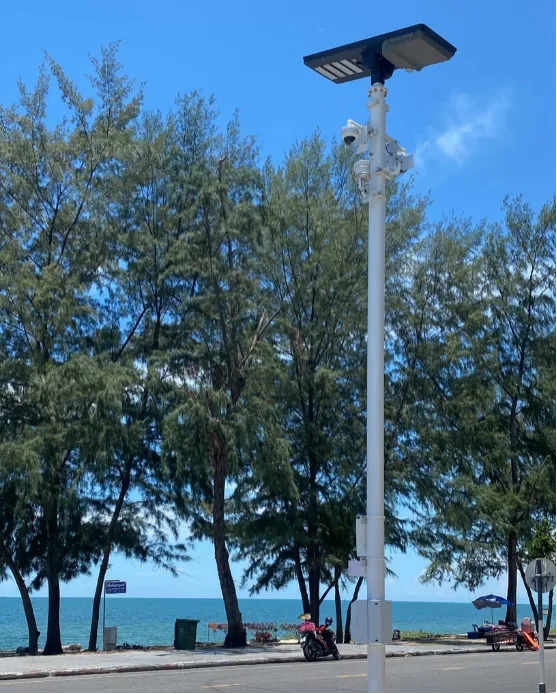
A statement such as “typhoon-proof solar street light” is not enough for technical procurement.
The supplier should explain which parts of the system have been evaluated.
Pole and Foundation
The pole design should consider:
· Site design wind speed
· Pole height
· Taper and diameter
· Wall thickness
· Steel grade
· Solar panel area
· Fixture area
· Bracket geometry
· Base plate
· Anchor-bolt arrangement
· Soil conditions
The same foundation size should not be used automatically for every location.
Final foundation dimensions should be confirmed through structural and geotechnical considerations.
Waterproof Protection
The IP rating describes protection against solid objects and water ingress under defined test conditions.
Buyers should verify the IP rating of:
· LED luminaire
· Battery compartment
· Controller enclosure
· Cable entry points
· Connectors
· Sensor housing
A high IP rating on the lamp head does not automatically mean that every connection in the complete system is equally protected.
Coastal Corrosion
For coastal projects, consider:
· Hot-dip galvanized poles
· Suitable coating thickness
· Stainless-steel fasteners
· Corrosion-resistant brackets
· Sealed connectors
· Salt-spray test information
· Regular inspection intervals
Corrosion performance depends on the complete material and coating system, not only the pole’s surface color.
Surge and Lightning Protection
Outdoor roadway lighting can be exposed to electrical surges caused by nearby lightning activity.
A project specification should define:
· Surge protective devices
· Grounding requirements
· Controller protection
· Luminaire driver protection
· Inspection procedures after severe storms
Solar Street Light Price in the Philippines
When buyers search for “solar street light price Philippines,” they often encounter prices that are difficult to compare because the included components are different.
One quotation may cover only the light fixture.
Another may cover a complete solar street light with pole and battery.
A third may include installation, concrete foundation, shipping, commissioning and warranty.
A realistic project budget should separate the following cost items:
Cost Item | What Buyers Should Confirm |
LED luminaire | Actual wattage, lumens, optics and driver |
Solar panel | Rated power, size and warranty |
Battery | Chemistry, voltage, Ah, Wh and BMS |
Controller | MPPT/PWM, control modes and protections |
Pole | Height, dimensions, wall thickness and coating |
Foundation | Excavation, concrete, reinforcement and anchor bolts |
Logistics | Packing, sea freight, inland transport and unloading |
Installation | Labour, lifting equipment, tools and commissioning |
Documentation | Drawings, test reports, manuals and inspection records |
Spare parts | Batteries, controllers, drivers, sensors and connectors |
Warranty | Product scope, labour responsibility and response process |
Why the Lowest Unit Price Can Cost More?
A low-priced system may create additional expenses if:
· The battery cannot support the required lighting hours.
· The solar panel cannot recharge the battery during poor weather.
· The LED output is lower than claimed.
· The pole is not suitable for local wind conditions.
· Replacement parts are unavailable.
· The battery must be replaced earlier than expected.
· The supplier does not provide technical support.
The more useful comparison is total project cost over the expected operating period, not the lamp price alone.
Because freight, installation, materials and local taxes can change, buyers should request a current itemized quotation rather than relying on a general online price range.
How to Compare Solar Street Light Supplier Quotations?
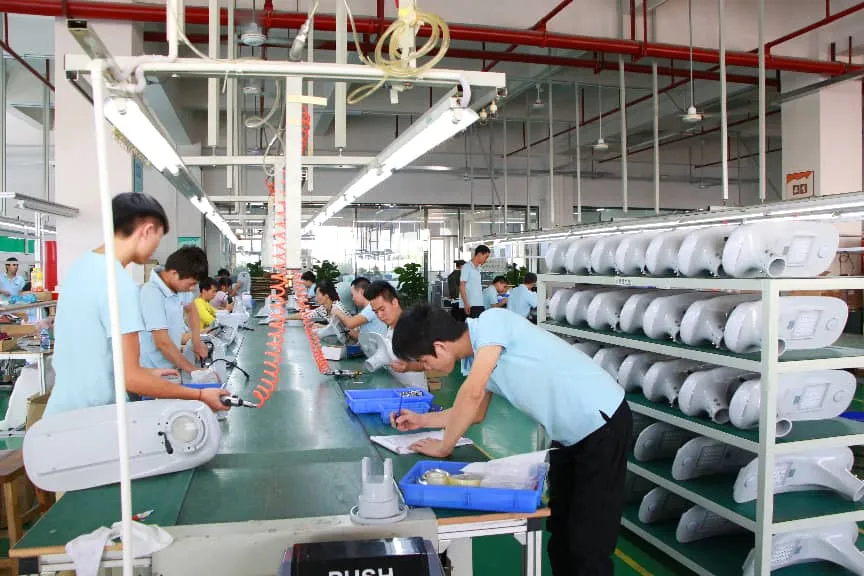
A reliable solar street light supplier should provide enough information for buyers to compare systems on the same basis.
Use the following checklist.
Lighting Performance
· Actual LED power
· Total lumens
· Luminous efficacy
· Color temperature
· Optical distribution
· IES file
· Lighting simulation
· Dimming schedule
Battery
· Chemistry
· Cell brand or approved cell standard
· Nominal voltage
· Rated Ah
· Total Wh
· Recommended depth of discharge
· BMS functions
· Cycle-life test conditions
· Battery warranty
· Replacement procedure
Solar Panel
· Rated Wp
· Panel dimensions
· Cell type
· Conversion efficiency
· Mechanical-load information
· Warranty
Controller
· MPPT or PWM
· Charging efficiency
· Protection functions
· Sensor functions
· Programmable lighting modes
· Remote-monitoring options
Pole and Structure
· Pole drawing
· Pole height
· Wall thickness
· Steel grade
· Galvanizing
· Bracket details
· Base plate
· Anchor bolts
· Design wind load
Project Service
· Site-information review
· Lighting recommendation
· Structural coordination
· Sample testing
· Quality-control records
· Installation manual
· Commissioning guidance
· Spare-parts plan
· After-sales response
· OEM/ODM capabilities
A quotation that only states “100W solar street light, 40,000mAh battery, IP67” is not detailed enough for a serious project comparison.
Solar Street Light Installation Process
A standard solar street light installation normally includes the following stages.
1. Site Survey
Confirm:
· Road width
· Pole location
· Soil conditions
· Existing utilities
· Solar exposure
· Tree and building shadows
· Drainage
· Traffic movement
· Installation access
2. Lighting and System Design
Determine:
· Target illumination
· Pole height
· Pole spacing
· Lamp arrangement
· LED output
· Battery autonomy
· Solar panel capacity
· Lighting schedule
3. Foundation Construction
Complete:
· Excavation
· Reinforcement
· Anchor-bolt positioning
· Concrete pouring
· Curing
· Final level inspection
4. System Assembly
Install:
· Solar panel
· Lamp head
· Battery
· Controller
· Brackets
· Cables and connectors
5. Pole Erection
Use suitable lifting equipment and verify:
· Pole verticality
· Bolt tightening
· Panel orientation
· Bracket alignment
· Cable protection
6. Testing and Commissioning
Check:
· Charging voltage
· Battery state
· Automatic switching
· Dimming schedule
· Sensor operation
· Lighting distribution
· Fault protection
7. Project Handover
Provide:
· Product specifications
· Drawings
· Test reports
· Installation records
· Warranty documents
· Maintenance manual
· Spare-parts list
Solar street light installation should be coordinated with local safety requirements and performed by qualified personnel.
Maintenance Checklist for Philippine Projects
Solar street lights require less grid-related infrastructure, but they are not maintenance-free.
Recommended inspection items include:
Every Three to Six Months
· Clean the solar panel.
· Remove leaves, bird waste and other obstructions.
· Inspect brackets and fasteners.
· Check for water ingress.
· Check cable seals and connectors.
· Inspect the pole coating.
· Confirm the lighting schedule.
· Record abnormal dimming or early shutdown.
After a Severe Storm or Typhoon
· Inspect pole alignment.
· Check the foundation for cracking or movement.
· Inspect solar panel brackets.
· Check the luminaire housing.
· Confirm cable and connector sealing.
· Test charging and lighting operation.
During Battery-Service Inspections
· Review battery voltage.
· Check charging behavior.
· Compare operating time with initial performance.
· Inspect the battery compartment.
· Review controller fault records.
· Replace the battery according to actual capacity condition, not only age.
Keeping maintenance records helps project owners identify gradual capacity loss before widespread lighting failure occurs.
Why Work with RoadSmart for Philippine Solar Street Light Projects?
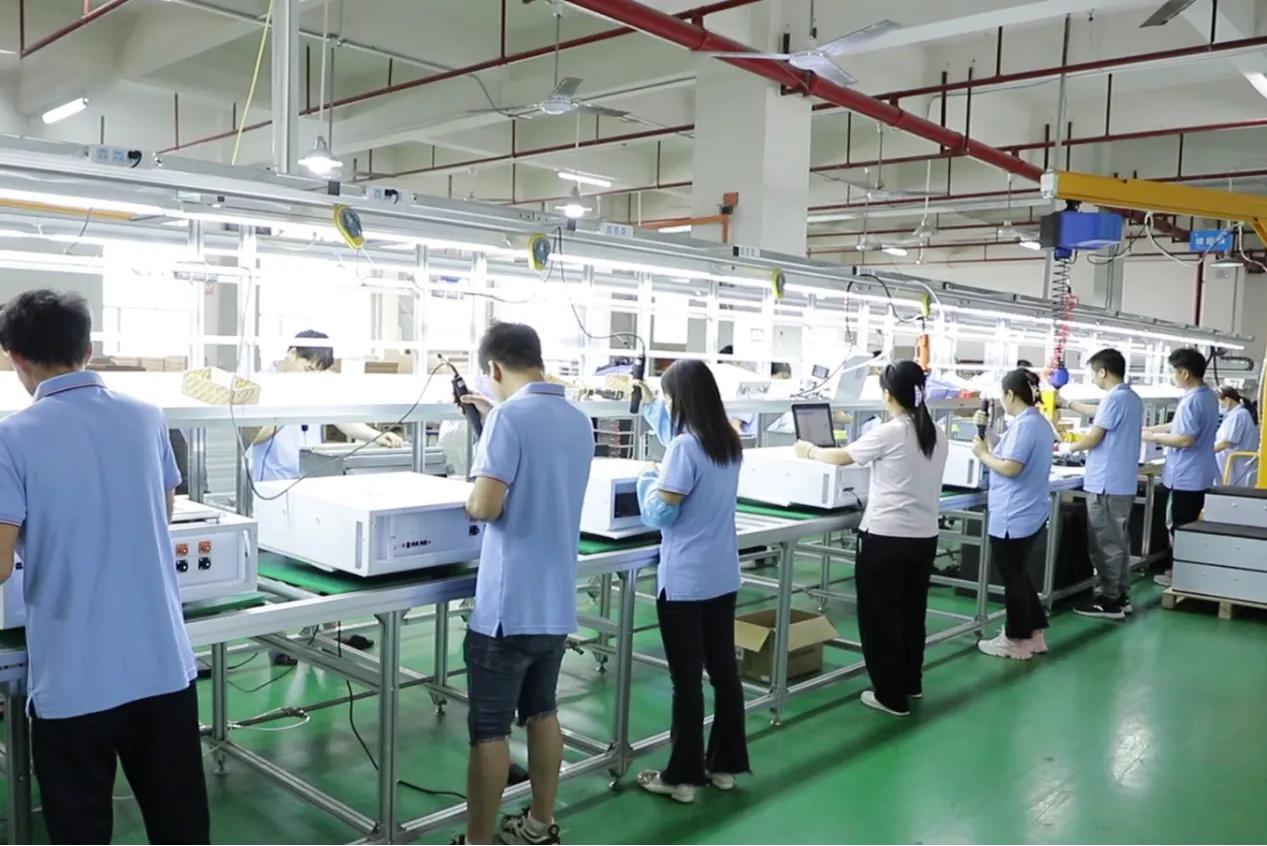
RoadSmart develops MPPT all-in-one, all-in-two and split solar street lights, as well as solar poles and LiFePO₄ battery solutions.
According to the company profile, RoadSmart has approximately 15 years of solar lighting experience, an R&D team of more than 100 people, over 250 patents and products used in more than 120 countries. Its product portfolio supports parameter, structural and appearance customization for different overseas markets.Buyers can also review RoadSmart’s solar street light projects across roads, communities, campuses, industrial parks and public facilities before selecting a similar configuration.
For a Philippine project, RoadSmart can evaluate requirements such as:
· Project location
· Road width
· Pole height
· Pole spacing
· Required operating hours
· Rainy-day autonomy
· Lighting mode
· Solar panel capacity
· LiFePO₄ battery configuration
· Wind and corrosion conditions
· Installation structure
· OEM/ODM requirements
The recommended system should be based on actual project conditions rather than the highest nominal wattage listed on a product page.
Information to Send Before Requesting a Quote
To receive a useful project recommendation, prepare the following information:
1. Project city, province or coordinates
2. Application type
3. Road or area dimensions
4. Required number of lights
5. Preferred pole height
6. Proposed pole spacing
7. Required lighting hours
8. Full-power and dimming requirements
9. Required rainy-day autonomy
10. Applicable project standards
11. Wind or coastal conditions
12. Installation responsibility
13. Destination port
14. Required delivery date
15. Warranty and spare-parts expectations
Providing this information allows the supplier to calculate the system rather than quoting only by wattage.
Frequently Asked Questions
How much is a solar street light with battery in the Philippines?
The price depends on actual LED output, battery energy, solar panel power, pole design, installation, shipping and warranty. Buyers should request an itemized quotation showing all included components instead of comparing a single headline price.
Which battery is best for solar street lights in the Philippines?
LiFePO₄ batteries are commonly selected for modern solar street lights. However, buyers must also evaluate battery voltage, watt-hours, BMS quality, usable depth of discharge, temperature conditions, cycle-life test data and replacement access.
Do solar street lights work during rainy days?
Yes. The light uses energy stored in its battery. The number of rainy nights it can support depends on battery capacity, solar panel size, LED consumption, lighting mode and the amount of solar energy collected during the period.
How many rainy days should a solar street light support?
There is no universal number for every Philippine project. The requirement should be based on the project location, rainfall pattern, road-safety importance and acceptable lighting reduction. Critical roads may require more reserve than low-traffic community paths.
Is a 300W solar street light really 300W?
Not necessarily. The number may be a product model or marketing claim. Verify actual LED input power, lumen output, battery Wh, solar panel Wp and tested operating time.
What pole height is suitable for a barangay road?
The correct height depends on road width, required illumination, optical distribution and pole spacing. A project lighting calculation is more reliable than selecting a pole only from a generic wattage table.
Is an all-in-one solar street light better than a split solar street light?
Not in every project. All-in-one models simplify installation, while split systems provide more flexibility for solar panel orientation, battery size and component replacement. The correct structure depends on the project.
Does a solar street light price include the pole and installation?
Sometimes, but not always. The quotation should clearly state whether it includes the pole, foundation, anchor bolts, freight, installation, commissioning, documentation and warranty.
How long does a solar street light battery last?
Battery life depends on chemistry, cell quality, depth of discharge, temperature, BMS settings, charging conditions and daily operating schedule. Ask the supplier for cycle-life test conditions rather than relying on a service-life claim without supporting parameters.
What documents should a project buyer request?
Depending on the project, buyers may request product specifications, battery data, solar-panel data, IES files, lighting simulations, pole drawings, test reports, installation manuals, quality-inspection records, warranty terms and spare-parts information.
Conclusion
Selecting a solar street light with battery in the Philippines is a system-design decision rather than a simple product purchase.
A reliable project begins by defining the road width, lighting target, pole arrangement, operating hours, local solar conditions and rainy-day requirement. These inputs determine the appropriate LED output, solar panel capacity, battery energy and control program.
Buyers should not compare systems by nominal wattage or mAh alone. They should compare:
· Actual LED power and lumens
· Battery energy in Wh
· Solar panel power in Wp
· Lighting schedule
· Rainy-day autonomy
· Pole and foundation design
· Wind and corrosion protection
· Installation scope
· Warranty and spare parts
For barangay roads, municipal infrastructure, subdivisions, campuses, parking areas and industrial projects, the best solar street light is not necessarily the product with the highest advertised wattage or lowest initial price.
It is the complete solar street lighting system that can deliver the required illumination reliably under the project’s actual Philippine climate, installation and operating conditions.
Planning a solar street light project in the Philippines?
Send RoadSmart your project location, road width, pole height, lighting hours, rainy-day requirement and estimated quantity to receive a preliminary system recommendation and quotation.
Get a Philippine Project Proposal
Reference Sources
- Climate of the Philippines, Philippine Atmospheric, Geophysical and Astronomical Services Administration.
- Tropical Cyclone Information, PAGASA.
- Department Order No. 19, Series of 2023, Department of Public Works and Highways.
- Missionary Electrification Development Plan 2024–2028, Philippine Department of Energy.